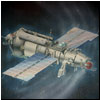
 The KVANT-2 module
The KVANT-2 module
| Kvant-2, added in 1989, carries an EVA airlock,
solar arrays, and life support equipment. The 19.6-ton module is based
on the transport logistics spacecraft originally intended for the Almaz
military space station program of the early 1970s.
The purpose of Kvant-2 is to provide biological research data, Earth observation data, and EVA capability. It adds additional system capability to Mir. Kvant-2 includes additional life support system, drinking water, and oxygen provisions, motion control systems, and power distribution, as well as shower and washing facilities. Kvant-2 is divided into three pressurised compartments:
instrumentation/cargo, science instrument, and airlock. The airlock not
only provides EVA capability, but also contains a self-sustained cosmonaut
manoeuvring unit that increases the range and complexity of tasks that
can be attempted via EVA. For instance, various construction materials
and electronic components can be placed outside of the Mir Complex modules
via EVA. The effects of space environment exposure on these construction
materials can later be investigated.
|
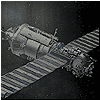 The KRISTALL module
| Added in 1990, Kristall carries scientific equipment,
retractable solar arrays, and a docking node equipped with a special androgynous
docking mechanism designed to receive spacecraft weighing up to 100 tons.
The purpose of the Kristall module is to develop biological and materials production technologies in the space environment. One component of the Kristall is a radial docking port. Originally designed as a potential means of docking the Russian Buran reusable shuttle orbiter, this port is now attached to the Docking Module. |
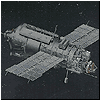 The SPEKTR module
| Launched on a Russian Proton rocket from the Baikonur
launch centre in central Asia, Spektr was lofted into orbit on May 20th,
1995. The module was berthed at the radial port opposite Kvant-2 after
Kristall was moved out of the way. Spektr carries four solar arrays and
scientific equipment (including more than 1600 pounds of US equipment).
The focus of scientific study for this module is Earth observation, specifically natural resources and atmosphere. The equipment onboard is supplied by both Russia and the United States. Scientific equipment on Spektr includes: Pion, Lira and Buton equipment for atmospheric research. Faza and Feniks equipment for surface studies. Astra-2 equipment for atmospheric trace constituent monitoring. Taurus and Grif equipment for monitoring Mir's induced x-ray and gamma-ray background. |
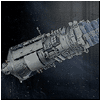 The PRIRODA module
| Priroda was the last module to be added to Mir.
After its launch from Baikonur on April 23th 1996, it docked to the space
station as scheduled on April 26th. Its primary purpose is to add
Earth remote sensing capability to Mir. It also contains the hardware and
supplies for several joint US-Russian science experiments.
Its Earth remote sensing capabilities include:
|
 The Docking module
| The Docking module was delivered and installed
by STS-74, making it possible for the space shuttle to dock with Mir. On
STS-71 in June 1995, the shuttle docked with the Kristall module on Mir.
However, to make that docking possible, the Kristall configuration had
to be changed to give the shuttle enough clearance to dock. Russian cosmonauts
performed an extravehicular activity (a space walk) to move the Kristall
module from a radial axis to a longitudinal axis, relative to Mir.
After the shuttle departed, Kristall was moved back to its original location.
It would have been impractical to leave Kristall in the longitudinal axis position because the longitudinal dock is used by the Russian vehicles Progress-M and Soyuz-TM. Moving Kristall back and forth between the two ports is not feasible. Therefore, the only workable solution was to add an extension to Kristall as it remains in its radial axis. This makes it possible for the shuttle to dock with Mir without interfering with the solar arrays, which are deployed near Kristall. |