
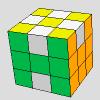
If NEITHER the DB NOR DF edges are placed, we'll end with L6E.
*If there are two opposite edges placed opposite eachother, place them in UR+UL, then permute M edges.
*If not, place UR+UL edges, then permute M edges.
If EITHER the DB OR DF edge are placed, we use an L5E alg.
The good news is that this step is fairly intuitive and the algs are few and short. When two edges are across from eachother, they can be in any of 3 places.
UR+UL: This is where you want them to be, so leave them for now.
UF+UB: Either U or U' puts them in place. Try to match up an edge at UF or UB if you can.
DF+DB: M2 U or M2 U'. Again, try to match up pieces if at all possible.
To permute the M edges, again, you need one of 3 'algs'. I hesitate to actually refer to them as algs, because they should almost always be done intuitively, because they are so short and simple, and because they aren't done from any standard position.
As a general rule, you can just adjust the M slice until a piece is on the opposite side of the U layer from where it needs to be. Then, perform U2, and adjust M again. All of this is incredibly simple (especially if you've gotten this far in the solution) and doesn't really differ from standard Roux, except in that you can use any of the 3 pairs of opposite edges, to maximize flexibility. This should produce optimal results.
If none of the three pairs is placed opposite eachother, look for an edge in the U layer that is placed correctly, or opposite where it goes. Place the corresponding edge (preferably one of those being in the D layer) along with your first edge, just like in normal Roux solves. After that, it's just permuting M edges, and the cube is solved.
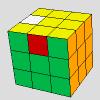
If you end up with one of these situations, you can solve it with one of the following algs. You may need to adjust the U layer beforehand, and you may need to adjust it after, too. The idea behind learning to perform these as set sequences instead of intuitive algs like above is that you can fingertrick these to maximize speed. U' turns seem to flow better coming off of turns with the left hand, U seems to flow better from the right, etc. I've included the basic algs in both MU and FURLDBMES. The latter should almost never be used, except for fewest moves. The cases are given with a an Imagecube image, and a secondary diagram. Also given is the setup case, listed in blue. All cases assume a BOY color scheme.
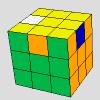
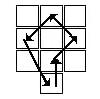
M2 U M2 U M U2 M'
M U2 M' U' M2 U' M2
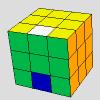
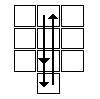
M' U2 M (U2)
(U2) M' U2 M
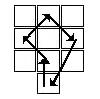
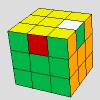
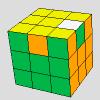
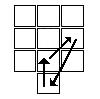
M2 U' M2 U' M U2 M'
M U2 M' U M2 U M2
M U2 M U M' U2 M' (U')
(U) M U2 M U' M' U2 M'
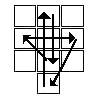
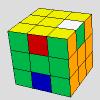
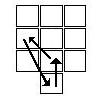
M U2 M U' M' U2 M' U
(U') M U2 M U M' U2 M'
M' U2 M U' M' U2 M (U)
(U') Same
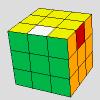
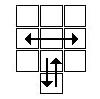
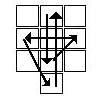
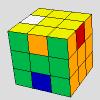
MUM2U2M2UM'
Same
M' U2 M U M' U2 M (U')
(U) Same
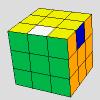
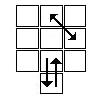
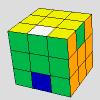
M U2 M' U M' U2 M' U' M2
M2 U M U2 M U' M U2 M'
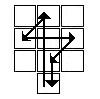
M' U2 M' U' M' U2 M U' M2 (U2)
(U2) M2 U M' U2 M U M U2 M
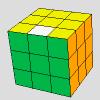
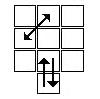
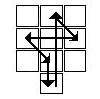
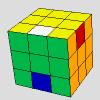
M U2 M' U' M' U2 M' U M2
M2 U' M U2 M U M U2 M'
M' U2 M' U M' U2 M U M2 (U2)
(U2) M2 U' M' U2 M U' M U2 M