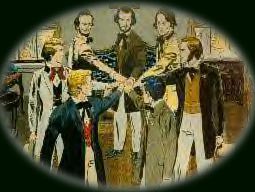
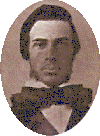
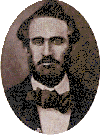
In the fall of 1854, a disagreement arose in the Kappa Chapter of the Delta Kappa Epsilon Fraternity at Miami University in Oxford, Ohio. This chapter consisted of 12 men. 6 of those men, led by Whitelaw Reid, supported on of the members for poet in the Erodelphian Literary Society. Four of the remaining six members: James Parks Caldwell, Benjamin Piatt Runkle, Isaac M. Jordan, and Franklin Howard Scobey, refused to vote for the brother because they knew him to lack poetic abilities. They favored a man for the office that was not a deke. Thomas Cowan Belle and Daniel William Cooper were not members of Erodelphian, but their relation to the disagreement was unqualified endorsement of the four. Thus, they became six.
The chapter of 12 was evenly divided in a difference of opinion that ordinarily would have been decided one way or the other and immediately forgotton, but both sides considered it a matter of principle , and could not reach a compromise. During the ensuing month the groups disagreed so much that their friendship grew distant.
Chapter meeting, or attempted chapter meetings, occurred for months with the breach constantly widening. A dramatic dinner meeting at a restaurant in Oxford in February of 1855 involving the dissenting groups set the stage for Sigma Chi's founding. Bell, Caldwell, Cooper, Jordan, Runkle, Scobey hosted the event, hoping to mend ways with the other six.They were on hand early, awaiting developments with anticipation. Of the meeting, Founder Benjamin Piatt Runkle recalled: " With the kindest of intentions, we determined to give a dinner in their honor. I remember that the feast was prepared at the village restaurant, the guests invited, and on the appointed night we gathered and waited for the guests. They did not come for a long time, and then only Mr. Reid and with a stranger. He took into his confidence Minor Milliken (an alumnus of the fraternity from nearby Hamilton, Ohio.) and the two decided on strenuous proceedings.
Milliken lost no time: "My name is Minor Milliken; I live in Hamilton. I am a man of few words." Then he passed judgement on all of the matters in dispute. Since he had heard only one side of the story, his verdict was against Runkle, Scobey, and the others who had originally opposed election of the Deke as the poet in the literary society. Milliken found them guilty.
Next, Milliken unfolded a plan he and reid had concocted by which "Justice" could be satisfied with the formal expulsion of the leaders in the rebellion (undoubtedly Runkle and Scobey), after which the others, having been properly chastised, could remain in the chapter.
At this dramtic moment, Runkle stepped forward, pulled off his DKE badge, tossed it upon the table and said "I didn't join this fraternity to be anyone's tool, and that, sir" addressing Milliken, "is my answer!" Runkle stalked out of the room, and his five collegues followed.
The final meeting of the twelve active members of Delta Kappa Epsilon's Kappa Chapter was held in Reid's room in the "Old Southeast" building several days later. After a strenous effort, led by reid, for the expulsion of the six, and with six against six on all vital issues, the meeting broke up in considerable disorder.
A rather prolonged ensued with the parent chapter of Delta Kappa Epsilon at Yale, resulting in the "Bull of Excommunication" om April 1855, expelling Bell, Scobey, Runkle, Jordan, Cooper, and Caldwell.It was at this time they began making plans to found their own fraternity.
One, of the best moves these six ever made was to associate themselves with WIlliam Lewis Lockwood. he had entered Miami in 1855 but had not joined a fraternity. He was the "businessman" of the group and possessed a remarkable organizing ability. More than any other founder, he was responsible for setting up the general plan of the fraternity, much of which endures to this day.
During the latter months of the 1854-1855 year, Runkle and Caldwell lived in a second floor back room of a building at the southeast corner of the public square on the north side of the High Street in what is known as the birthplace of Sigma Chi (or Sigma Phi, as it was originally called). In this room were held many of the earlier organizational meetings of Sigma Chi, and it was the sight that Runkle and Lockwood designed the badge. The White Cross was designed exactly as we know it today except for the Greek letters "Sigma Phi" in the black center which were later changed to "Sigma Chi".
Having been members of Delta Kappa Epsilon, six of the founders were familiar with the general outline of a fraternity constitution and ritual content. They were considerably influenced by Lockwood, who had known little of DKE or its differences. With all of their plans formally conpleted, the seven founders of the new fraternity announced it's establishment by wearing their badges for the first time in public on Commencement Day at Miami University, June 28th, 1855.
Sigma Chi's three great aims--Friendship, Justice, and Learning--reflect the break from DKE and the ideals that were ultimately the most important to our Founders. The lessons of the founding of Sigma Chi are revealed in three other important pieces of the founders legacy. The Spirit of Sigma Chi expresses the chief reason for their confrontation with Delta Kappa Epsilon, and it establishes a guide for our friendships and brotherhood in Sigma Chi. The Jordan Standard embodies the criteria by which men are found worthy of membership. Above all, the White Cross symbolizes the virtues and high ideals upon which the Founders based Sigma Chi and for which all initiated members constantly strive. |