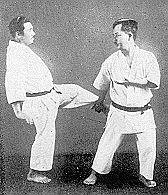
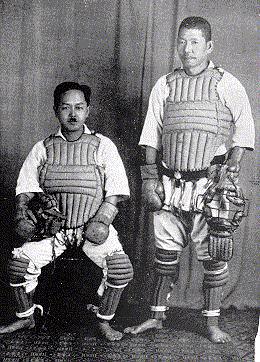
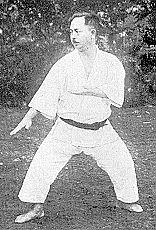
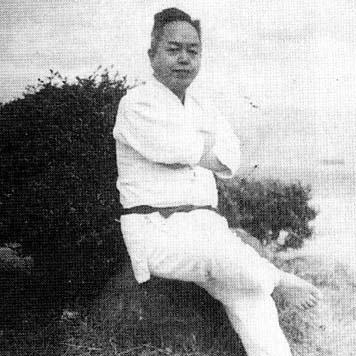
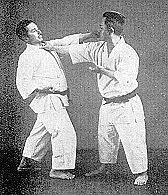
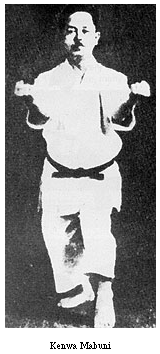
In 1924, Mabuni and Miyagi were asked to take charge of the training sessions, even though they were still fairly young. During these sessions, actual kumite was stressed to increase their physical techniques and strength. It is said that when a student wanted to learn more from a master, the master would simply invite the student to attack him freely, all the while, blocking and shifting his body while constantly asking the student, "Now, do you understand?" and encouragaing them to attack, again and again.
Between 1925 -1927, Japan's leading government sanctioning martial arts body, the Dai Nippon Butoku Kai, eventually accepted Okinawan Tode as a member. It was during this period that the generally accepted reading for Tode, meaning China Hand, was changed to the kanji of Karate, meaning Empty Hand. The reading of the kanji was not widely accepted, especially in Okinawa, until much later in 1936.
The Dai Nippon Butoku Kai began to demand the different groups applying for membership to be more specific in the description of their karate systems, and pressured them to name their individual systems. Mabuni originally named his system Hanko-Ryu, but later changed it to reflect the deep respect he had for his two great masters, Itosu and Higaonna. Using the alternative reading of the kanji for the first character from Itosu's name, which can also be read as SHI, and the first character from Higaonna's name, which can also be read as TO, Mabuni created the new name, SHITO for his new RYU, or style of karate.
It was during 1927-1928 that Mabuni moved to Osaka permanently to teach Shito-Ryu. Over the next few years, Mabuni dedicated himself to the further development and promotion of Shito-Ryu in the Osaka area. He was faced with an extremely difficult task due to the unwillingness of the population to accept his strange looking system of self-defense, resembling an ancient Okinawa Fist Dance. In order to bring Shito-Ryu to the general public's attention, Mabuni would perform many demonstrations where he would break bricks and boards to show the power of karate. Continually trying to gain acceptance of his art, Mabuni would give free instruction at various police stations across western Japan.
During the Pacific War, many promising young karate-ka lost their lives. Mabuni barely survived the post-war turmoil, contending with great poverty but he perservered and continued to devote himself unselfishly to the further development of Shito-Ryu. After the war, many of the previously established Shito-Ryu clubs in universities and colleges began to re-open. By this time, the future of Shito-Ryu was assured by many of the surviving students. Today, Shito-Ryu is practiced by people in countries all over the world. Its presence in international competition is a testament to continued growth and the legacy set forth by its founder.
|