 |
|
 |
|
|
|
|
|
| Conservation Savings that occur when you change your behavior Efficiency Savings that occur when you change the machine |
| RIGHT TIRE NEEDS AIR |
| LEFT TIRE NEEDS AIR |
| 55 MPH SAVES 17% |
| SAVINGS IN FUEL ECONOMY BY CHANGING YOUR BEHAVIOR AND DRIVING 55 MPH IF YOU DRIVE 55 MPH TODAY IF YOU DROVE YOU CAN SAVE 70 MPH 17.1% YESTERDAY 65 MPH 9.7% YESTERDAY When we change our behavior, we can change our demand for fuel... and reduce the price of gasoline. In the long run, changing our vehicles to run on another type of fuel, or reducing our use of cars (carpooling, mass transit, bicycle, work at home) will more permanently and more reliably reduce the gasoline and petroleum that the USA needs to import. |
| Conservation We save when we change our behavior Efficiency We save when we change the machine |
| Don't honk! I'm saving gasoline 55 mph saves 17% |
| Welcome to the "55 Saves 17%" campaign. If you want to participate, you can drive 55 mph and put the "55 MPH saves 17%" in your car's windows (rear, and right rear window). The signs for "NEEDS AIR" are for you to show to drivers whose tires look low. Low tire pressure reduces fuel economy. Click HERE to get to a printable "55 Saves" sign for your car. |
|
| Make a copy of this page and give it to a friend. Carry a tire pressure gauge in your car and check your tires when you fill your tank. EXTRA EFFORT: Do the Tire Yoga Stretch on your friend's car.... |
|
| If you'd like more information about how to reduce the USA's dependence on petroleum fuels, visit our web page that describes efforts to shift the use of energy: CLICK HERE FOR ENERGY |
| The URL of this page is www.geocities.com/creatingthefuture/55saves.html This web page was conceived by Steve McCrea and is not connected to the Center for Creating the Future or its affiliated organizations. |
| The Institute for the Post-Petroleum Era supports the "plant trees for biofuel" project. Yes, we agree that modern civilization uses more paper than we need to. Most paper compnies replant at least one tree for every tree removed (that's how they plan to stay in business). Howver, the fossil fuel used to cut, transport, process the tree into paper and distribute the paper to the store needs to be offset. The "Trees for Biofuel" campaign has identified some of the tree planting programs that plant trees that could (at some point) be turned into biofuel. There is an on-going program of research into the use of plants as fuel, funded in part by the US Department of Energy. If you want to sponsor trees to replace the fuel used to make and distribute the paper you use, then send $1 for each tree you want to replace. In general, the cost of $1 a tree is a rough estimate and it includes the cost of monitoring the growth of the tree and keeping it protected from people who need lumber. www.treeswater people.org We are currently looking for a contact in the US Department of Energy and for a procedure to pay for additional plantings of "trees for biofuel." If you are interested in learning more about the biofuels program at USDOE, go to www.energy.gov and search on "BIOFUELS" |
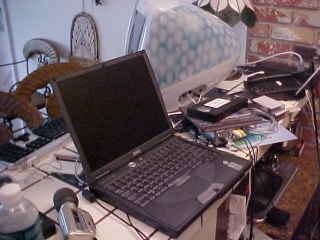 |
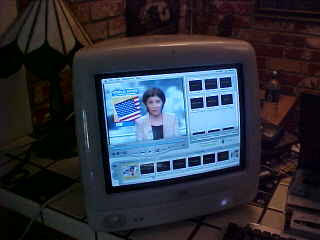
| This is where the web site is edited. DELL Inspiron 4000 Apple iMac DV in the background (with the Dalmatian spots) |
 |
 |
 |
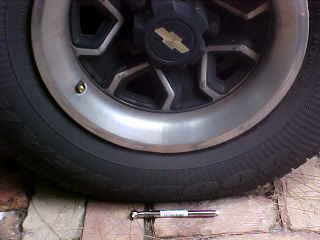 |
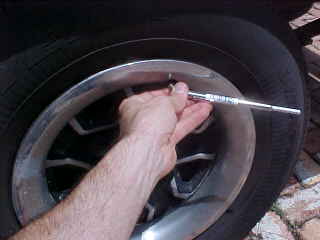
| At proper inflation of 35 psi, the flat part of the tire measures about the length of a standard tire-pressure gauge. |
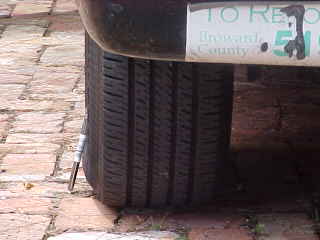 |
| At proper inflation of 35 psi, the profile of the tire is more vertical and less rounded. Notice that the gauge is almost vertical. |
 |
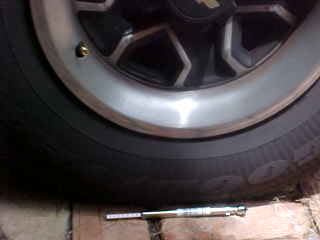 |
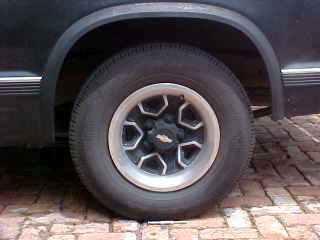
| At 30 psi, the part of the tire that touches the ground is almost two inches more than when the tire is properly inflated. |
| At 35 psi, the part of the tire that touches the ground is about the length of the gauge. |
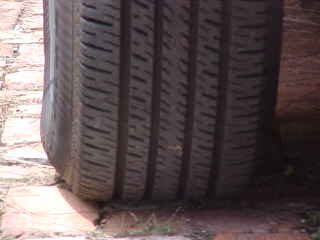 |
| When under inflated, there is a slightly more rounded profile. This is at 30 psi. |
 |
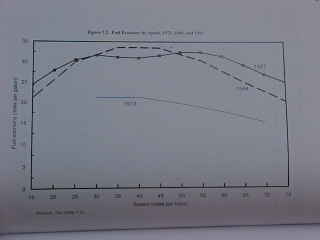 |
| The best fuel economy takes place below 55 mph |
| Fuel use increases by 17% when the driver speeds from 55 pmh to 70 mph |
 |
 |
| Transportation Energy Data Book US Department of Energy Volume 20, page 7-23. |
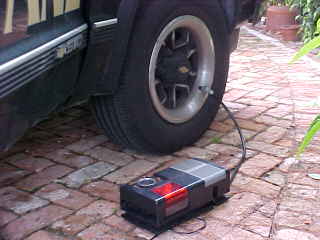
| This air pump runs off the car's battery (through the cigarette lighter) and stops when the desired pressure is reached. (Purchased at Sears auto center) |
| Steve McCrea edits videos for use by teachers -- "dictation videos" test the listening ability of students as well as their spelling. Currently in the process of negotiating the right to use segments of news reports, TV comedies and commercials. |
| The Institute for the Post-Petroleum Era proposes the following campaign to reduce demand for oil in the short-term (and slightly reduce the price at the pump): 1. keep tires inflated at the right level 2. drive 55 mph |
 |
| Jack Latona established the Center for Creating the Future, Inc., in 2001 as a think tank to further explore concepts about the future he had developed for a university course on The Millennium. In addition to their theoretical interest, these concepts have significant practical applications for businesses and other organizations. As a result, The Center�s web site now has two sections, one to continue theoretical discussion of the future, the other to provide information on how The Center can assist organizations to begin to create their futures now. Please CLICK HERE to go to the Center�s new web site at www.creatingthefuture.org. www.futureofFortLauderdale.com |