 |
|
 |
 |
|
|
|
| Comments by readers... |
| "Commuters lose 36 hours per year stuck in traffic." (Living on Earth) "Gas prices soar to $1.70" (hyperbole on TV news) Go below for analysis |
| "Commuters lose 36 hours per year stuck in traffic." (Living on Earth) "Gas prices soar to $1.70" (hyperbole on TV news) The President wants to protect the American way of life (May 6,2001, Ari Fleisher) Go below for analysis |
| See the analysis below... |
| Presidential spokesman Ari Fleisher articulates a "Second Wave" entrenced position |
 |
|
|
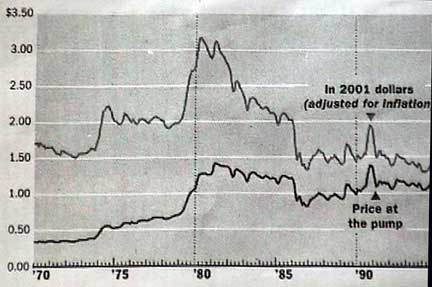
| Price of a gallon of gasoline: A gallon of gasoline that cost $0.90 in 1979 would cost $2.29 in 2000. Equivalently, if you were to buy exactly the same products in 2000 and 1979, they would cost you $0.90 and $0.35 respectively. Consumer Price Index http://www.westegg.com/inflation/ |
| Tools for calculations Consumer Price Index http://www.westegg.com/inflation/ Price of Gasoline http://www.eia.doe.gov/oil_gas/petroleum/special/gasoline_update/market_summary.html |
What is the effect of inflation on the cost of gasoline? What is the cost of gasoline in Europe and Asia? |
|
|
|
| Transcript of interview with an energy analyst CLICK HERE |
"There will be conservation measures. However, the belief of the task force that any gain will be marginal, the only way to deal with this effectively is by throwing more energy at the matter." (7 May 2001) -- analysis of the Bush Energy Plan See: www.loe.org |
"The President wants to protect the American way of life." (May 6,2001, by spokesman Ari Fleisher, calling for more extraction of fossil fuels) |
|
| This article is extracted from the RMI website... ============ http://www.rmi.org/sitepages/art1051.asp Frozen Assets? Alaskan Oil's Threat to National Energy Security by Amory B. Lovins and L. Hunter Lovins "We must continue, I believe, to safeguard the Arctic National Wildlife Refuge, one of the last truly wild places on Earth�the Serengeti of the Americas." �President Clinton, January 17, 2001 As you read this issue of RMI Solutions, Congress is debating whether the oil potential beneath the Arctic National Wildlife Refuge (ANWR) in Alaska is worth the environmental damage caused by extracting and burning it. Largely unexamined so far are more basic questions: Is it profitable? Is it necessary? Is drilling a good idea? Is there a better way? The rationale for drilling in the Refuge is to find a domestic oil supply, income for Alaska, and profit for private firms. The debate focuses on the environmental cost, the human rights of the threatened Gwich�in people, and opposition from Canada, which shares the migratory wildlife. Yet that energy-vs.-environment debate overlooks important reasons why drilling in the Arctic Refuge would not improve but compromise national energy security and economic vitality. DEPENDENCE ON OPEC OIL? The second rationale for drilling in the Refuge�relieving dependence on OPEC oil�has also waned. OPEC's percentage of the oil the U.S. imports has dropped by a third since the high-water-mark of imports in 1977. Only one-fourth of U.S. oil now comes from OPEC. Most imports come from more stable Western sources, and are so diversified that a full-scale war in the Persian Gulf in 1991 caused no gas lines at home. We're not as dependent on OPEC as some imply. Nor are we short of fuels. A White House aide on January 21 provoked merriment in energy circles by claiming that Arctic Refuge drilling was urgent because, as California's electricity crisis showed, the nation "desperately needs more fuel." How much of California's electricity is in fact made from oil? One percent. Of the nation's electricity? Two to three percent. How much of the nation's oil makes electricity? Two percent. California isn't short of fuel. What California is short of is cheap electricity. EFFICIENCY: ENERGY WITHOUT RISK Better buys aren't hard to find. In fact, we've already bought a lot of them, though far more remain untapped. Specifically, the past quarter-century's efficiency revolution is now "producing" over four times as much energy as the entire domestic oil industry (and ten times the oil the U.S. imports from the Persian Gulf) simply by using less energy to do more work in smarter ways. More than half the nation's energy services now come from efficient use. Each barrel of oil supports three-quarters more GDP than it did in 1975�and that's just for starters. Efficiency cut oil imports from the Persian Gulf by 87% during 1976�85 alone. Yet efficiency is strangely invisible in today's Refuge-oil debate. The energy policies of the early '70s and the mid-1980s painfully demonstrated how quickly energy gluts happen when customers seek efficiency. All this sets the stage for a rerun of a very bad movie�the 1986 price crash that ruined so many energy producers. That crash was caused by mixing two ingredients: an underlying efficiency trend plus a Federal supply stimulus. The first ingredient is now here; the second is promised by President Bush. There's no reason to expect a result different from the past couple of times we've tried the same recipe. AUTOMOBILE POTENTIAL Let's suppose that a compliant Congress, steady high oil prices, and successful exploration did find the hoped-for 3.2 billion barrels of profitably recoverable oil beneath the Refuge. Over a typical 30-year field life, that averages 292,000 barrels per day, enough to produce about 156,000 barrels of gasoline per day. That would run just two percent of America's present fleet of cars and light (non-commercial) trucks. That much gasoline could be saved by making those vehicles a mere 0.4 mpg more efficient. Even with no improvement in vehicle efficiency, just adopting aftermarket tires as efficient as the originals would save several Refuges' worth of oil. The average new American car last year might have been the highest expression of the Iron Age, but its 24-mpg efficiency rating tied for a 20-year low. The auto industry can do better, and is starting to. Briskly selling hybrid-electric cars now include a Corolla-class 48-mpg five-seater and a CRX-class 67-mpg two-seater. THE INSECURITY OF NORTH SLOPE OIL A further argument for drilling in the Refuge has been to make full use of the Trans-Alaska Pipeline System (TAPS), likely to keep running at half-capacity through at least 2008 as declining Prudhoe Bay output is offset by new oil from other North Slope fields outside the Refuge. If you'd spent $8 billion (in 1977 dollars) for an 800-mile-long, four-foot diameter pipe over some of the most rugged terrain on the planet, you'd want to see it kept busy for as long as possible too. TAPS'S RETIREMENT PLAN? Even if a kinder, gentler world were assured, TAPS's clock is still ticking. The 23-year-old pipeline�now well into middle age and nearing its originally intended retirement age�hasn't aged gracefully. Corrosion, erosion, and the sheer stress of pumping gooier oil are taking their toll. Accidents seem to be rising. Last April, a pressure hammer moved the pipe 23 inches, a serious event that went unnoticed for almost a month. If any oil exists under the Arctic Wildlife Refuge, its best, safest, and most economic use will be forever holding up the ground under America's last great wildland. -------------------------------------------------------------------------------- rmi.org is published by Rocky Mountain Institute. 1739 Snowmass Creek Road | Snowmass, CO 81654-9199 | Ph: 970.927.3851 Copyright 2001-2002. All Rights Reserved. |
| World Coal Institute http://www.wci-coal.com/pages/framemaster.htm |
| Clean Coal http://www.icci.org/icciinfo.html |
| Oil Institute American Petroleum Institute www.api.org |
| Nuclear Power Information Edison Electric Institute eei.org |
| Earth island Institute (renewable energy) www.eii.org |
 |
| For more information, see GASOLINEPRICE |