 ™
™cpchuah.com
™
Abstract
Revolution counter and limiter are used in many applications where the control of speed is desired. This requires the revolution counter to be as accurate as possible. This device plays a major part in the F1 cars as it provides information on the speed of revolution of the engine as well as automatic reduction in speed if the revolution is higher than the preset. One major use of FPGA (Field Programmable Gate Array) technology has been performing fast prototyping before an ASIC is built. This work presents an implementation of the revolution counter and limiter based on FPGA. The design is compatible with cars using distributor base ignition system ranging from 4-cylinder to 12-cylinder engine. The design is implemented in Xilinx FPGA chip.
Introduction
The aim of this
project is to build a low cost revolution counter and limiter and implements
it in Xilinx FPGA chip.
This entails that the design must be simple so that it could be added on to
any vehicle as an add-on. The first part of this project is to determine how
to get the signal from the contact breaker. Research is being done on ignition
systems to understand how a contact breaker works. A Hall sensor is then being
chosen comparatively with an optical sensor. This is due to the reasons that
an optical sensors doesn't work very well when it is covered with dust as the
case in the car engine.
The signal from the contact breaker is then being used to calculate the speed
of the car. A relationship between the signal from the contact breaker and speed
is being developed. Several ways in counting the pulses (signal) was identified
and the best way is chosen. The aim of the counting design is such that it provides
the best results compared to the actual speed. This result is then being use
to design the revolution limiter. Revolution limiter is such that when the revolution
counter is over a certain preset value, it will interrupt the
engine's ignition system to slow down the speed. Research is being done into
several areas of revolution limiter such as soft and hard limiter. Both the
types of limiter are useful in slowing down the speed of the car. Ways of exploiting
this idea is then being shown by the final design.
Overview of the system
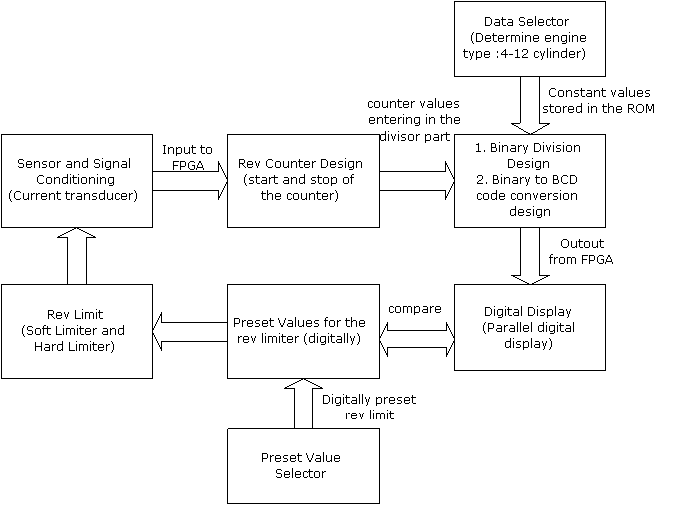
Block Diagram 1 : Overview of the revolution counter and limiter system
Ignition Systems ( Background )
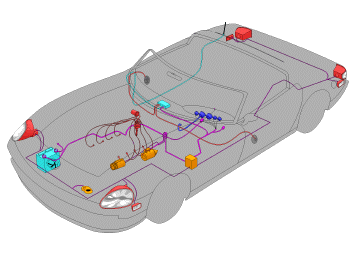
The purpose of the ignition system is:
The basic principle of the electrical spark ignition system has not changed for over 75 years. What has changed is the method by which the spark is created. The automobile has evolved from a mechanical system (distributor) to a solid state electronic system. Both systems control a low voltage primary circuit through an ignition coil, which will induce a high voltage in the secondary circuit that is then directed to the right spark plug at the right time.
Primary Circuit
The primary circuit consists of an ignition switch, ballast resistor, some type of off/on switch , ( in the older cars a set of breaker points) , which is usually inside a distributor, an ignition coil and the connecting wires. The purpose of the primary circuit is to allow low voltage from the battery, to pass through the ignition coil where the voltage is stepped up from 12 volts to as much as 40,000 volts.
Secondary Circuit
The secondary circuit consists of the secondary windings of the ignition coil, which produces the high voltage needed to arc across the spark plug gap. This voltage is sent out the center coil tower, through a high tension wire to the distributor cap where a rotor distributes the spark through the distributor cap, to the right spark plug at the right time.
Breaker Points
Breaker points have not been used since the mid 70’s, but many older cars still have them. Because of the simplicity of breaker points, it is a good starting point in understanding the switching mechanism that controls the current flow through the coil. The points are made up of a fixed contact point and a movable contact point. The movable point is spring loaded and rides on a 4,6, or 8-lobe cam (depending on the number of cylinders). The points are located inside a distributor. As the engine rotates, the camshaft turns the distributor, which then opens and closes the breaker points as many as 15,000 to 25,000 times a minute. When the points are closed, current is allowed to flow through the ignition coil, thereby building a magnetic field around the windings. When the points are opened, they interrupt that current flow, thereby collapsing the magnetic field and releasing a high voltage surge. This high voltage enters the top of the distributor, where an ignition rotor distributes that voltage through a cap to the right spark plug at the right time. The distributor also contains a condenser that prevents arcing by absorbing excess current when the points open. The difficulty with the breaker point system is that the part that rubs against the cam wears. This wear causes a constant need for adjustment and eventual replacement. In mid 70’s this problem was corrected through the use of solid state electronics and transistors as switching devices.
Ignition Coil
The ignition coil contains both the primary and secondary winding circuits. The coil primary winding contains 100 to 150 turns of heavy copper wire. The turns of this wire must be insulated from each other or they would short out and not create the primary magnetic field that is required. The primary circuit wire goes into the coil through the positive terminal and exits through the negative terminal. The coil secondary winding circuit contains 15,000 to 30,000 turns of fine copper wire, which also must be insulated from each other. To further increase the coil's magnetic field both windings are installed around a soft iron core. To withstand the heat of the current flow, the coil is filled with oil for cooling. The ignition coil is the heart of the ignition system. As current flows through the coil a strong magnetic field is built up. When the current is shut off, the collapse of this magnetic field induces a high voltage, which is released through the large centre terminal through the distributor to the spark plugs.
Copyright © 2000. All Rights Reserved. Unauthorised publishing of the content of this page is strictly prohibited. Please e-mail me at [email protected]
LEGAL: The use of e-mail addresses in the CPCHUAH.COM domain for unsolicited bulk e-mail (UBE) and other forms of "spam" constitutes a serious civil and criminal offence. Offenders will be found/traced and prosecuted to the fullest extent of all laws.
Last updated Wednesday, March 21, 2001 21:39