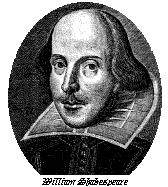
SHAKESPEARE: HE'S STILL THE MAN, ACCORDING TO MRS. COY-GONFA

WHAT'S UP WITH SHAKESPEARE?

William Shakespeare is still the man. He is considered the world's greatest dramatist, not just by me but by most of those who judge these things. Shakespeare was so popular in his day, that King James decided to be his patron (which means he supported his company financially.) He was so hot that anybody who was anybody went to see the latest Shakespearean productions. Even those who were just regular folks made their way to the Globe or other theaters eager to see what new thing the man had created.

Born in Strataford upon Avon, England, about April 23, 1564 to John and Mary (Arden) Shakespeare, he married Anne Hathaway when he was just eighteen and she twenty-six. The couple had three children, Susanna, and the twins Hamnet and Judith. (Hamnet did not survive childhood.) Shakespeare died April 23, 1616, after having achieved great success as a playwright and some time actor.

Shakespeare is credited with the authorship of numerous sonnets and some thirty-seven plays. His genius is largely evident in the characterizations presented in his tragedies, comedies and histories. No dramatist in the history of English literature has created such a variety of men and women whose foibles and tragic flaws so accurately depict the weaknesses of the human soul. And since, (in the words of King Solomon, the wisest man in history)"There is nothing new under the sun," we are able to recognize the humanity of Shakespeare's characters today, because men are still men and a good story is still a good story.

Today, Shakespeare's plays have been translated into many other languages and are performed all over the world. Today, despite the passing of time, his plays are the focus of many Hollywood movie events and productions on and off Broadway. Today, even four hundred years later, Shakespeare is still hot!


THE TRAGEDIES


Classic tragedy involves the downfall of a nobleman, a(tragic hero) one with many outstanding qualities but with a tragic flaw (a character weakness or an error in judgement) which leads to his downfall. The tragic hero loses everything, position, power, reputation, peace of mind, even his immortal soul, but gains insight before his death.
  • Hamlet, Prince of Denmark
  • The Tragedy of Macbeth
  • Othello, The Moor of Venice
  • King Lear
  • The Life and Death of Julius Caesar
  • Antony and Cleopatra
  • Romeo and Juliet
  • The Tragedy of Coriolanus
  • Cymbeline, King of Britain
  • Titus Andronicus
  • Timon of Athens
  • Troilus and Cressida
  • Pericles, Prince of Tyre
 

THE COMEDIES

Whereas tragedies usually end in death, comedies often end in weddings. Shakespearean comedies usually involve love and romance, mistaken identity and confusion, but in the end, "all's well that ends well."

  • The Tempest
  • Twelfth-Night or, What You Will
  • As You Like It
  • The Winter's Tale
  • A Midsummer-Night's Dream
  • Much Ado About Nothing
  • The Merchant of Venice
  • Measure For Measure
  • All's Well That Ends Well
  • The Comedy of Errors
  • The Two Gentlemen of Verona
  • The Taming of the Shrew
  • The Merry Wives of Windsor
  • Love's Labour's Lost
 

THE HISTORIES

The Elizabethan Age, during which Shakespeare penned some of his greatest work, was one in which England reached a state of strength she had never known before. England had won her wars and now enjoyed a period of peace, prosperity and patriotism. Her people were proud to be English because they believed that they were citizens of the greatest country on Earth. Because of this rise in nationalism, there was an increased interest in all things English, its people and its history and its kings.
  • The First Part of King Henry IV
  • The Second Part of King Henry IV
  • The Life and Death of King Richard II
  • The Life and Death of King Richard III
  • The Life and Death of King John
  • The Life of King Henry V
  • The First Part of King Henry VI
  • The Second Part of King Henry VI
  • The Third Part of King Henry VI
  • The Life of King Henry VIII


SHAKESPEARE'S ENGLISH

In addition to the great literature that Shakespeare has left us, he has enriched the English language by adapting, creating and coining, an estimated 1,500 words to the language.(McQuain, Jeffrey and Stanley Malless. Coined By Shakespeare. 1998) Shakespeare impacts all of us, in the words and expressions we use everyday, as in the following examples:

assassination, addiction, bedroom, bloodstained, circumstantial, cold blooded, doomsday, downstairs, eyeball, fashionable, full grown, glow, go-between, green eyed jealousy, take the hint, hurry, judgment day, lonely, love letter, marketable, moon beam, never ending, obscene, premeditated, puke, puppy dog, quarrelsome, rival, sanctimonious, shooting star, soft- hearted, submerge, swagger, switch, tardiness, unaware, unclog, undress, vaulting, vulnerable, watch dog, well behaved, wild goose chase, worthless, zany.

Without doubt,.... SHAKESPEARE IS STILL THE MAN!


Email Mrs. Coy-Gonfa
Shakeskpeare Reviews
Enjoying Macbeth
Information on the Globe Theater
The Great Chain of Being
The Scottish Kings
Lambs' Tales (Summaries)
Shakespeare 101: A Student Guide
Julius Caesar, a paraphrase
Links to everything you wanted to know about the Roman era
History of the Globe Theater
Pictures of the Globe Theater
Somatotypes and personality
Shakespeare Critiques and Criticisms
The Complete Shakespeare
Mrs. Coy-Gonfa's Multicultural Literature Page
Fit to Print: Mrs. Coy-Gonfa's Literary Analysis Essay Page
Back to Take a Stand: Mrs. Coy-Gonfa's Persuasive Essay Page
Mrs. Coy-Gonfa's Tips for Writing the Research Paper
Up Close and Personal: Mrs. Coy-Gonfa's Tips for Writing the College Application Essay
Back to Mrs. Coy-Gonfa's Classnotes 10
Back to Mrs. Coy-Gonfa's Classnotes 11
Back to Mrs. Coy-Gonfa's Classnotes 12A.P.
Back to Mrs. Coy-Gonfa's Filing Cabinet
The O'Bryant School Home Page
Email Mrs. Coy-Gonfa
PLEASE VISIT MY GUEST BOOK.

Sign Guestbook View Guestbook


Hosted by www.Geocities.ws

1