Tang Information
���A sword is only worth it's tang. I like a little "tang" myself. The tang, in case you don't know, is the part of the blade that fits into the handle. It is what supports the blade. Since the sword has become an obsolete weapon, they are manufactured as curiosities or decorations. As such they are not made to be used. The tang has suffered the most. afterall the part that you don't see doesn't have to be there.
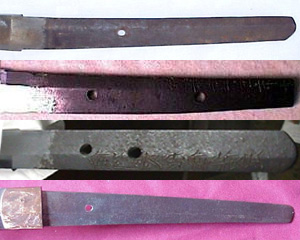
���The above picture demonstrates a few Japanese Tangs called Nakago. They run almost completely through the tsuka, or handle. They are secured to the tsuka by pegs called, Mekugi. Notice how long they are. They are also very strong, and made from the same metal as the rest of the blade. These Nakago are full tang.
Full Tang

���The best kind of sword that you can hope to own is full tang with a forged and folded blade. They are made today, but cost upwards of a thousand dollars. Often they have to be specially ordered. In this case, as the name suggests, the tang slides through the handle and nearly touches the kashira, or butt cap of the handle.
3/4 Tang

���Most of the vetter "decoration swords" sold today are three quarter tang. It is sufficient for a sword that will sit on a katana kake, or rack, forever. Swords with ABS handles almost always break at the end of the tang. Be careful with your sword.
1/2 Tang

���I didn't even think this existed until, in the interest of science I drilled out the mekugi on my Emperor series Katana. There before me was this...junk. I call it a 1/2 tang, but it's really more like a 1/4 tang. The tang measures about 3 inches until the first mekugi-ana and then ends. My friend bend this sword one day while attempting to cut down a tree in the woods. He denies that he bent it claiming that it was bent when I handed it to him. The cheaper swords have these. I, for instance, bought this sword from AWMA when I was about 15. I think It was ruined within a month.
"Rat Tail" Tang

���If you buy a sword from the Phillipines this is what you are getting. Often the tang consists of two peices of metal, the blade, and the bolt. The bolt, often a softer metal, is welded onto the extention of the blade, then a kashira is screwed onto the tip of it. You have been warned. If you see "Rat Tail" anywhere near a bladed weapon JUST SAY NO. I have experience with these crappy swords. I have broke one of them before, and repaired it, then broke it, then repaired it, then gave it to my brother, he broke it, then he repaired it. That swords current whereabouts are unknown.
|
