


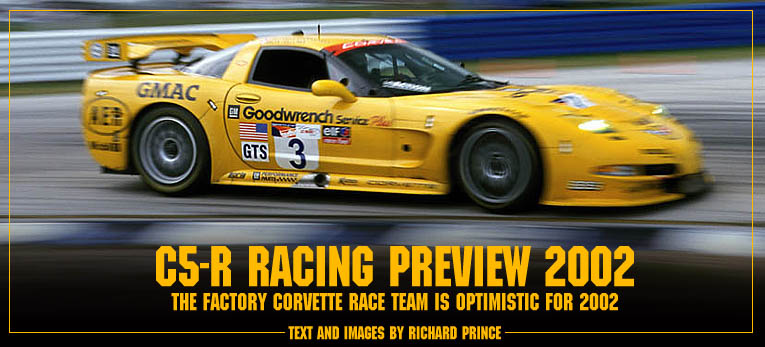
Chevrolet’s
factory Corvette racing program goes into the 2002 season with tremendous
optimism. The combination of top driving talent, highly developed racing cars,
and a super skilled crew bode well for this year’s championship chase, which
begins at Sebring on March 16.
For those who have not been following the racing program, a
little background is in order. GM decided to develop and campaign a road racing
version of its C5 Corvette back in 1997. To carry out the plan, a coalition of
GM engineers, managers, and technicians from various disciplines partnered with
Pratt & Miller, an independent design, development, and fabrication business
with a long history of success creating and racing cars and trucks.
The racing car that resulted from the collaboration is called
a C5-R. In keeping with the rules that govern the GTS class, which is where the
C5-R competes, it is in essence a highly modified version of the regular street
C5 Corvette. The C5-R starts life with production C5 hydro-formed frame rails
and various other production parts, and to those are added a wide array of
highly refined, custom fabricated components made from semi-exotic materials
such as carbon composites, magnesium, beryllium, and titanium.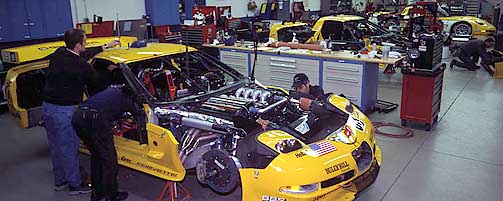
After nearly a year of wind tunnel development and on-track testing, the two-car
C5-R team made its debut at the Rolex 24 at Daytona in 1999. In the face of
intense competition from an already successful three-car factory Dodge Viper
team, the C5-Rs struggled at Daytona and through all of 1999 and into 2000. The
Corvette won the GTS class for the first time at Texas Motor Speedway in
September 2000.
With renewed commitment from GM, and building on all
they had learned during the previous two seasons, the C5-R team truly dominated
in 2001. They won six out of eight American Le Mans Series races enroute to the
ALMS
team and manufacturer championships, finished first overall and first and second in class at the Rolex 24 at Daytona, and finished first and second in class at the 24 Hours of Le Mans.
This
Year’s Opposition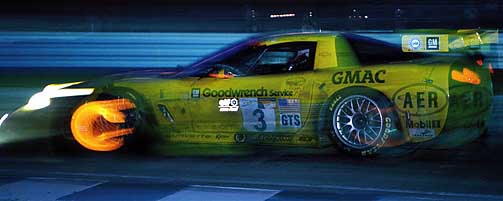
The
incredibly successful Dodge Vipers that dominated the Corvettes in 1999-2000 no
longer pose a serious threat. Chrysler disbanded its factory team at the
conclusion of 2000 and left future Viper racing to privateers. While they did
have some limited success in Europe last year, none of the privately run Vipers
competing on North American soil were competitive. To their credit, the American
Viper Racing team continues to try but they are not expected to give the C5-Rs
any real trouble throughout the season.
Additionally, three European Viper teams will compete at
Sebring. The Corvette squad has beaten all of these teams handily in the past,
but if nothing else, they have the Corvettes outnumbered. In a 12-hour race,
where there’s that much more time for attrition and bad luck, outnumbering the
opposition can sometimes be a determining factor.
Besides battling the Vipers, Chevy’s C5-Rs will face two Ferrari
550 Maranellos at Sebring. These gorgeous Italian thoroughbreds were only
homologated for competition in ALMS at the end of last year and are something of
an unknown commodity. A British team called Prodrive entered their 550 in the
Petite Le Mans at Road Atlanta last October but dropped out almost immediately
with mechanical difficulties, giving little hint at how fast they are capable of
going.
One of the two Maranellos entered at Sebring will be campaigned by
Prodrive and the other will be run by Team Olive Garden. Both cars are expected
to run the entire
ALMS
schedule this year. They are definitely underdogs at Sebring in light of the
Corvette Team’s intense level of preparedness but again, just about anything
can happen in a 12 hour race.
As in 2001, Corvette’s chief competition is expected
to come from the Saleen S7R. Though failing to finish at both its first and
second races, one of the Saleens stunned the racing world by winning GTS at last
year’s Sebring contest. Campaigned by Konrad Motorsport, that same car went on
to set numerous track records and beat the Corvettes at Laguna Seca in 2001.
A total of four Saleens will compete at Sebring, including two entries from the
Konrad team. While there is no denying that the Saleen S7R is inherently faster
than the C5-R, the various teams and drivers running the Saleens have thus far
been unable to keep pace with the P&M squad and Chevy’s all-star driver
lineup.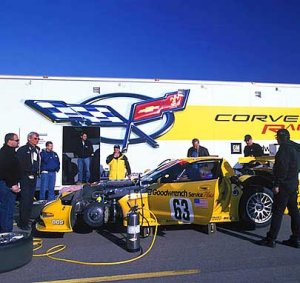
Konrad’s is probably the most capable of the three teams entered
at Sebring, but it will compete without Oliver Gavin, one of its star pilots
from last year. Ironically, Gavin left to join GM Racing and drive a Corvette.
New and Improved C5-R
In addition to the Gavin, the #3 Corvette will have
regulars Ron Fellows and Johnny O’Connell for the opener at Sebring. For the
shorter ALMS races, where only two drivers are warranted, Fellows and
O’Connell will get the call. As in the past, Andy Pilgrim, Kelly Collins, and
Franck Freon will handle #4 at Sebring and the other long races, while only
Pilgrim and Collins will pair up for the short races.
The cars these expert drivers will be given in 2002 look nearly
identical to those raced in 2001 and in fact they are almost the same. To remain
competitive, however,all race programs must continuously evolve and the
Corvettes have done exactly that.
Perhaps the single biggest improvement to the car’s
performance stems from aerodynamic advances developed in the wind tunnel and
confirmed at track tests. Several very subtle changes to the nose section and
front underbody have significantly improved balance, which translates to better
handling and faster lap times.
Also helping are new wheels and tires. OZ rims will replace
the previously used BBS units and several new tires will augment those already
utilized. Goodyear’s engineers and technicians put in a lot of time during
Corvette Racing’s off-season and have come up with several new compounds and
construction variants that will better enable them to choose tires specifically
suited to conditions at particular tracks.
As in past years, the C5-Rs will continue to rely on a 7-liter
racing version of the production LS1 for motivation. Power is said to be up
about 7 percent compared to last year as a result of relocated air intakes and
several other induction refinements.
In addition to improving the car’s performance, another way
to achieve success is to improve driver performance. To that end, the engineers
at P&M and
GM sought ways to make their drivers more comfortable behind the wheel. The most
notable change to come out of this analysis is an improved seat. Besides being
simply more comfortable, it offers the added benefits of better lateral support
and increased impact protection to the driver in the event of an accident.
All of these changes and more came out of an intense off
season development program that saw, among other things, extensive on-track
testing at Sebring last November and at Homestead’s road course in February.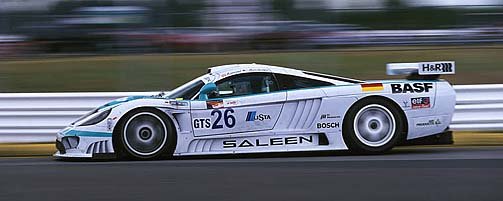
The huge investment of time, money, and hard work will soon
be put to the only test that matters. Sebring is the crown jewel of American
road racing and this year’s contest is made even more special by virtue of the
fact that it’s the race’s 50th anniversary. Though plagued by bad
luck there in past years, team Corvette goes to Sebring with renewed optimism.
All of their preparation, in concert with the small measure of luck that racers
always need, should see them through to the checkered flag.
 |
 |
 |
 |
 |
 |