Agenda 21, Chapter 17, Section B
Marine Environmental Protection
As with Agenda 21 and the Rio Earth Summit initiatives in general, when approaching complex issues such as resolving the problems of land-based activities causing degradation of the marine environment, the results have at best proved inconclusive. The more straightforward issues concerning sea based marine pollution have integrated into a clear mandate for action, with an overall successful approach.
The International response to land-based marine pollution (1992-2001)
 A problem highlighted in Section B was the �lack of a global scheme to address marine pollution from land-based sources�.
A successful outcome from the Agenda initiative was the Global Programme of Action (GPA) for Land-based Activities (LBA), which was established under the United Nations Environment Programme.
GPA/LBA sets out international targets and methods by which states can achieve the objectives laid down in Agenda 21.
The level of achievement of the Agenda 21 objectives is an indication of the current success of the GPA/LBA mandate.
Scoring System: Based on research and personal interpretation, and use of the table below.
| High | Objectives achieved in developed and developing countries |
| Medium | Objectives achieved in either developed or developing countries |
| Low | Objectives not achieved |
Prevent, reduce and control degradation of the marine environment Level of success: Low
There is an important distinction to be made based on the global distribution of wealth and resources, between high and low-income countries.
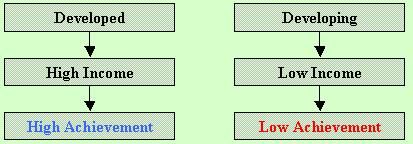
A persistent trend in developing countries has been the failure to apply "joined-up" thinking, using the above objectives in an integrated manner, ensuring that environmental measures go hand-in-hand with economic improvements :A root cause of which continues to be associated with severe economic restrictions, and an institutional environment, which is often poorly structured.
Objectives A and B: Apply preventative, precautionary and anticipatory approaches and ensure Impact Assessment of activities Level of success: Medium
The precautionary principle is widely accepted as a prominent feature in environmental policy making at all levels. A central feature of the environmental policies of the European Union is the use of the precautionary principle in management strategies such as the Water Framework Directive. (EC2000/60).
Following the 1998 Sintra Statement the precautionary principle is being used in the OSPAR convention as the basic motivation for policies tackling the problems and issues of hazardous substances. The precautionary principle has been applied to limit emissions and discharges with the overall �target of the cessation of discharges, emissions and losses of hazardous substances by 2020�. (Sintra Statement) This ambition of �near zero� inputs or emissions has been viewed in OSPAR as representing �a shift to the more precautionary approach.� (Richards 2000)
In developing countries the precautionary principle has a reduced influence in environmental policy making due to the greater reliance upon Cost Benefit Analysis (CBA) reflecting the pressures on economic and institutional resources.
This is certainly the case of sewage treatment in the GPA region of East Africa. In Dar es Salaam, Tanzania (Case Study) the creation of a sewage treatment system for a population of 3 million, costing US$220 million, is justified against the costs of the current lack of facilities for domestic sewage estimated at US$565 million spread over a 25-year period.
Box 1: Control of Nitrogen and Phosphorus inputs
Precautionary action to reduce Nitrogen and Phosphorus inputs has only been attempted at the regional level, but the threat to the marine environment from these sources continue to increase, as action is confined to a reactionary role. Improved methods of fertiliser application, including the use of natural wetlands to intercept nutrient runoff and the use of improved fertilisers illustrates precautionary action (GEAMP.2001).
HELCOM (Helsinki Commission), which oversees integrated management in the Baltic Sea has set threshold levels for Nitrogen and Phosphorus at a 50% reduction compared to current use, with the aim to promote changes in land use practises. More preventive measures attempted in Chesapeake Bay, USA to remove Nitrogen from effluent proved partially successful but at a huge expense and were consequently disregarded as a viable option.
| POPs Convention (2000) | Synthetic Organic Compounds |
| 122 signatories Banned 12 chemicals Most toxic and persistent |
11,000 known compounds in useDifficult to control |
| Problems:
Reliance on precautionary action without adequate assessment�Stock piling� in developing countries
Lack of alternatives, DDT still used to tackle Malaria
Failure of joined-up thinking, ignoring overriding economic influence on poor countries |
Problems:
Lack of research for alternatives esp. herbicides and fungicides� Bans usually reactive, precautionary action needed.Organochorlines well studiedLimited scope: banned only in hotspot areas |
Objective C: Integrate marine environmental protection into relevant polices Level of success: Low
Protecting the marine environment through policy integration has proved problematic in both developed and developing countries but for different reasons.
The rapid rate of urban population growth, and an inability to deal with the associated diffuse sources of pollution, has meant that integrated marine environmental protection has been difficult in developing countries.
Attempts in developed regions have also failed in the objective of achieving an integrated approach. In the European Union this has been recognised as the result of the traditionally sectoral approach to marine management (where) there is still poor integration between policy and management of sectors including fisheries, oil and gas, mineral extraction, land and sea based pollution and shipping. (Jones S 2000)
The sectoral approach is indicative of the current institutional framework for environmental policies in the UK, where government departments are compartmentalised into dealing with traditional issues. For example, the disjointed arrangements is evident in the fact that MAFF is responsible for regulating fishing, DTI is responsible for oil and gas exploitation, Environment Agency controls and regulates industrial and domestic pollution, and English Nature is responsible for habitats and conservation.
The sectoral framework is being challenged by non-governmental organisations (NGOs) such as WWF and Greenpeace who are succeeding in promoting piecemeal changes, as seen in the 1999 UK judicial review of off shore oil licencing procedures and the failure of integration with the EU Habitats Directive.
Box 2: The Wider Region of the Caribbean
is a microcosm of the problems of land-based activities occurring in other developing countries. The Caribbean UNEP initiative provides the opportunity for states in the region to succeed in integrating policy under the Assessment and Management of Environmental Policies (AMEP), incorporating protocols for addressing land-based sources of marine pollution.
However, the failure of region wide implementation is linked to Caribbean countries being economically dependant on exploiting natural resources and investing in polluting industries. Another barrier to the success of the AMEP initiative has been the political unwillingness of many of the region�s states to compromise their sovereignty and cede significant authority to an external programme. The Wider Caribbean also suffers from array of additional problems, including the legacy of decades old environmental legislation inapplicable to present circumstance.
Objective D: Develop technology consistent with the internalisation of environmental costs. (Polluter Pays Principle) Level of success: Low
Economic incentives including the Polluter Pays Principle and Tradable Discharge Permits (TDP�s) have been used as a principle tool in intergovernmental and national policies to internalise environmental costs. The OSPAR convention has incorporated these incentives into policy:
�The contracting party shall apply�(b) the polluter pays principle, by virtue of which the costs of pollution prevention, control and reduction are to be borne by the polluter. (article 2.2b)�
The use of economic incentives in the European Union and the UK is well established and predates the 1992 Rio Declaration, with the internalisation of costs resulting in the development of cleaner technologies through BATNEEC provisions
In the UK the polluter pays principle (PPP) is widely applied to all forms of pollution through effluent charges and tradable waste permits and has succeeded in promoting a higher standard of water quality management.
The use of PPP requires a high level of monitoring and the stringent enforcement of regulatory provisions, the lack of institutional capacity in developing countries, which has restricted its application and the failure to internalise costs.
Box 3. Environmental Quality reports for Malaysia (1998) reported that animal husbandry, food manufacturing and the textiles industry continued to represent high sources of pollution. This has been confined to small and medium scale industrial operators who suffer from a lack of access to clean manufacturing and waste reduction technologies.
Objective E: Improve living standards of coastal populations Level of success: Low
Rapid population growth combined with migration to the coastal zone has resulted in extensive urban growth in many developing countries; this extensive alteration population structures and inadequate institutional capacity has limited the success in improving coastal living standards.
It is important to realise that improved alterations in livings standards has to be integrated with general environmental approaches. It is estimated that, in general, coastal economies are wealthier than those, which are landlocked. For non-European developing countries the average per capita of coastal countries is US$ 5,567, which is 3 times the landlocked figure of US$ 1,771.
If economic development is at the expense of the natural environment, including degradation of coral reefs or removing mangroves, the increase in living standards will only be short-term. Basically, it needs to be sustainable.
Part of the overall objective for the Common Fisheries policy for the European Union is to improve the economic status of many coastal communities dependent on fishery resources. A widely accepted consequence of the Common Fisheries Policy is that most natural resources have been exploited beyond their safe biological limits, with current fisheries practices being unsustainable.
Aiming to improve coastal living standards is not a holistic approach to solving a root cause of environmental degradation. Improving coastal living standards may only exacerbate the problems of population migration and urban growth, and increase the gap between rich and poor sections of society.
Box 4: Approximately $10 billion is spent each year on water supplies in developing countries, but nearly 80% of this total is aimed at the better off. Approximately 50% of rural and 20% of urban households in the Third World, most of them poor, have no safe water supply.
Processes and mechanisms for the North - South transfer of appropriate resources Level of success: Medium
Transfer of appropriate technology from developed to developing countries in the last 10 years has not been occurring to the desired level.
The GPA and Global Environment Facility (GEF) are principle mechanisms for the North to South Transfer of technology and appropriate resources. Unfortunately, the level of resource allocation by these organisations has been limited.
The mechanisms by which technology has been transferred have suffered from a range of problems. Pitching funding at the appropriate level in relation to a countries institutional capacity has proved particularly difficult to achieve.
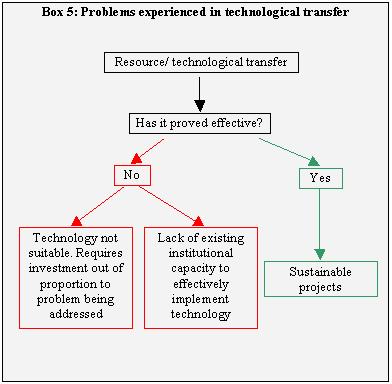
Financial assistance to developing countries, which has proved successful in promoting sustainable practises but has only been on a small scale. Tackling widespread problems associated with fertilizer and pesticide application in developing countries has been fruitful. The Integrated Pest Management (IPM) Global facility provides financial support to national governments for strengthening farmer driven participation. In addition the Food and Agricultural Organisation (FAO) sponsors 9 Asian countries to develop community based involvement in IPM practises. Stakeholder involvement approaches, which aim to educate the population, have proved more sustainable.
The International response to sea based marine pollution (1992-2001) It has been suggested that the main provisions of Agenda 21 in relation to sea-based forms of pollution are not new, but rather were a reminder to states to promote the improvement, acceptance and implementation of existing rules. (Nollkaemper, A., 1993) In this way, it would appear that the suggested activities outlined in Chapter 17 were already on the international action list, and so would have had a better chance of success than those of the land-based section.
The International Maritime Organisation, (IMO) is the body primarily responsible for the implementation of the provisions relating to sea-based pollution. Many of the activities listed have been achieved in some form or another in the last decade, which is due in part to the �sound� existing framework, which was in place prior to the agenda.
| - | Objectives | - | Level of Success | - |
| - | - | High | Med | Low |
| A | Shipping | - | - | - |
| - | Pollution | - | X | - |
| - | Navigational safety | X | - | - |
| - | Hazardous cargoes | - | X | - |
| B | Offshore Oil and Gas | - | X | - |
| D | Ports | - | - | X |
| E | Oil Pollution | - | X | - |
Shipping � Conventions and Protocols Level of success: Medium
The lack of ratification of global conventions covering sea-based marine pollution continues to be a cause for concern. The majority of non-ratifying States are to be found among developing States, and it has been seen in the past that there is a marked relationship between the gross national product of States and the level of ratification of MARPOL Conventions. (Nollkaemper, 1993)
To combat this problem, IMO has developed a Technical Co-operation Programme, which has been successful in a number of areas such as the establishment and upgrading of national maritime administrations, the creation of regional networks of maritime authorities and the development of regional port State control mechanisms. The Maritime Safety Committee of IMO considers a lack of trained and experienced personnel within national administrations to be the main reason for the lack of compliance by flag States with IMO regulations. The technical co-operation programme has helped to address this issue, however problems still remain - in part due to the varying degrees of expertise within maritime institutions globally.
Shipping � Pollution Level of success: Medium
Oil Pollution.
Since 1981, oil pollution from ships has decreased by 60% from 1.47 million tons a year to 0.59 million tons. This is an indication that effective steps are being taken to reduce pollution from shipping. Improved safety standards have also led to a fall in the number of major, accidental pollution incidents. The number of spills over 700 tonnes at the end of the 1980s was only a third of the total a decade earlier.
Air Pollution
The issue of air pollution has been high on the agenda of the Marine Environmental Protection Committee (MEPC), an IMO body, since 1988. In its Resolution A.179 (17) the IMO Assembly requested that MEPC, in co-operation with MSC, develop standards for reducing the use and consumption of ozone-depleting chlorofluorocarbons, as well as provisions to reduce air pollution emanating from ship machinery and cargo handling operations. A new draft annex to the MARPOL Convention was also to be prepared on these issues (Nollkaemper, 1993)
Annex VI
There is concern that if the introduction of the new Annex VI to MARPOL is unduly delayed this could encourage a confusing explosion of different local control measures by coastal states. To date, only two countries have ratified Annex VI, and the International Chamber of Shipping is encouraging ratification in the hope of securing the required number of government signatories before the IMO target of January 2003.
Non-indigenous organisms. Since 1973, slow progress has been made in addressing this issue, and it was only in 1991 that MEPC adopted regulatory measures aimed at minimising the risk of the introduction of unwanted organisms. This came in the form of International Guidelines, which Prevent the Introduction of Unwanted Aquatic Organisms and Pathogens from Ships� Ballast Water and Sediment Discharges. It has always been clear that these guidelines would not conclusively solve the problem as any progress is impeded by the apparent absence of advances in ballast water management and treatment processes. Steps are being taken to develop and improve compliance with the guidelines, possibly by creating a new annex to the MARPOL Convention. The IMO have also established a Global Ballast Water Management Programme.
Shipping � Navigational Safety Level of success: High
Port State Control. (PSC)
This is now seen as the last safety net for maritime safety and a way for coastal states to exercise better control of their waters, through the exclusion of substandard shipping. Since the publication of Agenda 21, there have been many improvements to this regime. The Paris Memorandum of Understanding, signed in 1978 has been joined by a number of further MOUs, thus increasing global coverage of this system. This is necessary if PSC is to be a viable tool in the eradication of substandard shipping and the reduction of accidents at sea.
Training standards
With the adoption of the 1995 Standards of Training and Certification of Watch-keeping for Seafarers, (STCW �95), seafarers are required to achieve a standardised level of training globally. The system operates on a certification basis, thus enhancing the professional standards of sea-going personnel, with a view to raising navigational safety, and reducing accidents at sea due to inexperience and lack of training. These standards entered into force in 1997.
IMO have also revised Chapter V of the Safety of Life at Sea (SOLAS) Convention, concerning navigational safety. This is planned for entry into force in 2002 and the new rules will apply to many more ships than at present. Vessels will be required to carry new electronic aids for navigation purposes and the chapter will also include new regulations addressing so called �human element� issues, including bridge design, equipment layout, bridge procedures, navigational practice and voyage planning.
Shipping � Hazardous Cargo Level of success: Medium
Transport of irradiated nuclear fuels.
At its 61st session in December 1992, MSC established a Joint IAEA/IMO/UNEP Working Group, which agreed to a draft code that should not be confined to irradiated nuclear fuel (as envisaged by A21) but should also cover plutonium and high-level radioactive wastes. (Nollkaemper, 1993). This is very much a precautionary approach. Since 1993, two codes have been adopted, one by IMO (Dangerous Goods Code) and the second by the IMO/United Nations Environment Program/IAEA (Code of Practice for the Safe Carriage of Irradiated Nuclear Fuel, Plutonium and High Level Radioactive Wastes in Flasks on Board Ships 1993).
Dumping Level of success: High
Dumping. The main instrument regulating the deliberate disposal of dredged material and land-generated waste at sea is the 1972 Convention on the Prevention of Marine Pollution by Dumping of Wastes and Other Matter, commonly known as the London Dumping Convention. A protocol to this convention was adopted in 1996 prohibiting dumping, except of certain exempt substances. It also adopted a precautionary approach, making it necessary for any party wishing to dump material at sea to prove that it is safe, effectively reversing the burden of proof from the regulating authority. The protocol will enter into force thirty days after ratification by 26 countries, 15 of which must be contracting parties to the 1972 Convention. With Australia as the 13th Contracting State since early December 2000, the 50% benchmark has been reached, and it is possible that the Protocol might enter into force during the course of 2002.
Ports Level of success: Low
Port waste reception facilities
This issue will remain on IMO's agenda well into the next millennium. Many nations have not succeeded in providing port waste reception facilities, for visiting ships, including those countries who have accepted commitments as signatories to the MARPOL Convention. To date, a universally acceptable system has not been devised, however some countries have adopted the 'no special fee' principle, whereby the cost of using reception facilities is assimilated into normal port dues. The IMO Marine Environment Protection Committee (MEPC) has produced a set of guidelines designed to remind governments of their obligations to provide the reception facilities needed by ships to meet their own corresponding obligations under MARPOL. The European Commission is working on a directive to establish mandatory obligations both on ships and on ports, with penalties for non-compliance.
Congested Shipping in International Waters Level of success: Medium
Efforts are being made to address the issue of pollution caused by shipping in congested areas. The development of new technologies such as Automatic Identification Systems, (AIS) using transponder technology, will aid in the control of shipping, and also in the identification of offenders. Coastal states will be able to make better use of Vessel Traffic Services, (VTS), to maintain a level of control over these areas.
Oil Pollution Level of success: Medium
The 1990 IMO treaty on International Convention on Oil Pollution Preparedness, Response and Co-operation, (OPRC) requires states to establish national systems for responding promptly and effectively to oil pollution incidents. This includes the creation of a national contingency plan, designated national authorities and operational focal points responsible for oil pollution preparedness and response, reporting and handling requests for assistance.
In 1992, IMO adopted a Protocol to Amend The International Convention on the Establishment of an International Fund for Compensation for Oil Pollution Damage 1971, IMO 1992.
Summary
The plethora of protocols, guidelines and mandatory provisions that the IMO has �cemented� into international hard law has made achieving the objectives laid down by Agenda 21 more simplistic. In fact, it may be argued that a number of the activities planned in the agenda were already being tackled at the time. The IMO has adopted a fairly strong interpretation of the precautionary principle into much of its policies and principles and this has proved successful in reducing pollution incidents in international and territorial waters.