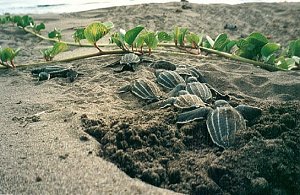
Leatherback Turtles – Manzanillo, Costa Rica
Organisation: Associacion ANAI
Contact Details: Asociaci�n ANAI Apdo. 170—2070, Sabanilla de Montes de
Oca, San Jos�, Costa Rica,Tel.: ++ (506) 224 3570/224 6090, Fax: ++ (506) 253 7524,
E-mail: [email protected]
— [email protected] , www.anaicr.org
Volunteer: Bob Carter
Location: Gandoca, South West Costa Rica
Species: Leatherback Turtle
Cost: around USD15 per day for food and lodging
Email: [email protected]
(please mail if there’s anything else you think I could help you with)
General Details:
I took part in this project for a month a long time
ago, back in 1996, but it is still running, and, I hear, more successful than ever.
Some details of work, requirements, etc, may of course have changed – contact the
project for up to date information. Costs have gone up slightly, but are still
extremely reasonable at around $15 a day for food and accommodation (staying with local
families or in volunteer camp). I'm not sure what the minimum time commitment is -
probably a couple of weeks. English is the main language for volunteers and Spanish
is very helpful for local contact. No special skills required apart from some fit
legs!
The project is based in the village of Gandoca, in
the far south east of Costa Rica. It was set up to protect the eggs of the
critically endangered Leatherback Turtle (the largest of the marine turtles) from
poaching. Eggs are a popular delicacy in Costa Rica, and can be an important source
of extra income for impoverished communities. The project has tried to work together
with the community, compensating them for the loss of earnings by employing some as
rangers and using others to house paying volunteers. When I was there, this was
working well and the project was on generally good terms with the local people.
Gandoca is a vital nesting spot. Volunteer work
is done mainly at night and during the summer months (the nesting season), and involves
patrolling the beach to look for nesting turtles. If one is found, one of two things
may happen:
- If the turtle has already begun to lay, she is allowed
to continue while measurements are taken of her dimensions, and her tag number (if any)
recorded. The project has been tagging turtles to attempt to identify them, so many
turtles encountered are those previously recorded. After laying is complete, her
tracks are covered to attempt to disguise the nest location.
- If the turtle is still looking for a nesting spot, the
volunteer team will wait until she has dug her egg hole and is preparing to lay (at which
point she is in rather a stupor and will not be disturbed by human presence). They
will then lie under her to collect the eggs as they fall. These are taken to a
secure hatchery where they are reburied.
Hatcheries are staffed 24 hours a day in shifts by
the volunteers. Other work may include clearing the beach of branches, etc, or
occasional maintainance work.
Personal Experiences:
This was a fantastic experience. Being close to
one of these turtles is absolutely magical, and sitting on the beach one morning watching
a female lumbering her way back into the ocean silhouetted against a tropical sunrise is
an image I shall never forget. Most nights you will probably encounter at least one
animal, and it is a privilege to be so close to such a rare and ancient thing.
The other great advantage of the project is its
low cost. Longer stay volunteers were sometimes also able to stay free of charge
(this may have changed). Further, the work you do is very necessary – almost
the whole project staff is made up of volunteers.
The area itself is remote but very
beautiful. Some volunteers complained about being bored during the day, or did not
like the basic conditions. This is a potential problem for some people, but the
only problem I found was lack of sleep. After walking up and down the beach most
nights, I generally got to bed around 4am. The howler monkeys and the local farmers
woke up an hour or so later, and the rest of the day was too hot to sleep inside!
For me, the accommodation was fine (a basic bed in a small wooden room) and
the food (rice and beans three times a day, plus occasional extras) no problem.
I would recommend this project to anyone who
loves wildlife, wants a hands-on project in a remote area and doesn’t have a fortune
to spend. If your idea of heaven is spending your nights flat on your face in the
sand with your head up a turtle’s bum (and it was certainly mine), then this is the
project for you.
However, if you like your luxury, don’t
like walking or mosquitoes, you should think twice. Not everyone found what they
were looking for here, but those that didn’t had come, I think, with unrealistic
expectations.
|
| Rainforest Reserve – Monteverde Conservation League, Costa Rica
Organisation: Monteverde Conservation League
Contact Details: www.monteverdeinfo.com/monteverde_conservation_league.htm
Volunteer: Bob Carter
Location: Monteverde, North East Costa Rica
Species: Rainforest plants and animals
Cost: No costs for volunteering but volunteer must organise food and accommodation
Email: [email protected]
(please mail if there’s anything else you think I could help you with)
I volunteered with MCL for a month in 1996. I
was travelling in Costa Rica at the time and wanted to do some volunteer work. No
cost for volunteering, but needed to pay my own accommodation and food costs.
I stayed with a family in the village (a good insight
into local life) and got involved in two main areas:
- writing a staff management database for the office.
- staffing the reception at the “Bajo del
Tigre” rainforest trail. This is a small reserve open to the public very close
to the village. It is secondary rainforest but nevertheless is a beautiful little
area containing a wide range of wildlife. By manning the visitor centre you are
freeing up time for the full time staff to do their other work. Although the
staffing work is not terribly exciting, it is nevertheless rewarding and gives you a
chance to spend some peaceful time in a very beautiful spot. We were also able to
make an excursion to the amazing field station in the Children’s Eternal Forest, a
much larger reserve nearby, and stay there at reduced rate as volunteers.
It was a great experience to live in Monteverde for a
month. The cloudforest is incredible (free entry for volunteers) and the area
generally very interesting. No costs for volunteering, just pay for room and food
(as well as staying with a family I later rented a small cabin, which was about 150
dollars a month at the time). They don’t generally have more than one or two
volunteers at a time, so it may suit two people travelling together so you don’t get
lonely in the evenings.
It would be important to contact the organisation in
advance to make sure they require some help. There may be maintenance work, etc, to
be done in the reserves as well. However,
I was originally a little frustrated, since I had
written from England saying when I would arrive and was told there would be some work for
me. I duly turned up in Monteverde only to be told that it would be another month
before assistance was needed. Although this wasn’t a problem for me, do make
sure you have something set up in advance unless your itinerary is very flexible.
|