| HOME | PORTFOLIO | GLOSSARY | CONTACT |
|
|
Linguistic Theory | |||
|
|
Table of ContentClass Notes for 16.10.06 Class Notes for 16.10.06Why is a portfolio important?It is a means of securing the results of the seminar sessions. What should a portfolio contain, and how are these components defined?It should contain the main results of the seminar sessions, the tasks that were given, and a glossary of technical terms. Why should the portfolio be on a website?
How do you make a website?There are several ways of doing this. In any case you need a webserver. The webserver can be
Then you need to register a domain.
Finally, you have to author HTML compatible text files which then can be browsed on the server through the internet. What is a website, actually?Anything that can be browser-accessed. What is a hypertext, actually?A hypertext is a marked text which is linked to another document or part of another document whereupon activating will navigate you to that document. Examples:
What is a text, actually?"A text is a sequence of paragraphs that represents an extended unit of speech" (Loos). Text in its broadest term are words used to express something. Linguistically, a text is a communicative act. These forms of communcation can either be spoken or written.
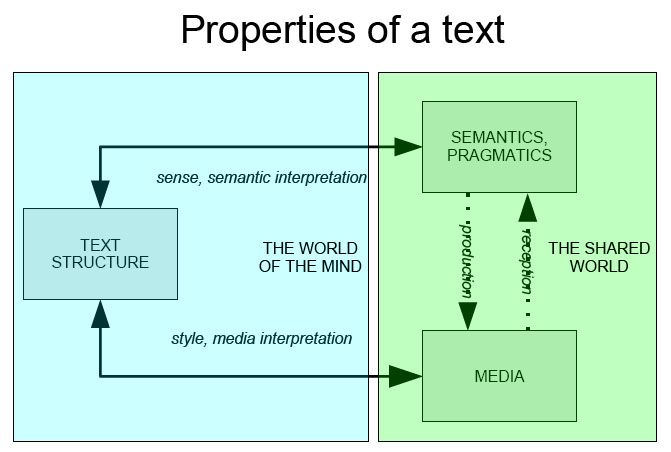
The properties of a text relate to the mind... to the world... What is text theory?A theory of the interpretation and verbalisation of texts.The main object of research is the text as an integral part of social interactions. What is text linguistics?Text linguistics is an area of linguistics that studies texts as communication systems. It describes the 'grammar' of a text, applying linguistc analysis to the text on a broader level, i.e. on more than the sentence or the word. What is applied text linguistics?For example, the construction of a website can be considered as applied text linguistics. QuestionnaireDoes the language you speak reveal anything about your personality?Answer 1: Nein. How many languages and/or varieties of a language do you speak?Answer 1: Rheinisch, Deutsch, Englisch, Französisch Do you think that 'Euro English' will eventually be standardised?Answer 1: Ja Why do we speak?Answer 1: Um sich verständlich zu machen - allerdings ist Sprechen nicht die einzige Möglichkeit (siehe Hunde). Folk Linguistics vs. Scientific Linguistics"Folk linguistics is a term applied to the amateur study of linguistics. The term is often used as a pejorative" (Wikipedia). LanguagesHow many languages are there?According to Ethnologue, there are 6,912 living languages in the world. How many languages are spoken in Germany?According to Ethnologue, there are 29 languages listed for Germany, of which 2 are extinct languages. Therefore, 27 languages are spoken in Germany. How many languages are spoken in Britain?Ethnologue lists 18 languages for the United Kingdom. Four of those are extinct languages, and two are only spoken as a second language. This means that 14 languages are spoken in the United Kingdom. Class Notes for 23.10.06DESRCRIBING A TEXTAny given text can be described with respect to its structure, physical attributes, and functional attributes. Text Structure: Every text contains certain sub- und superordinate text objects. Therefore, texts are hierarchically structured. Physical Attributes of Texts: Properties such as colour, font, style, font-size, are physical attributes of a text. Functional Attributes of Texts: Grammatical features of a text; somethimes even motion (e.g. in hypertexts). Example: My web-portfolio will serve as an example. Heading 1 is "Linguistic Theory", the topic of the class. Heading 2 is "Portfolio", which tells the reader that he or she is on the portfolio page of my website. Heading 3 is "Table of Content". Underneath this heading, the headings of all the following sections are listed, namely the class notes for the respective sessions. This list is followed by the heading "Class notes for 16.12.06", and the first portfolio entry underneath it. The entries again contain sub-headings. They also contain, for example, paragraphs and structured lists. The headings are all in bold print, they have a larger font-size than the main text. The higher the level of the heading, the larger the font. The headings of the different sessions, for example, also have a different colour. Hyperlinks are also coloured in blue and are also underlined. Once the link has been visited, the font-colour becomes a dark red. The text is aligned to the left. It is written left to right and top to bottom. The text follows the rules of English grammar. The hyperlinks at the top of the page are linked to the respective sections on the web-page. If one clicks, for example, "Class Notes on 16.12.2006" one gets to the heading of this section in the portfolio. There are also links to other pages on the same websites as well as links to pages on other websites which open when the link is clicked.
Class Notes for 30.10.06Creation of a textThe creation of a text firstly contains semantic and pragmatic elements. First of all, one has to decide on the subject matter of the text, i.e. what the text is to be about. Subsequently, the structure of the text has to be definied. Example:The Weather
After the subject matter is decided, the text has to be structured accodring to, e.g. title, subtitle, author, headings, etc. as can be seen in the table above. These elements define the structure of the text. Terms like 'heading' are theoretical terms on the level of text grammar. The structure is hierarchical and can also be presented by tree diagrams. As for the media, the different headings, paragraphs, etc. are styles (German: Formatvorlagen). A 'style' defines for every object what it looks like. The table above also gives examples of different styles. In designing a website, the creator has to keep in mind that, for example, the length of the lines can be changed by the reader in a web-browser. It is possible to view the meta data of every website in your browser. Class Notes for 06.11.06What is language?Language is a system of signs, like voice sounds, gestures, or written signs. Even distance can be a sign, as there are different conventions in different cultures. It can, however, be argued that gestures, the position of the body, etc. are a paralanguage. Nowadays they are mostly considered to be part of language. In some cultures language and gestures are very closely linked. Language is...
Design features of language:From Charles Hockett (1966), "The Problem of Universals in Language" The Search for Universals Through Comparison with Animal Systems "The design-features listed below are found in every language on which we have reliable information, and each seems to be lacking in at least one known animal communicative system. They are not all logically independent, and do not necessarily all belong to our defining list for language--a point to be taken up separately..." 1. Mode of communication-vocal-auditory, tacticle-visual, or chemical-olfactory 2. Rapid Fading: Message does not linger in time or space after production. 3. Interchangeability: individuals who use a language can both send and receive any permissible message within that communication system. 4. Feedback: users of a language can perceive what they are transmitting and can make corrections if they make errors. 5. Specialization: the direct-energetic consequences of linguistic signals are usually biologically trivial; only the triggering effects are important. 6. Semanticity: there are associative ties between signal elements and features in the world; in short, some linguistic forms have denotations. 7. Arbitrariness: there is no logical connection between the form of the signal and its meaning. 8. Discreteness: messages in the system are made up of smaller, repeatable parts; the sounds of language (or cheremes of a sign) are perceived categorically, not continuously. 9. Displacement: linguistic messages may refer to things remote in time and space, or both, from the site of the communication. 10. Productivity: users can create and understand completely novel messages.
11. Cultural transmission: the conventions of a language are learned by interacting with more experienced users. 12. Duality (of Patterning): a large number of meaningful elements are made up of a conveniently small number of meaningless but message-differentiating elements. 13. Prevarication: linguistic messages can be false, deceptive, or meaningless. 14. Reflexiveness: In a language, one can communicate about communication. 15. Learnability: A speaker of a language can learn another language. "There is...a sense in which [productivity], displacement, and duality...can be regarded as the crucial, or nuclear, or central properties of human language." What is a language?"A language is a system, used for communication, comprising a finite set of arbitrary symbols and a set of rules (or grammar) by which the manipulation of these symbols is governed. These symbols can be combined productively to convey new information, distinguishing languages from other forms of communication" (Wikipedia). Language can also constitute the identity of a particular group of beings. "A language" can furthermore be a set of variety dialects or refer to the standard variety of a language. What is a definition?A definition usually consists of two parts, the definiendum (that which is to be defined) and the definiens (that which defines). Example: 'language' = definiendum 'system of signs' = definiens. The definiens often consists of the genus proximum (the nearest kind), e.g. 'a system', and the differentia specifica (specific differences), e.g. '...of signs'. The differentia specifica can be either an enumeration of sub-kinds or constrasts with opposites.
Class Notes for 13.11.06What is a model?A simplification of a complex entity or process; a simplified representation of reality. A model has a meaning, a structure, and an appearance. The appearance can be an artifact. The International Phonetic Alphabet (IPA), for example, is a model of the speech sounds. Examples of models
What is a theory?
What is the difference between a model and a theory?Humans construct theories in order to explain, predict and master phenomena (e.g. inanimate things, events, or the behaviour of animals). In many instances we are constructing models of reality. A theory makes generalizations about observations and consists of an interrelated, coherent set of ideas and models. An example of how theories are models can be seen from theories on the planetary system. The Greeks formulated theories that were recorded by the astronomer Ptolemy. In Ptolemy's planetary model, the earth was at the center, the planets and the sun made circular orbits around the earth, and the stars were on a sphere outside of the orbits of the planet and the earth. Retrograde motion of the planets was explained by smaller circular orbits of individual planets. This could be illustrated as a model, and could even be built into a literal model. Mathematical calculations could be made that predicted, to a great degree of accuracy, where the planets would be. His model of the planetary system survived for over 1500 years until the time of Copernicus. So one can see that a theory is a model of reality, one that explains certain scientific facts; yet the theory may not be a true picture of reality. Another, more accurate, theory can later replace the previous model. (Wikipedia) Class Notes for 27.11.06Linguistic MethodologyTheory Formation and ArgumentationExplanationMany scientists and theorists on scientific method argue that concepts of causality are not obligatory to science, but are in fact well-defined only under particular, admittedly widespread conditions. Under these conditions the following requirements are generally regarded as important to scientific understanding:
Confirmation and falsificationAccording to Stephen Hawking in A Brief History of Time, "a theory is a good theory if it satisfies two requirements: It must accurately describe a large class of observations on the basis of a model that contains only a few arbitrary elements, and it must make definite predictions about the results of future observations." He goes on to state, "any physical theory is always provisional, in the sense that it is only a hypothesis; you can never prove it. No matter how many times the results of experiments agree with some theory, you can never be sure that the next time the result will not contradict the theory. On the other hand, you can disprove a theory by finding even a single repeatable observation that disagrees with the predictions of the theory ... The defining characteristic of a scientific theory is that it makes falsifiable or testable predictions about things not yet observed. The relevance, and specificity of those predictions determine how (potentially) useful the theory is. A would-be theory that makes no predictions that can be observed is not a useful theory. Predictions which are not sufficiently specific to be tested are similarly not useful. In both cases, the term 'theory' is inapplicable." (Wikipedia) Deductive argumentation
Inductive argumentation
Abductive argumentation
Components of a linguistic theory:
History of linguistics: from Philology to Computational LinguisticsThe 20th century marks a shift from a diachronic to a synchronic perception of langage. The new interest was in the function and structure of language. Functional Linguistics
Structural Linguistics
Class Notes for 04.12.06Generative LinguisticsWhen Noam Chomsky was writing his doctoral thesis in the 1930s, most people were doing structural linguistics - collecting corpora of languages which had never been discussed or analysed before. They were looking for a way to describe these languages. As nothing was known about them so far, people had to start from scratch and analyse, for example, how words are organised, structured, etc. Noam Chomsky claimed that what we can hear or what is performed is only the tip of the iceberg and that there is an underlying 'mental grammar'. This idea had so far been rejected as being unscientific. Chomsky tried to determine what this grammar looked like. This included descriptions of words, pronunciation, etc. As for the question of how sentences of a language are related to each other, Chomsky found out that - even though the structure is different - the syntagmatic relations between words are the same. What the sentences have in common is a deep structure. This deep structure is what one finds in simple, active, affirmative, declarative (saad) sentences. Starting with this idea, Chomsky found other structures in language. The change from the deep structure to the surface structure is called transformation. For this reason, generative grammar is also called transformational grammar. Chomsky claims that we are born with this kind of linguistic knowledge in a psychological sense. The question is how much of this knowledge a newborn baby has. The actual language itself cannot be innate, because there are too many languages. What all languages have in common though are certain basic parameters, like SOV or SVO languages. Text Analysis
Class Notes for 11.12.06COMPARATIVE PHILOLOGYThe term 'philology' is derived from the Greek words 'philos' and 'logos'. A literal translation would mean 'the love of words'. In a wider sense, the term denotes the study of both literature and language. In a narrower sense, it means the scientific and historical study of language. Today's meaning of the term is restricted to the historical study of language. In the 19th century, the historical study of language was the main interest of linguists like Bopp, Rask, and the Grimm brothers. Their aim was to discover regular processes in language changes. The general approach was to corroborate hypotheses on the basis of similar features existing in records of apparently cognate languages. The Comparative MethodThe comparative method is a diachronic search for a common origin of different languages. Different languages are compared in order to find language families and establish historical relatedness. This happens on the levels of phonology, morphology, syntax, and the lexicon. The first step is to assemble cognates, i.e. words with the same etymological derivation (e.g. English: 'father', German: 'Vater'). The second step is to compare a list of cognate terms and search for shared linguistic innovations from a proto-language. The last step is the reconstruction of the original proto-form of a word through comparison of a set of cognates. If, for example, two or three cognates have retained the same sound, it is quite likely that this sound is the original one (majority principle). Diachronic Comparison
The Grimm Brothers (1785-1863, 1786-1859)
The Great Vowel ShiftThe great vowel shift presumably began in the 15th century and continued until the 17th. There are, however, linguists who are of the opinion that it started earlier and ended later. In any case, it was the most important process describing the change from Middle English to Early Modern English. The implications are that it "raised Middle English long vowels, causing the high long vowels to become diphthongs, as the mid long vowels became high long vowels and so on" ( Class Notes for 18.12.06FUNCTIONAL LINGUISTICSThere are differences in the definitions of functional linguistics. The French linguist André Martinet (1908-1999) speaks about 'significant units' (which can be any kind of units ranging from morphemes to texts) which are hierarchically organised according to their size. He analyses how language functions in different contexts. People's experiences are taken into account. Martinet was strongly influenced by the Prague School of linguistics. A second definition of functional linguistics is provided by Michael Alexander Kirkwood Halliday (born 1925), an English linguist. He also talks about concrete forms but, as opposed to Martinet's concern with people's experiences, is interested in the speaker's intentions. Therefore, the two linguists are basically talking about two sides of the same coin. The Prague School of linguistics (ca. 1928-1939) took a holistic (i.e. anti-atomistic) view of linguistics. They tried to understand linguistic units as a complete entity in context. The Prague School's methods of structuralist literary analysis influenced both linguistics and semiotics.
Class Notes for 15.01.07STRUCTURAL LINGUISTICS
Leonard Bloomfield (1887-1949), American linguist
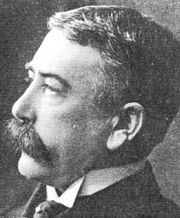
Ferdinand de Saussure (1875-1913), Swiss linguist [source:http://en.wikipedia.org/wiki/Image:Ferdinand_de_Saussure.jpg]
In America:
Empiricism vs. Rationalism
Class Notes for 22.01.07Historical OverviewCOMPARATIVE PHILOLOGY
FUNCTIONAL LINGUISTICSMalinowski (1924)
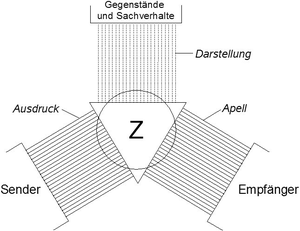
Bühler (1934)
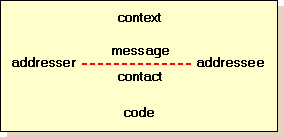
[source: http://de.wikipedia.org/wiki/Organon-Modell] Roman Jakobson (1960)
Poetry is very highly structured - in comparison to ordinary language Founders of RUSSIAN FORMALISM
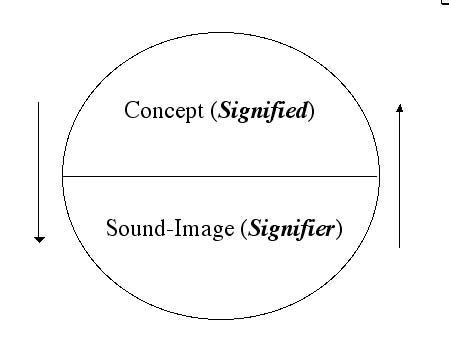
STRUCTURALISMFerdinand de Saussure (1919)
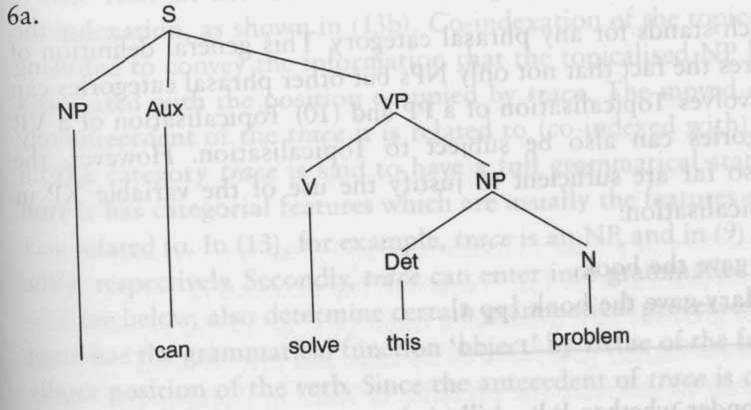
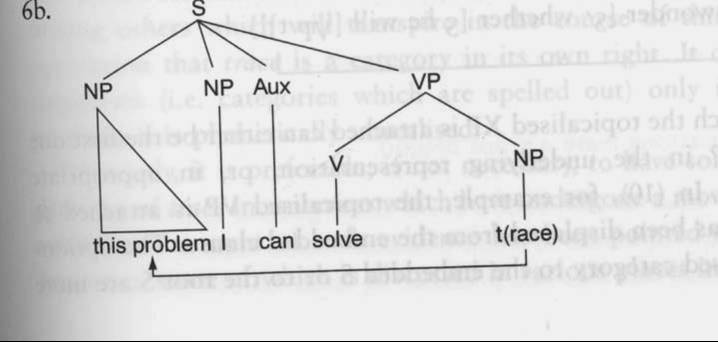
[source: http://cyberartsweb.org/cpace/cpace/theory/luco/screenshots/Saussure.jpg] GENERATIVE LINGUISTICSGenerative linguistics is in itself a broad concept. It makes up a school of thought within linguistics. One of the leading figures in generative linguistics is Noam Chomsky. He developed the concept of a 'generative grammar'. NOAM CHOMSKY (born 1928) Noam Chomsky was born in 1928 and studied philosopy and linguistics at the University of Pennsylvania. In 1957 he wrote one of his most important works, Syntactic Structures. Chomsky's concept of a generative grammar implies a finite set of rules which can be applied in order to generate an infinite number of sentences. It can also be used to describe a language. In that case rules are inferred from examples of utterances in that languages. These rules can then be used to generate other sentences in that languages. Chomsky distinguishes between two different levels of representation, namely the surface structure (SS) and the deep structure (DS). The deep structure represents the syntactic relations of a sentence, whereas the surface structure is a derived representation of the deep structure. SS can be derived from DS by transformations like passivisation, forming of questions, etc. Example: DS: "I can solve this problem." SS: "This problem, I can solve" (derived by topicalisation). Even though the structure of the sentence seems to have changed, it is in fact only the form of representation. The sentence structure can be represented by tree diagrams. In the second diagram, the DS is still represented by the 'trace'.
Transformational rules map the deep structure onto surface structure representations. Chomsky alleges that a simple system of phrase structure can provide the basis from which all sentences can by derived by simple transformations. For this reason, 'generative grammar' is also called 'transformational grammar'. Chomky furthermore claims that different languages have similar deep structures and that there are properties which all languages have in common. These similarities are merely concealed by the respective surface structures. Based on these assumptions, Chomsky developed the concept of a universal grammar. He believes that every speaker knows a certain set of principles that are common to all languages. One such principle is structure-dependency. It denotes that knowledge of a language relies on the structural relationships in the sentence rather than on the sequence of words. Nonetheless, languages are different, for example in their lexicon. Parameters have to be selected among possible variants. This can be compared to the use of a lightswitch. A certain parameter can either be turned on or off. One example of such differences is word order. Some languages, like English, have a SVO word order, whereas others, like Turkish, have SOV, or VSO (like Irish). Chomsky distinguishes between E-Language and I-Language. The first is used to collect data and to describe the properties, and a grammar is constructed which describes the regularities. The I-Language is concerned with what the speaker knows about language and where his language comes from. "Language is a system represented in the mind/brain of a particular individual" (Chomsky 1988). Chomsky furthermore distinguishes between competence and performance. Competence is what the speaker or hearer knows about his language. Performance is the actual use of a language in a particular situation.
Class Notes for 29.01.07COMPUTATIONAL LINGUISTICSDefinition: The study of language using the means provided by computers. Computational linguistics is closely related to Natural Language Processing (NLP) by computer. NLP is not a program of scientific investigation, though, which computational linguistics claims to be. C.l. deals with the "statistical and logical modeling of natural language from a computational perspective" (Wikipedia). The theories used to be worked out by pen and paper (which narrowed the possibilities), but now theories can be tested on vast amounts of linguistic data which is mainly provided by the World Wide Web. Computational linguistics defines in terms of linguistic theory:
In general, computational linguistics attempts at reproducing human language with the help of computers. The subfields of computational linguistics are:
Machine Translation
Examples: Semantic Representation:
One of the leading figures in computational linguistics is Martin Kay. "His achievements include the development of chart parsing and functional unification grammar and major contributions to the application of finite state automata in computational phonology and morphology. He is also regarded as a leading authority on machine translation" (Wikipedia). "Recent research has shown that language is much more complex than previously thought, so computational linguistics work teams are now sometimes interdisciplinary, including linguists (specifically trained in linguistics). Computational linguistics draws upon the involvement of linguists, computer scientists, experts in artificial intelligence, cognitive psychologists and logicians, amongst others" (Wikipedia). There is still no computer program that can substitute the work of human translators completely. Results can, however, be very near that aim if, for example, the world-field is narrowed down (like in weather reports) so that there is less or no ambiguity, or if a person identifies all names in the text.
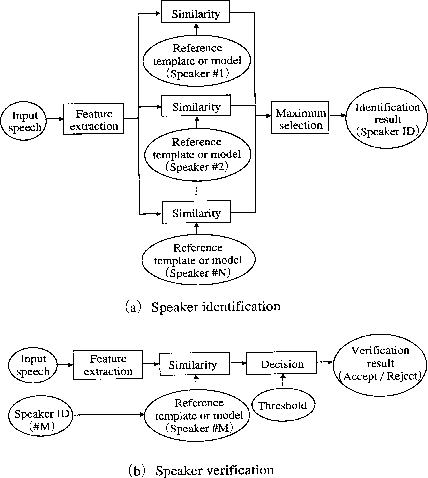
Class Notes for 05.02.07SPEECH TECHNOLOGYSpeech technology is the production of artificial speech. The different areas of speech technology are 'phonetics and phonology', 'lexicography', 'grammar', and the 'theory of dialogue'. There are different aspects of speech processing, namely speech recognition, speaker recognition or speaker identification, speech signal, and speech synthesis. The first computer-based speech synthesis systems were developed by John Larry Kelly in 1961. Speech Recognition Speech recognition is the "automatic conversion of spoken words to computer text" (Arms). One of the difficulties about speech recognition is the ambiguity of sounds. This becomes obvious in the following example: A: "Hi there, I am an Ampendix." B: "Hold it right there. ... What does the 'I.M.N.' stand for?" Speaker Recognition Speaker recognition is one form of biometrical identification. This identification is based on previous recordings. The speech waves are analysed in order to find idiosyncratic properties of a person's voice. Thus, the machine can identify a person by analysing his or her voice. The following diagram illustrates this process:
[source: cslu.cse.ogi.edu/
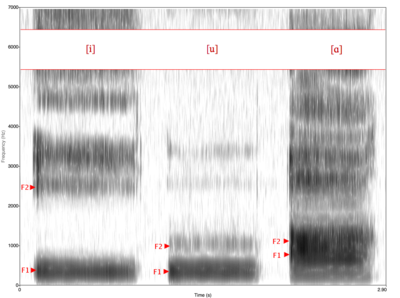
Speech Signals Speech signals can be represented by spectrograms. A spectrogram is the "two-dimensional visual respresentation of sound, plotting frequency against time; amplitude is indicated only approximately by brightness of color contrast (in a colored spectrogram) or darkness of gray-scale (in a black and white spectrogram)" ("Glossary" Indiana University). The following graphic shows the spectrograms of the vowels i, u, and a:
[source: http://en.wikipedia.org/wiki/Image:Spectrogram_-iua-.png] The dark areas, here called F1 and F2, are called formants.
Speech Synthesis "Speech synthesis is the artificial production of human speech. A system used for this purpose is termed a speech synthesizer, and can be implemented in software or hardware. Speech synthesis systems are often called text-to-speech (TTS) systems in reference to their ability to convert text into speech. However, there exist systems that can only render symbolic linguistic representations like phonetic transcriptions into speech" (Wikipedia)
SourcesArms, William. "Glossary." Digital Libraries. <http://www.cs.cornell.edu/wya/DigLib/MS1999/glossary.html> (Last visited on Feb. 28, 2007). Barry, Peter. Beginning Theory: An Introduction to Literary and Cultural Theory. Manchester: Manchester UP, 2002. Chomsky, Noam. Syntactic Structures. Berlin, New York: Mouton de Gruyter, 1957. Cook, Vivian, and Mark Newson. Chomsky's Universal Grammar - An Introduction. Oxford, Cambridge: Blackwell Publishing, 1996. Gibbon, Dafydd. "Linguistic Theory Organisation". <http://wwwhomes.uni-bielefeld.de/~gibbon/Classes/Classes2006WS/MALinguisticTheory/linguistic-theory-intro.pdf> (Last visited on Feb. 10, 2007). Loos, Eugene E., ed. "Glossary of Linguistic Terms". <http://www.sil.org/linguistics/GlossaryOfLinguisticTerms/>. (Last visited on Jan. 12, 2007). |
MA British and American Studies Winter Term 06/07 Contact: [email protected] |
||||||||||||||||||||||||||||||||||||||||||||||||||||||||||||||||||||||||||||
| ©2006 Cornelia Wächter |