Home
COMPLETE COVERAGE CAMPAIGN
CCC Overview
CCC General Plan & Next Steps
Dialogue with the Media: NPR
Ways to Support the CCC
Scrubs, T-shirts, Pins & Magnets
SAVE THE CIVILIANS
STC Overview
STC General Plan & Next Steps
GENERAL MATERIALS
Nonviolence
Guidelines for Participants
Events * Film Series
The Power of Images
Photo Credit
CONTACT the CAMPAIGNS
Contact Us
|

|
 Nonviolence Nonviolence
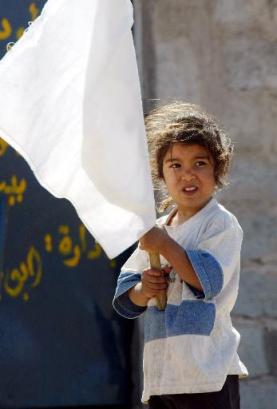
The Complete Coverage Campaign and Save The Civilians are campaigns of active nonviolence, or C.A.Ns. We use the phrase “campaign of active nonviolence” for several reasons.
First, the word “campaign” indicates that these efforts are designed to be long-term, strategized efforts towards single, narrow goals. We are not an "organization." We do not seek "members." We seek to build a group of people committed to accomplishing a goal and to press ahead single-mindedly until that goal is reached.
Second, we use “nonviolence” because we know that the power of Gandhian nonviolence is the only method sufficient to accomplish certain goals. Force, or the threat of force, is no match to nonviolence in ultimate effectiveness.
Third, we highlight that our campaign is one of “active” nonviolence. Many people who hear the word nonviolence consider it to be weak, passive or submissive because of their misunderstanding of concepts such as pacifism and passive resistance. Gandhi used the word nonviolence because he felt that passive resistance wasn’t appropriately descriptive of his brand of active non-cooperation with injustice. We want to be very clear that nonviolence is not merely a passive, defensive technique, but is rather an active tool used for offensive purposes. Active nonviolence requires more courage and discipline from its adherents than that demanded of any soldier.
 Guidelines for Participants
The following guidelines were created after research into other groups' guidelines as well as guidelines used by Mahatma Gandhi. While we stand firm behind the concepts and principles underlying these guidelines, we are always open to suggestions so that we may improve the way in which we state such principles. Please note that the term “opponent” was used by Gandhi and does not imply, in any way, a lack of respect or concern for the persons identified by that term.
We commit to each other to:
- Act in a manner that reflects the peaceful world we strive to create, being peaceful in our attitude, words, symbols, slogans, actions and reactions.
- Refuse to return the anger or assaults of the opponent or of bystanders.
- Treat every person, including the opponent, with respect.
- Refrain from damaging or defacing property.
- Remain accountable for our own actions and to accept willingly the consequences of our actions including refusing to resist arrest.
- If arrested, to behave in an exemplary manner consistent with these guidelines.
- Promote the safety of ourselves and all others, including the opponent and bystanders, at all times.
- Adhere to directions of designated peacekeepers during direct actions.
- Seek compliance with these guidelines by all participants at any CCC / STC events.
 The Power of Images
The following is from a story by The Associated Press which appeared in various newspapers around the world and in the Las Vegas Review Journal on Saturday, July 23, 2005 on page 18A.
IMAGES OF DYING CHILDREN GENERATE MORE NIGER AID
GENEVA -- Donations to fund United Nations humanitarian work in drought-stricken Niger have jumped dramatically because of media images of starving children, the U.N. humanitarian chief said Friday.
Donors had been slow to come forward with funds for Niger until the crisis hit news headlines recently. The United Nations first appealed for assistance in November and got almost no immediate response, Egeland said.
"Over the last few days, the world has finally woken up, but it took the images of children dying. We should not have had so many children dying in Niger."
The Complete Coverage Campaign salutes the media for presenting to the public the real images of the drastic situation in Niger. We urge the media to do the same for the suffering civilians in Afghanistan and Iraq.
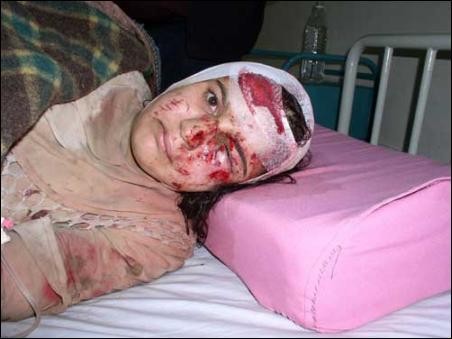
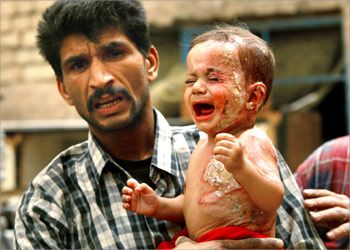
The power of images is great, and when the images show real suffering, we are indeed moved to compassion. The media holds this power because they make the decisions regarding what images to show and what stories to tell. While some people feel it is wrong to use such images, we believe the wrong is found not in publishing the images, but rather in failing to share with the public the suffering which is taking place. Nothing expresses the reality of suffering more than the power of images.
 Photo Credit
We originally obtained the photographs on this site from www.Albasrah.net. We are grateful to the photographers who made these images of the immense civilan suffering available, and are currently seeking the photographers names so we can give them individual credit.
 CONTACT US
We would love to hear from you.
For feedback or dialogue, or for further information,
please write us:
Thank you.

This work is licensed under a Creative Commons License.
|