Home
GENERAL MATERIALSPhoto Credit
SAVE THE CIVILIANSSTC Page
CONTACT the CAMPAIGNS

 Complete Coverage Campaign Overview
Few institutions are more important to a democratic society than a free and independent media. Such freedom requires the public, elected officials, and civic organizations to support truth, fairness, and balance in reporting and to insist that media outlets honor the principles that empower them.
Nicholas Johnson, former FCC commissionerIn our nation, no other entity is as potent or pervasive as the American media in influencing thought and attitudes, impacting our democracy and shaping the popular culture. Given this power, American citizens share the responsibility for making sure the media is held to the highest standards of ethics, fairness and objectivity.
AFL-CIO Media Reform Campaign, 3/3/05, Las Vegas, NVA self-governing society, by definition, needs to make its own decisions. It cannot do that without hard information, leavened with an open exchange of views. Abraham Lincoln articulated this concept most succinctly when he said: "Let the people know the facts, and the country will be safe." There is still a need today -- perhaps more than ever -- for identifying sense amidst the nonsense, for sifting the important from the trivial, and, yes, for telling the truth. Those goals still constitute the best mandate for a free press in a democracy.
George Krimsky, former head of news, Associated Press / World ServicesOUR SHARED RESPONSIBILITIES
These quotations indicate not only the great power of the media, but also the media’s great responsibility in a true democracy. They speak not only of the potential for using the media to affect public opinion, but also of the public’s responsibility of preventing the media from being used for that purpose.
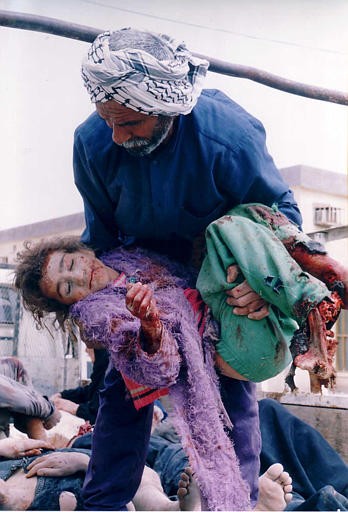
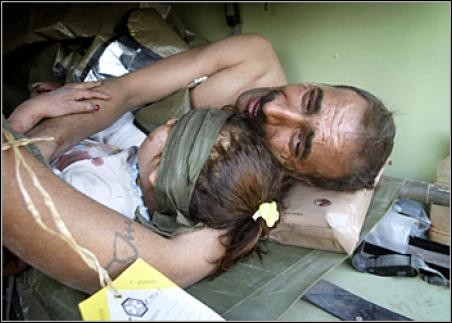
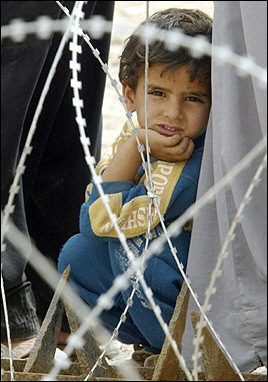
The Complete Coverage Campaign takes seriously our responsibility to insist that media outlets honor truth, fairness and balance. Truth, fairness and balance are honored by the media only when the public is given a complete picture of each news story. When just part of a story is told, there is no complete coverage. The media reports much about the violence and politics of Iraq, but very little about the humanitarian crisis experienced daily by the Iraqi people.Knowing that the victims of modern warfare are nearly 90% civilian (Unicef, The State of the World's Children, 1996), a complete picture must include full coverage of the immense civilian suffering in zones of military operations.
CARING ABOUT HUMAN TRAGEDIES
Because most humanitarian crises are covered extensively by our media – tsunamis, earthquakes, hurricanes, famines – the Complete Coverage Campaign calls for equally comprehensive coverage of the humanitarian crises ongoing in Iraq.These tragedies, these stories of human suffering, must be told. We must know the full truth, because only in knowing can we share some of the sorrow and the pain, grieve as we should, and offer what assistance we can. Caring about the well being of others is one of our founding principles. Our caring does not stop just because the people who are suffering happen to live in a “war” zone.
WE ALL SHARE THE SAME CONCERN
We know that those in the media share our concern and compassion for the civilians in Iraq. We understand, however, that they labor under very real pressures which make comprehensive coverage of these crises extremely difficult. We do not ignore or underestimate these pressures. But we know that those pressures must be overcome if coverage is to be complete, if our news is to fulfill the requirements of truth, fairness and balance.
 CCC General Plan & Next Steps
as of 10 January 2007
The CCC began as a campaign of active nonviolence (C.A.N.), following traditional phases or steps of successful campaigns. Click here to learn more about C.A.N.’s.From March 2005 until July 2006, the CCC worked to maintain a dialogue with the management of National Public Radio (NPR) in Washington, D.C. Our general plan has been to dialogue with them, rather than to protest them, so that we could better explain the reasons why civilian humanitarian concerns must be part of their coverage. During this time, we monitored NPR’s coverage and corresponded with them. These efforts resulted in increased – yet still very sporadic – coverage. Our letters to NPR detail both their coverage and our response. You can learn more about this dialogue by clicking Dialogue with the Media: NPR .
Because of our decision to focus our work on the Save The Civilians Campaign, the CCC will discontinue monitoring and contacting NPR until further notice. But if you care about this issue, and want to take some action yourself, please see our "Ways to Support the CCC" section below.
 Dialogue with the Media: NPR
UPDATED as of: 22 July 2006Beginning in June 2005, our goal has been to dialogue with National Public Radio (NPR) in Washington D.C. regarding the need to cover the situation in Iraq from a humanitarian perspective. Because we have sought to dialogue with NPR management, rather than protest against their coverage, we have been able to talk at length with upper management and obtain a commitment from them to offer the type of coverage for which we are calling. NPR’s promise to cover the human story has been partially fulfilled, but we believe that NPR can and should do better.
For a year we monitored three of NPR’s major news programs -- Morning Edition, All Things Considered and Morning Edition Saturday with an eye towards calling NPR’s attention to where their actual coverage strays from their promised complete coverage.
Although the CCC is currently no longer continuing a dialogue with NPR, if you feel that complete coverage of the Iraq story is important, you can still contact NPR and ask for more comprehensive reporting.
- Send an email to NPR management to encourage them to continue their expanded coverage
1) Send your email to both Barbara Rehm, Managing Editor at [email protected] and Bill Marimow, Acting V.P. of News at [email protected]
2) Get your friends and colleagues to write as well!
Your email to NPR might say something like the following:
Dear NPR Management:
I am aware that your coverage of the civilian situation in Iraq has occasionally expanded to include more stories about what life is like for ordinary Iraqis. I want to thank you for this coverage and encourage you to continue to cover the humanitarian crisis under which so many Iraqi citizens live day after day. It takes great courage to do this type of reporting. Your efforts are greatly appreciated.
- Write to other local and national media as well to persuade them to cover the whole story in Iraq
- Organize a Media Petition drive in your local area to gather signatures and send them to NPR or other media. The CCC used the following on its petition forms:
BECAUSE MOST HUMANITARIAN CRISES --TSUNAMIS, EARTHQUAKES, HURRICANES, FAMINES -- ARE COVERED EXTENSIVELY BY OUR MAINSTREAM MEDIA, the COMPLETE COVERAGE CAMPAIGN CALLS for EQUALLY COMPREHENSIVE COVERAGE of the HUMANITARIAN CRISIS in IRAQ from a non-political, humanitarian perspective.
National Public Radio (NPR) in Washington, D.C. has promised to offer the kind of coverage for which we are calling. Signing this petition shows your appreciation of NPR’s commitment & continues the call for all mainstream news outlets to do the same!
- Learn more about nonviolence
- Learn more about the civilian situation in zones of military operations
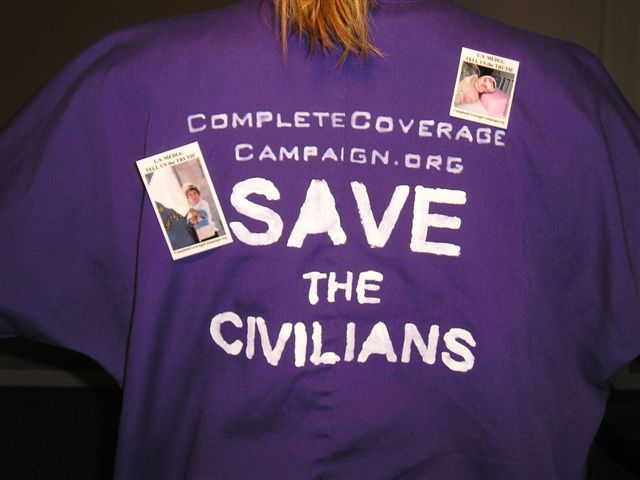
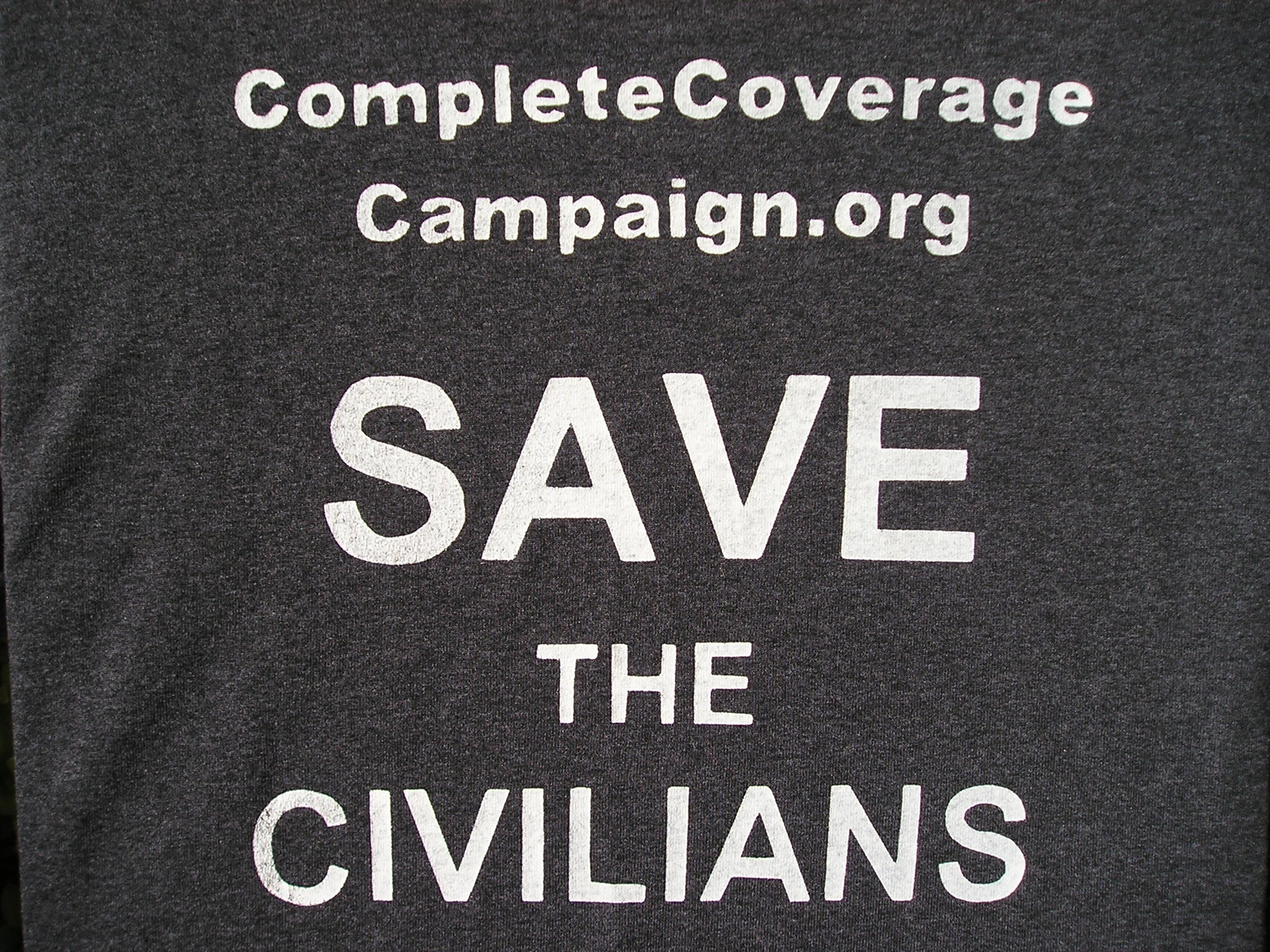
"Save the Civilians" or "Tell Us the Truth" SCRUBS, T-SHIRTS, PINS & MAGNETS
SCRUBS ARE AVAILABLE IN ASSORTED COLORS
T-SHIRTS ARE AVAILABLE IN PURPLE, DARK GRAY & LIGHT GRAY
U.S. Media:
TELL US the TRUTH!
CompleteCoverageCampaign.org
ALL PHOTOS ON THIS SITE
ARE AVAILABLE AS
PINS & MAGNETS