The History of Rhodes Island
| > About
The Colossus of Rhodes > Colossus of Rhodes & New York > History of Rhodes Island > The modern Rhodes Island |
 In
Pindar's ode, the island was said to be born of the union of Helios the
sun god and the nymph Rhode, and the cities were named for their three
sons. The rhoda is a pink hibiscus native to the island.
In
Pindar's ode, the island was said to be born of the union of Helios the
sun god and the nymph Rhode, and the cities were named for their three
sons. The rhoda is a pink hibiscus native to the island.
Invasions by the Persians eventually overran the island, but after their defeat by the forces from Athens in 478 BC, the cities joined the Athenian League. When the Peloponnesian War broke out in 431 BC, Rhodes remained largely neutral although it was still a member of the League. The war lasted until 404 BC, but by this time Rhodes had withdrawn entirely from the conflict and had decided to go her own way.
In 408 BC the cities united to form one territory, and built a new capital on the northern end of the island, the city of Rhodes: its regular plan was superintended by the Athenian architect Hippodamus. However the Peloponnesian War had so weakened the entire Greek culture that it lay open to invasion. In 357 BC the island was conquered by Mausolus of Halicarnassus, then fell to the Persians 340 BC. But their rule was also short and Rhodes became a part of the growing empire of Alexander the Great in 332 BC after he defeated the Persians, to the great relief of the citizens of Rhodes.
 With
the death of Alexander his generals fought for control. Three of them,
Ptolemy, Seleucus, and Antigonus, succeeded in dividing the kingdom among
themselves. Rhodes formed strong commercial and cultural ties with the
Ptolemies in Alexandria, and together they formed the Rhodo-Egyptian alliance
which controlled trade throughout the Aegean in the 3rd century BC. The
city developed into a maritime, commercial and cultural center and its
coins were in circulation almost everywhere in the Mediterranean. Its
famous schools of philosophy and science, literature and rhetoric, shared
masters with Alexandria: the Athenian rhetorician Aeschines who formed
a school at Rhodes; Apollonius of Rhodes, the astronomers Hipparchus and
Geminus, the rhetorician Dionysios Trax. Its school of sculptors developed
a rich, dramatic style that can be characterized as "Hellenistic
Baroque".
With
the death of Alexander his generals fought for control. Three of them,
Ptolemy, Seleucus, and Antigonus, succeeded in dividing the kingdom among
themselves. Rhodes formed strong commercial and cultural ties with the
Ptolemies in Alexandria, and together they formed the Rhodo-Egyptian alliance
which controlled trade throughout the Aegean in the 3rd century BC. The
city developed into a maritime, commercial and cultural center and its
coins were in circulation almost everywhere in the Mediterranean. Its
famous schools of philosophy and science, literature and rhetoric, shared
masters with Alexandria: the Athenian rhetorician Aeschines who formed
a school at Rhodes; Apollonius of Rhodes, the astronomers Hipparchus and
Geminus, the rhetorician Dionysios Trax. Its school of sculptors developed
a rich, dramatic style that can be characterized as "Hellenistic
Baroque".
In 305 BC, Antigonus had his son besiege Rhodes in an attempt to break the alliance. After a year they gave up and signed a peace agreement in 304 BC, leaving behind a huge store of military equipment. The Rhodians sold the equipment and used the money to erect a statue of their sun god, Helios, the statue now known as the Colossus of Rhodes.
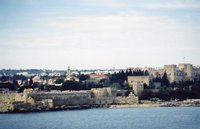
Palace of the (Prince) Grand Master and Rhodes Harbour - Rhodes Photo:G
LarsonIn 164 BC, Rhodes signed a treaty with Rome, and became a major
schooling center for Roman noble families. At first the state was an important
ally of Rome and enjoyed numerous privileges, but these were later lost
in various machinations of Roman politics. Cassius eventually invaded
the island and sacked the city.
 In
the 1st century AD, the Emperor Tiberius spent a brief exile on Rhodes,
and Saint Paul brought Christianity to the island. In 297, the long Byzantine
period began for Rhodes, when the Roman empire was split and the eastern
half became a Greek empire. Although part of Byzantium for the next thousand
years, it was nevertheless repeatedly attacked by various forces. It was
first occupied by Muslim forces of Muawiyah I in 672. Much later Rhodes
was retrieved for the Byzantine Emperor Alexius I Comnenus during the
First Crusade.
In
the 1st century AD, the Emperor Tiberius spent a brief exile on Rhodes,
and Saint Paul brought Christianity to the island. In 297, the long Byzantine
period began for Rhodes, when the Roman empire was split and the eastern
half became a Greek empire. Although part of Byzantium for the next thousand
years, it was nevertheless repeatedly attacked by various forces. It was
first occupied by Muslim forces of Muawiyah I in 672. Much later Rhodes
was retrieved for the Byzantine Emperor Alexius I Comnenus during the
First Crusade.
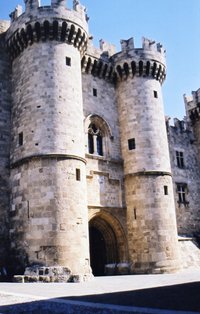
Palace of the (Prince) Grand Master - Rhodes Photo:G LarsonIn 1309 the
Byzantine era came to an end when the island was taken by forces of the
Knights Hospitaller. Under the rule of the newly named Knights of Rhodes,
the city was re-built into a model of the European mediaeval ideal. Many
of the city's famous monuments, including the Palace of the Grand Master,
were built in this period.
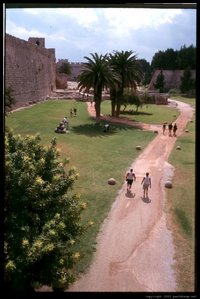
Outside the city walls of RhodesThe strong walls which the Knights had
built withstood the attacks of the Sultan of Egypt in 1444 and of Mehmed
II in 1480. Finally, however, Rhodes fell to the large army of Suleiman
the Magnificent in December 1522. The few remaining Knights were permitted
to retire to Malta, and the island was a possession of the Ottoman Empire
for nearly four centuries.
In 1912, Rhodes was seized from the Turks by the Italians, and in 1947, together with the other islands of the Dodecanese was united with Greece. It thus bypassed many of the events associated with the "exchange of the minorities" between Greece and Turkey.
Throughout much of its history Rhodes had a thriving Jewish Community. From the 1500's on most of this community were Ladino (Judeo-Spanish) speakers. During World War II Nazi Germany occupied the island and deported the Jews. Most ended up dying in various concentration camps. A remnant of the Jewish community survives in Rhodes. The Rhodes Jewish Museum (http://www.rhodesjewishmuseum.org/) maintains a history of this unique community. Descendants of the "Rhodeslies" now have communities in various communities in the US, Europe and Africa.
© 2004 - Dimitris Liarelis