Updated: January 23, 2008
Thermal Surface Displacement of an
Si Nanoparticle in an SiO2 Matrix


The thermal motion of the surface of a spherical Si nanoparticle embedded in a SiO2 matrix is calculated, and compared to experimental measurements of low frequency polarized and depolarized Raman scattering.

   Features of the low frequency Raman spectrum of metal (Ag, Au) and semiconductor (Si, CdS, CdSe) nanoparticles embedded in a solid glass matrix are qualitatively explained in terms of the free vibration spectrum of an isolated elastic sphere. In particular, the frequencies vary as (1/d) where d is the nanoparticle diameter. However, a number of experiments give Raman peak locations that are lower than the predicted free vibration frequencies. Some earlier calculations have incorporated the elastic properties of the matrix, but these have usually calculated the frequency and the damping, but have not provided the shape of the Raman spectrum.
   Details of the calculation are reported elsewhere. Here is a summary: The system under consideration is a single nanosphere of Si embedded in an infinite SiO2 glass matrix. Raman scattering detects fluctuations in the polarizability tensor. It is assumed here that these fluctuations are as a result of bulk thermal vibrations of the system. Ignoring quantum corrections, every phonon mode should have the same average energy (kBT). Assuming a temperature of 300 K, this energy is kBT = 4×10-21 J. The quantum spacing between levels of a phonon mode is hf, where h is Planck's constant and f is the frequency of the mode. The average occupation number of a phonon mode is approximately kBT / (hf). For a phonon of frequency 20 cm-1, this is 10, which is large enough for the mode to be treated classically.
   The incoming amplitude of the wave, A, at frequency ω has been calculated based on this (md30.htm).
   The boundary value problem is then solved (using Borland Turbo C++ programs scp78.c, scp79.c, scp80.c) to get the amplitude of the vibration inside the sphere. There are two amplitudes inside the sphere for the case of spheroidal vibrations: B and C. Otherwise there is a single amplitude inside the sphere, B. These amplitudes are complex numbers. What is plotted is the displacement of the surface of the nanoparticle. This displacement has r, θ and φ components, plotted in different colors in the figures below. The angular dependence of the displacement is not shown.
   This same approach has also been applied to the cases of CdS nanoparticles in a GeO2 matrix and Cd(S,Se) nanoparticles in a glass matrix.
   A separate problem which I do not address here is how to calculate the actual Raman spectrum. This is not straightforward since the polarizability of the nanoparticle will change as the nanoparticle vibrates, but it is not clear quantitatively how much.
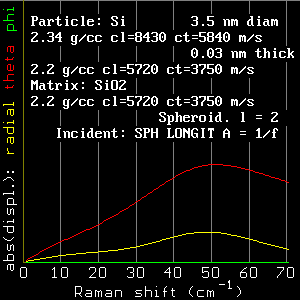
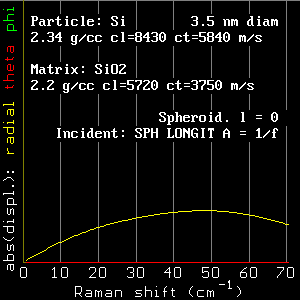
   The same vertical scale is used in all of these figures.

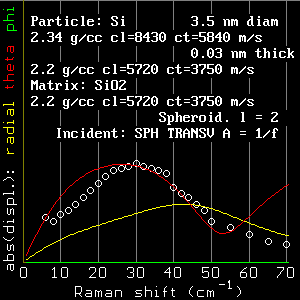
Figure 1.   l = 2 spheroidal mode
The incident amplitudes A calculated in md30.htm were used. (Compare this to figure 2 in md26.htm, where the same plot is made, except that the amplitude A was simply assumed to be 1.)
(a) The incident wave is transverse spheroidal with amplitude A, where
A2 =    dω kBT (2 l + 1)
-----------------------
l(l+1) π2 ρm ctm ω2
Grey circles are representative polarized Raman spectrum data points from FIG. 2(a) in Fujii et al. Phys. Rev. B 54, (1996) 8373-8376, vertically rescaled for best fit with the red line.
(scp78.c, scp78b.c, 31a.gif)
(b) The incident wave is longitudinal spheroidal with amplitude A where
A2 = dω kBT (2 l + 1)
-------------------
 π2 ρm clm ω2
(scp78.c 31b.gif)

Figure 2.   l = 0 spheroidal      ("breathing")
The incident wave is longitudinal spheroidal with amplitude A where
A2 = dω kBT (2 l + 1)
-------------------
 π2 ρm clm ω2
(scp79.c 31c.gif)

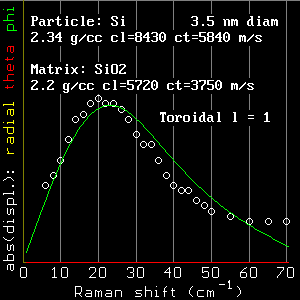
Figure 3.   l = 1 torsional      (Rigid rotational oscillation)
The incident wave is transverse (torsional) with amplitude A where
A2 = dω kBT (2 l + 1)
-------------------
l(l+1) π2 μm ctm
Grey circles are representative depolarized Raman spectrum data points from FIG. 2(b) in Fujii et al. Phys. Rev. B 54, (1996) 8373-8376, vertically rescaled for best fit with the green line.
(scp80.c, scp80b.c, 31d.gif)
What is being plotted?    The displacement field is u(r,t),
with components ur, uθ and uφ.
For l = 1 torsional modes:
ur = uθ = 0.
uφ = eiωt f(r) sin(θ)
where f(r) is a complex valued function. The green curve at left is
||f(Rp)|| where Rp is the radius of the nanoparticle.

   The material parameters, choice of scale and axis labelling for the above figures are modelled on plots from experimental data shown in FIG. 2 (a) and (b) in "Raman scattering from acoustic phonons in Si nanocrystals" by M. Fujii, Y. Kanzawa, S. Hayashi and K. Yamamoto, Phys. Rev. B vol. 54, pages 8373-8376 (1996). In particular, the Raman shift scale is the same. That article considers samples of various diameters, and one sample is of diameter 3.5 nm. The Raman measurements were carried out at room temperature [page 8373]. Figures 1(a) above does show a peak around 30 cm-1, and this is also the case in the Fujii et al. paper. I also note that FIG. 2(b) in the Fujii paper shows a peak in the depolarized Raman spectrum for the 3.5 nm diameter particles at around 22 cm-1. The above figure 3 has a peak at 23 cm-1. The torsional l = 1 mode would not ideally be expected to be Raman active. However if the nanoparticles are non-spherical in shape then it could be important. Figure 2 shows the l = 0 amplitude, and this does not show much peaking behavior.
   The widths of the theoretical peaks and to some extent even the shapes are similar to the experimental data. It should be noted that the experiment is done with a sample with a distribution of particle sizes. The theoretical results suggest that the Raman spectrum would be essentially the same even if an experimental sample could be made with all particles the same size.
   The assumed density and longitudinal and transverse speeds of sound for the Si and the SiO2 are as shown in the figures. In these calculations, the Si is assumed to have isotropic elasticity. But in real silicon, the speed of sound depends on the direction of propagation. The speeds along the [100] crystal direction have been used here.


Daniel Murray
Associate Professor
Math, Stats & Physics Unit
University of British Columbia - Okanagan
Kelowna, BC, Canada
daniel "dot" murray "at" ubc "dot" ca

For a list of related articles click here.


"Microscopic calculations on Raman scattering from acoustic phonons confined in Si nanocrystals" Jian Zi, Kaiming Zhang, Xide Xie Phys. Rev. B, Aug. 15, 1998 arXiv:cond-mat/9807293 v1 22 Jul 1998 arxiv.org/pdf/cond-mat/9807293 - c:\cofrest\9807293.pdf [email protected] http://www.fudan.edu.cn/index_ch.php
Ding Haojiang and Chen Weiqiu, "Nonaxisymmetric free vibrations of a spherically isotropic spherical shell embedded in an elastic medium"
Int. J. Solids Structures Vol. 33, No. 18, pp. 2575-2590, 1996 ::
M. Montagna and R. Dusi, "Raman scattering from small spherical particles" Phys. Rev. B 52, 10080 (1995) - about matrix effect, small influences.
"Raman scattering from fractals. Simulation on large structures by the method of moments" G.Viliani, R.Dell'Anna, O.Pilla, M.Montagna, G.Ruoco, G.Signorelli, V.Mazzacurati http://arxiv.org/pdf/cond-mat/9504039 ::
Transverse acoustic nature of the excess of vibrational states in vitreous silica http://arxiv.org/pdf/cond-mat/0209519 ::
Lingjun Wang, Guanghong Wei, Jian Zi "A planar force-constant model for phonons in wurtzite GaN and AlN: Application to hexagonal GaN/AlN superlattices" http://arxiv.org/pdf/cond-mat/9812293 ::
Raman scattering by electron-hole excitations in silver nanocrystals Authors: H. Portales, E. Duval, L. Saviot, M. Fujii, M. Sumitomo, S. Hayashi To be pub.in PRB cond-mat/0101471 http://arxiv.org/pdf/cond-mat/0101471 :: "Phonons in a nanoparticle mechanically connected to a substrate" K. Patton and M. Geller (Dec. 30, 2002 version) :: V. L. Gurevich and H. R. Schober, Phys. Rev. B 57, 11295 (1998).
Hosted by www.Geocities.ws

1