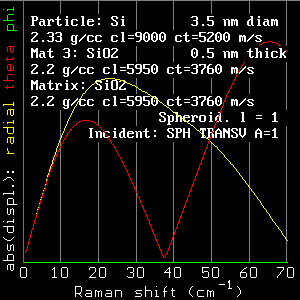
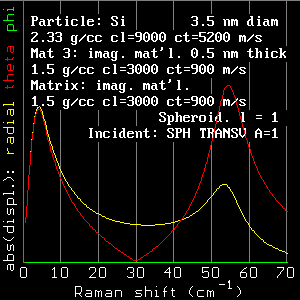
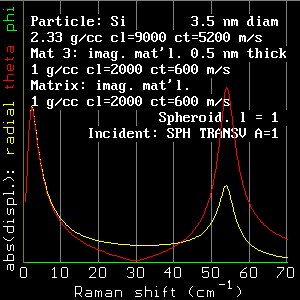
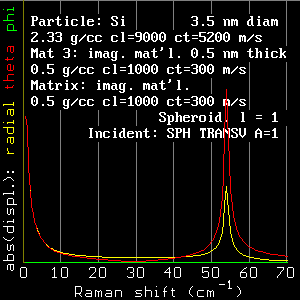
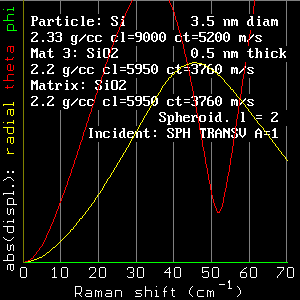
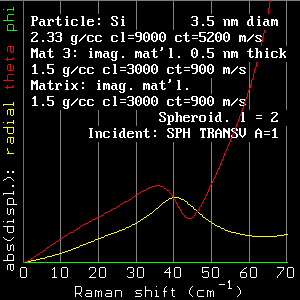
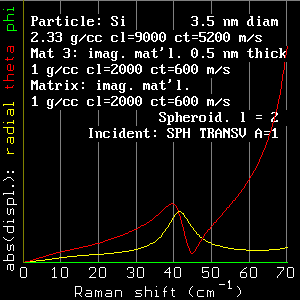
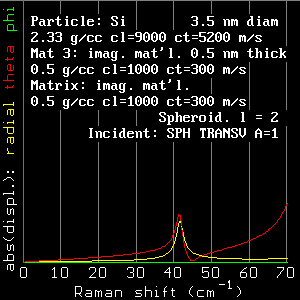
In this calculation, the amplitude, A, of the incident ingoing wave
is assumed to be 1, and independent of frequency. I assume these ingoing waves
arise from thermal excitation of each phonon mode with energy kBT.
When the variation of density of states is taken into account, A should actually
vary with frequency.
The wave inside the nanoparticle has (complex valued) amplitudes
B and C corresponding to the ∇ Φ term and the
∇ × ∇ × (r Φ)
term (not necessarily respectively). In either case, the scalar function Φ(r,θ)
is of the form jl(k r)Pl(cos(θ)).
The displacement field u has components
ur, uθ and uφ. Based on
B and C, this field is evaluated at the surface of the nanosphere. The θ
dependence is factored out. The three absolute values of these components
are plotted in the figures below. The φ component (the flat green line) is always zero for spheroidal
modes.
.....
Figure 1: 3.5 nm diameter Si nanosphere in SiO2 matrix
(C++ listing: scp70k3.c)
(a)
(b)
(c)
(d)
Figure 2: 3.5 nm diameter Si nanosphere in SiO2 matrix
(C++ listing: scp70k3.c)
(a)
(b)
(c)
(d)
My speculation right now is that the r component of u
is more important to Raman scattering. However, justifying this guess
requires a better understanding of what causes the polarizability tensor of
the nanoparticle to vary as it shakes.
Daniel Murray
Associate Professor
Math, Stats & Physics Unit
University of British Columbia - Okanagan
Kelowna, BC, Canada
daniel "dot" murray "at" ubc "dot" ca