Updated: January 23, 2008
Thermal Surface Displacement of a
Cd(S,Se) Nanoparticle in an Glass Matrix


The thermal motion of the surface of spherical CdS and CdSe nanoparticles embedded in a SiO2 matrix is calculated, and compared to experimental measurements of low frequency inelastic Raman scattering off CdS0.4Se0.6 nanoparticles in a glass (SiO2+K2O+ZnO) matrix. Raman scattering seems to be primarily associated with the l = 0 "breathing" vibrational mode.

   Features of the low frequency Raman spectrum of metal (Ag, Au) and semiconductor (Si, CdS, CdSe) nanoparticles embedded in a solid glass matrix are qualitatively explained in terms of the free vibration spectrum of an isolated elastic sphere. In particular, the frequencies vary as (1/d) where d is the nanoparticle diameter. However, a number of experiments give Raman peak locations that are lower than the predicted free vibration frequencies. Some earlier calculations have incorporated the elastic properties of the matrix, but these have usually calculated the frequency and the damping, but have not provided the shape of the Raman spectrum.
   One experiment is reported in B. Champagnon, B. Andrianasolo, A. Ramos, M. Gandais, M. Allais, J. Benoit, "Size of Cd(S,Se) quantum dots in glasses: Correlation between measurements by high-resolution transmission electron microscopy, small-angle x-ray scattering, and low-frequency inelastic Raman scattering" J. Appl. Phys. vol. 73, no. 6, (1993) pages 2775-2780. They say, "For a long time these materials have been used as sharp cut-off optical filters with the absorption edge varying from 530 to 715 nm as the composition of the semiconductor phase varies from CdS to CdSe." The glass they made is similar to commercially available (red) type RG630 optical filter glass (approximate composition: SiO2 46%, K2O 20%, ZnO 21%, TiO2 6%, B2O 4%, by weight of each oxide).

Table I.   Composition of glass in experiment
compoundname(s)weight
fraction
density
(g/cc)
SiO2quartz, silica 46% 2.65 (ref)
2.27 (ref)
K2Opotash 20% 2.35 (ref)
ZnOzincite 21% 5.4-5.7(ref)
5.6 (ref)
TiO2rutile, anatase, brookite 6% 4.2 (ref)
4.26 (ref)
3.9-4.2 (ref)
B2O3boron sesquioxide 4% 2.46 (ref)
2.55 (ref

   The density of standard commercially available RG630 glass is 2.76 g/cc (Schott glass property data sheets ::). I was unable to find any information about the elastic properties of RG630 glass, but Table II below provides general information on various types of glass. In the absence of other information, I assumed that the speed of sound in RG630 glass is the same as in SiO2 glass.

Table II.    Properties of Some Types of Glass
glass typedensitylongitudinal
sound speed
transverse
sound speed
 ρm clmctm
RG630 2.76 g/cc????
96% silica glass2.18 g/cc5852 m/s3620 m/s
fused quartz2.2 g/cc5848 m/s3687 m/s
pyrex glass2.3 g/cc5636 m/s3296 m/s
SiO22.2 g/cc5720 m/s3750 m/s

   Details of the calculation are reported elsewhere. Here is a summary: The system under consideration is a single nanosphere of either CdS or CdSe embedded in an infinite SiO2 glass matrix. Raman scattering detects fluctuations in the polarizability tensor. It is assumed here that these fluctuations are as a result of bulk thermal vibrations of the system. Ignoring quantum corrections, every phonon mode should have the same average energy (kBT). Assuming a temperature of 300 K, this energy is kBT = 4×10-21 J. The quantum spacing between levels of a phonon mode is hf, where h is Planck's constant and f is the frequency of the mode. The average occupation number of a phonon mode is approximately kBT / (hf). For a phonon of frequency 20 cm-1, this is 10, which is large enough for the mode to be treated classically.
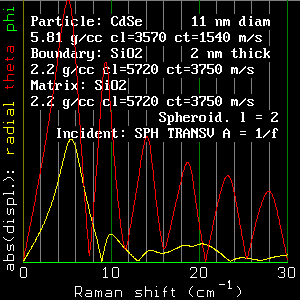
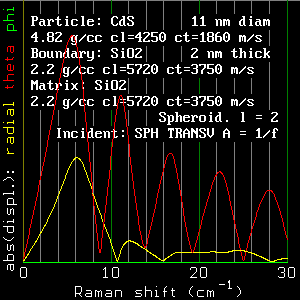
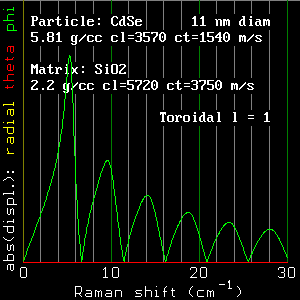
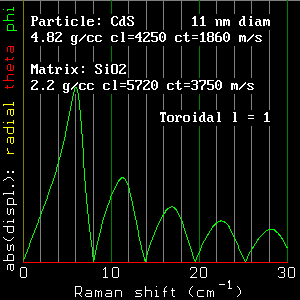
   The elastic vibration boundary value problem is then solved (using Borland Turbo C++ programs scp78e.c, scp79e.c, scp80e.c) to get the amplitude of the vibration inside the sphere. There are two amplitudes inside the sphere for the case of spheroidal vibrations: B and C. Otherwise there is a single amplitude inside the sphere, B. These amplitudes are complex numbers. What is plotted is the displacement of the surface of the nanoparticle. This displacement has r, θ and φ components, plotted in different colors in the figures below. The angular dependence of the displacement is not shown.
   This same approach has also been applied to the cases of Si nanoparticles in a SiO2 matrix and CdS nanoparticles in a GeO2 matrix.
   Champagnon et al. used three different samples, A, B and C with differing particle sizes. I have made comparison only with sample B, and I made my calculations only for particle diameter 11 nm. In their Table I, they give the diameter of sample B from small angle x-ray scattering (SAXS) as 11.0 nm. However, high resolution transmission electron microscopy (HRTEM) gave an "effective size" of 8.8 nm. The experimental data was taken for both positive and negative Raman shifts, but only the positive shift data is shown here.
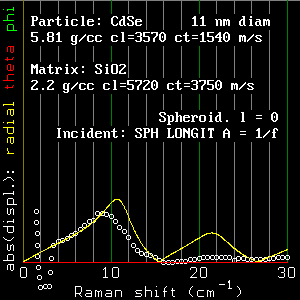
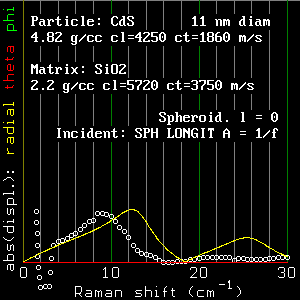
   The same vertical scale is used in all of these figures.

Figure 1(a).   l = 0 spheroidal      ("breathing")    silica or quartz glass matrix
The yellow curve is the radial surface displacement of a nanoparticle
(left: CdSe, right: CdS)
as a function of frequency.

Grey circles are representative Raman spectrum data points from FIG. 4 in Champagnon et al. J. Appl. Phys. 73, (1993) 2775-2780, vertically rescaled for best fit with the yellow line.
(scp79e.c 33c.gif 33g.gif)
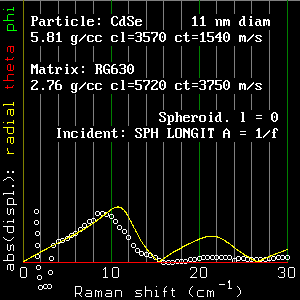
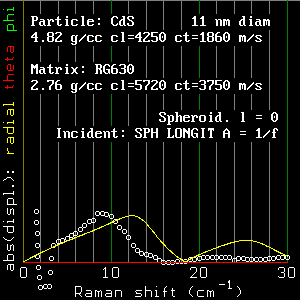
   Even though the speed of sound in RG630 is not known, it is at least known that the density of RG630 is significantly higher than in SiO2. (I believe this is because of the addition of denser ZnO). Therefore, I repeated the calculation using the density of RG630 to see if it made any difference. Looking at Figure 1(b) below, it turns out that it makes hardly any noticeable difference.

Figure 1(b).   l = 0 spheroidal      ("breathing")     type RG630 glass matrix
The yellow curve is the radial surface displacement of a nanoparticle
(left: CdSe, right: CdS)
as a function of frequency.

Grey circles are representative Raman spectrum data points from FIG. 4 in Champagnon et al. J. Appl. Phys. 73, (1993) 2775-2780, vertically rescaled for best fit with the yellow line.
(scp79e.c 33i.gif 33j.gif)

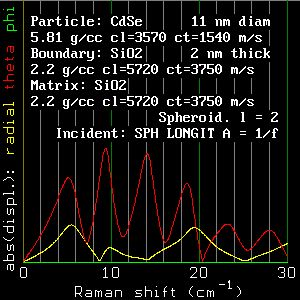
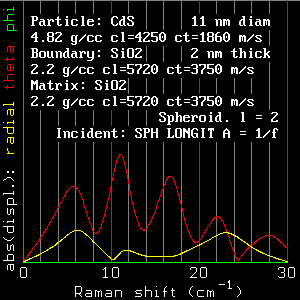
Figure 2.   l = 2 spheroidal mode     ("football mode")
(a) (scp78e.c, 33a.gif, 33e.gif)
(b) (scp78e.c 33b.gif 33f.gif)

Figure 3.   l = 1 torsional      (Rigid rotational oscillation)
(scp80ed.c 33d.gif 33h.gif)

   There is a striking similarity between the l = 0 "breathing mode" amplitude and the Raman scattering amplitude. Why this might be, I don't know. The other vibrational modes have larger surface displacements, yet their large peaks do not seem to correspond to any features in the experimental Raman spectrum. Symmetry arguments [Eugene Duval, Phys. Rev. B 46 (1992), pp. 5795-5797] say that free spheres should only be Raman active for the l = 0 and l = 2 spheroidal modes. For nonspherical nanoparticles in a matrix, odd l torsional modes can also be Raman active [N. N. Ovsyuk and V. N. Novikov, Phys. Rev. B 53 (1996) pages 3113-3118]. However, these symmetry arguments cannot predict the relative scattering ability of vibrational modes of different types.
   One possibility is that Raman scattering is stronger for the l = 0 mode because the "breathing mode" is associated with fluctuations in material density, while all the other modes are primarily waves associated with shear stress and strain, but rather small changes in density. Raman scattering is associated with time variation of the polarizability of the sample. The polarizability of the nanoparticle depends in an essential way on the motions of the electrons within, and possibly outside as well. I don't know anything at this point that allows me to attempt more detailed calculations of the Raman scattering amplitudes that would help to explain what the above figures show.
   The foregoing calculation does not include the effect of phonon dispersion. The speed of sound in crystalline materials decreases at higher frequencies. Figure 1 shows that the experimental Raman peak is slightly lower than the theoretically predicted ones. Part of the reason for this could be phonon dispersion.
   Other factors not included in this calculation are: (1) anisotropy of the elasticity of the Cd(S,Se) nanocrystals; (2) non-spherical shape of the nanocrystals; (3) elastic character of the interface between the nanocrystals and the glass.


Daniel Murray
Associate Professor
Math, Stats & Physics Unit
University of British Columbia - Okanagan
Kelowna, BC, Canada
daniel "dot" murray "at" ubc "dot" ca

For a list of related articles click here.


"Microscopic calculations on Raman scattering from acoustic phonons confined in Si nanocrystals" Jian Zi, Kaiming Zhang, Xide Xie Phys. Rev. B, Aug. 15, 1998 arXiv:cond-mat/9807293 v1 22 Jul 1998 arxiv.org/pdf/cond-mat/9807293 - c:\cofrest\9807293.pdf [email protected] http://www.fudan.edu.cn/index_ch.php
Ding Haojiang and Chen Weiqiu, "Nonaxisymmetric free vibrations of a spherically isotropic spherical shell embedded in an elastic medium"
Int. J. Solids Structures Vol. 33, No. 18, pp. 2575-2590, 1996 ::
M. Montagna and R. Dusi, "Raman scattering from small spherical particles" Phys. Rev. B 52, 10080 (1995) - about matrix effect, small influences.
"Raman scattering from fractals. Simulation on large structures by the method of moments" G.Viliani, R.Dell'Anna, O.Pilla, M.Montagna, G.Ruoco, G.Signorelli, V.Mazzacurati http://arxiv.org/pdf/cond-mat/9504039 ::
Transverse acoustic nature of the excess of vibrational states in vitreous silica http://arxiv.org/pdf/cond-mat/0209519 ::
Lingjun Wang, Guanghong Wei, Jian Zi "A planar force-constant model for phonons in wurtzite GaN and AlN: Application to hexagonal GaN/AlN superlattices" http://arxiv.org/pdf/cond-mat/9812293 ::
Raman scattering by electron-hole excitations in silver nanocrystals Authors: H. Portales, E. Duval, L. Saviot, M. Fujii, M. Sumitomo, S. Hayashi To be pub.in PRB cond-mat/0101471 http://arxiv.org/pdf/cond-mat/0101471 :: "Phonons in a nanoparticle mechanically connected to a substrate" K. Patton and M. Geller (Dec. 30, 2002 version) ::
V. L. Gurevich and H. R. Schober, Phys. Rev. B 57, 11295 (1998).
M. Pauthe, E. Bernstein, J. Dumas, L. Saviot, A. Pradel, M. Ribes, "Preparation and characterisation of Si nanocrystallites embedded in a silica matrix" J. Mater. Chem. vol. 9 (1999) pages 187-191. ("Journal of Materials Chemistry") www.rsc.org :: (Email: [email protected])
C. Voisin, D. Christofilos, N. Del Fatti and F. Vallée "Environment effect on the acoustic vibration of metal nanoparticles Physica B vol. 316-317 (2002) pages 89-94.
(email: [email protected]) "The impact of the environment on the frequency and damping of the breathing acoustic mode of noble metal nanoparticle is discussed using the model of isotropic homogeneous elastic spheres embedded in an elastic medium." (I have a hard copy of this)
The Clausius-Mossotti relation:
(deps/drho)= (eps-1)(eps+2)/(3rho) --- rho = mass density, eps = permittivity ph.utexas.edu
r-1)/(εr+2) = (n α)/(3 ε0)
where n is number of atoms per cubic metre.   [I suspect this is correct in SI units]
ref
AC Electrokinetics: Applications for Nanotechnology ref
r-1)/(εr+2) = NαE/(3 ε0) xxx
Lorenz-Lorenz equation
n2-1
---------
n2+2
= N α
--------
3 ε0V
http://chsfpc5.chem.ncsu.edu/CH795Z/lecture/lecture10/dielectric_polarization.html Vibrational Spectroscopies of Surfaces and Interfaces
asdf ::
P. Melman and R. W. Davies Application of the Clausius-Mossotti equation to dispersion calculations in optical fibers Journal of Lightwave Technology vol 3 1985 page 1123 http://www.cparity.com/leos/archives/journals/ieee/leos/jlt/1985003/1985_05.htm
"Strain-induced three-photon effects" J. Jeong, S. Shin, I. Lyubchanskii and V. Varyukhin Phys. Rev. B vol. 62, no. 20 (2000) xcfsf ::
Hosted by www.Geocities.ws

1