matom ω2 = Σ ((nx)2/((nx)2+(ny)2+(nz)2) ksp.. (0.5)(nxkx a)2
The speed of the waves is sqrt(C11/ρ) = ω/kx. Thus, C11 = ρ (ω/kx)2. Recall also that ρ = matom a-3. Finally, C11 is obtained by summing over all neighbours the expression
C11 = Σ (ksp../(2a)) ((nx)4 /((nx)2+(ny)2+(nz)2)
Considering up to fifth neighbours,
Step 3. Consider a transverse wave moving in the [100] direction. The speed (phase velocity) of the wave is sqrt(C44/ρ). The wavelength of the wave is λ = 2 π / kx, where kx is the wavevector. uy(nx,ny,nz) is the y displacement of the atom whose lattice position is (nx,ny,nz). All x and z displacements are zero.
uy(nx,ny,nz) = uy(0,0,0) exp(i nx kx a )
F(0,0,0,nx,ny,nz) is the magnitude of the force on atom (0,0,0) from atom (nx,ny,nz).
F(0,0,0,nx,ny,nz) = ksp.. ( r - a sqrt((nx)2+(ny)2+(nz)2) )
and
r = sqrt( x2 +y2 +z2 )
x = nx a
y = ny a + uy(nx,ny,nz) - uy(0,0,0)
z = nz a
Fy(0,0,0,nx,ny,nz) is the y component of the force on (0,0,0) from (nx,ny,nz).
Fy(0,0,0,nx,ny,nz) = (y/r) F(0,0,0,nx,ny,nz)
To linear order in uy(0,0,0),
Fy(0,0,0,nx,ny,nz) = [(ny)2/((nx)2+(ny)2+(nz)2)] ksp.. (exp(i nxkx a) - 1 ) uy(0,0,0)
The next step is to expand the complex exponential exp(i nxkx a). To linear order it is i nxkx a. Because of the mirror symmetry of the lattice, this will add up to zero when all neighbours are summed over. The lowest nonvanishing term is -(1/2)(nxkx a)
matom ω2 = Σ (ny)2/((nx)2+(ny)2+(nz)2) ksp.. (0.5)(nxkx a)2
The speed of the waves is sqrt(C44/ρ) = ω/kx. Thus, C44 = ρ (ω/kx)2. Recall also that ρ = matom a-3. Finally, C44 is obtained by summing over all neighbours the expression
C44 = Σ (ksp../(2a)) (nx)2(ny)2 /((nx)2+(ny)2+(nz)2)
Considering up to fifth neighbours,
Couplings Beyond Second Neighbours:
Combining previous results,
In other words, C12 and C44 are always exactly the same, no matter what values of the spring constants are chosen. This equivalence has been verified numerically up to tenth neighbours.
First and Second Neighbour Model:
Incorporation of springs connecting higher order nearest neighbours has two practical disadantages. First, there is a larger number of interactions that must be calculated, which will have a cost for calculation time. Storage space will be strained since larger lookup tables must be maintained. Second, since the distance over which the interaction is non-local is larger if more neighbours are considered, it would be expected that the continuum limit would be approached more slowly.
It is thus desirable to test the lattice calculation in the situation in which it can be expected to perform the best, and that is when only first and second neighbour interactions are kept. In this situation,
| a (C11+2 C12) = | ksp1 | + | 4 ksp2 |
Combining these, it turns out that C12 = C44. Even if more distant neighbour interations are included this still remains the case. Therefore, there is no value in including springs beyond second neighbours. Analytical solutions for a sphere are available for an isotropic elastic medium, for which C12 = C11 - 2 C44. Combining these conditions, the result is that 3 C44 = C11. This corresponds to an isotropic elastic material whose Poisson ratio is exactly 0.25. Thus, the model can do two things: (1) It can simulate an isotropic material with Poisson ratio 0.25; (2) It can simulate a cubic crystal for which C12 = C44. A number of materials do have Poisson ratio close to 0.25 such as some iron alloys, Cerium (0.248), Yttrium (0.243), Gadolinium (0.259), Iridium (0.26), Lutetium (0.261) and Silicon Carbide (0.24). There are also some cubic crystals with C12 close to C44 such as NaCl, CsBr, RbI and RbBr.
Comparison With Exact Analytic Solution:
The classic problem of the vibrational modes of an isotropic elastic sphere has been extensively studied. [Lamb 1882] [Love 1944] [Sato and Usami 1962] [Auld 1973] [Nishiguchi and Sakuma 1981] [Bastrukov 1994] [Graff 1994] [Bastrukov et al. 1998] [McDaniel and Holt 2000 pdf ::] [Ye 2000 pdf] [Patton and Geller 2001 pdf ::]. This problem finds diverse application in geophysics [geophysics introduction], seismology [simple introduction to earthquake waves], solid stars [Bastrukov 1996], silicon nanoparticles [Patton and Geller 2001 pdf ::] and aqueous foam spheres [McDaniel and Holt 2000 pdf ::], and an accurate list of the exact frequencies has recently been reported [Murray 2002].
Consider a freely suspended isotropic elastic sphere not subject to body forces. The sphere has radius R, uniform density ρ, shear modulus μ and Poisson ratio ν. These parameters fully describe the problem. If the sphere is disturbed, it will begin to vibrate. A given eigenfunction has frequency ω (in radians per second). The speed of transverse waves (shear waves) is
It is convenient to express normal mode frequencies in terms of the dimensionless variable
Modes are of two types: spheroidal and torsional. In spheroidal modes, the velocity field is of the form
| u(r,θ,φ,t) exp(-i η Cs t / R ) = | An ∇ | [ | j(n, kl r ) P(n,cos(θ)) | ] |
| + Bn ∇× ∇× | [ | r j(n, ks r ) P(n,cos(θ)) | ] |
where r is the position vector, j(n,x) are spherical Bessel functions of the first kind and P(n,x) are Legendre polynomials. The ratio Bn/An must be chosen so as to satisfy the boundary conditions [Murray 2000].
The expression for the displacement field u for torsional modes is
| u(x,y,z,t) exp(-i η Cs t / R ) = | Cn ∇× | [ | (x,y,z) j(n, ks r ) P(n,cos(θ)) | ] |
If the velocities of the atoms became too large, the forces would become nonlinear. Since we are interested in linear elastic behavior, the velocities of the atoms are kept small enough that the forces are linear. Normally, in these simulation, the peak speed of an atom is on the order of 1x10⁻⁵ Cs. If the speed is made too small, there are numerical precision problems.
The sharpness of the Fourier spectrum peaks depends on the amount of time over which the integrations are made.
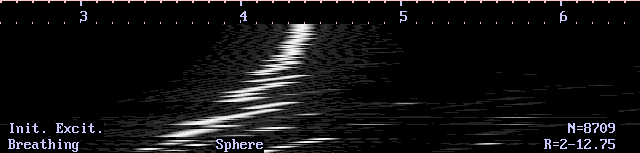
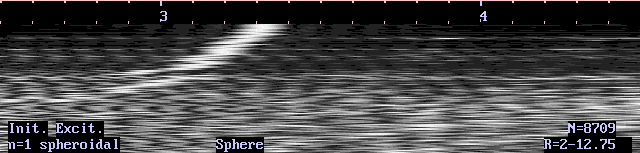
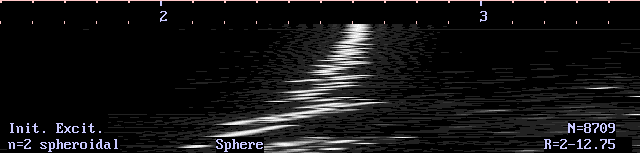
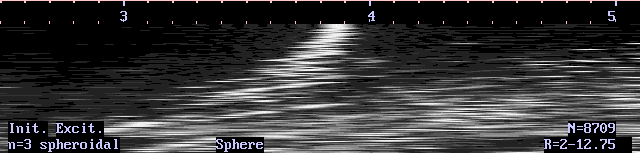
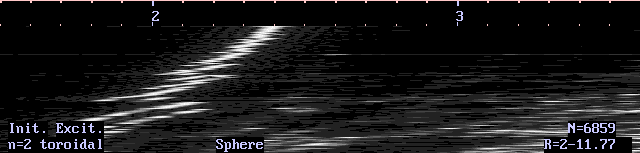
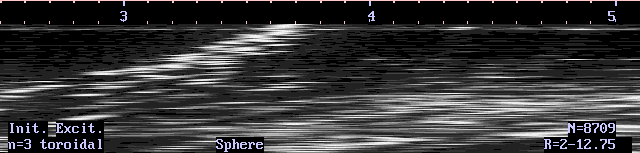
| Figure 1. Dimensionless frequency parameter η for vibrational modes of a cubic crystal sphere are shown. The vertical axis is the reciprocal of the sphere's radius. The upper edge of the chart (above the black band) corresponds to infinite R. The bottom edge of the chart corresponds to R=2. The maximum R and maximum number of atoms used are plotted at the lower right. (cc2mod.cpp cc2sph0.gif cc2sph1.gif cc2sph2.gif cc2sph3.gif cc2tor2.gif cc2tor3.gif) |
 |
 |
 |
 |
 |
 |
| Table III: Test of Lattice Calculation | ||||
| Type | l | η (simul.) | η (exact) | % diff. |
| sph | 0 | 4.45 | 4.440 | 0.2% |
| sph | 1 | 3.43 | 3.425 | 0.1% |
| sph | 2 | 2.64 | 2.640 | 0% |
| sph | 3 | 3.95 | 3.917 | 0.8% |
| tor | 2 | 2.50 | 2.502 | -0.1% |
| tor | 3 | 3.87 | 3.865 | 0.1% |
The values of η from the simulations as shown in Table III were obtained by simple interpolation of Figures 1(a-f). The results in Table III show that the lattice calculation is able to accurately calculate the vibrational frequencies of an isotropic elastic sphere. This provides an independent check on the analysis as well as on the correctness of the computer program. The rapidity of the convergence as N increases demonstrates that reasonably accurate frequencies could have been obtained even if the simulation been limited to a much smaller number of atoms.
Vibrational Frequencies of Salt Spheres:
The requirement that C12 = C44 restricts the applicability of the simulations. Table IV shows elastic constants of some salt crystals at 300K or room temperature.
| Table IV. Elastic Constants of Selected Cubic Crystals Source: Ashcroft & Mermin "Solid State Physics" Table 22.2 page 447 C. Kittel "Introduction to Solid State Physics" Table 3, page 150 | ||||
| Substance | C11 | C12 | C44 | C12 -C44 |
| (GPa) | (GPa) | (GPa) | (%) | |
| NaCl | 48.7 | 12.4 | 12.6 | -1.6% |
| CsBr | 30.0 | 7.8 | 7.6 | 2.6% |
| RbI | 25.6 | 3.1 | 2.9 | 6.7% |
| GaSb | 88.5 | 40.4 | 43.3 | -7.0% |
| RbBr | 31.7 | 4.2 | 3.9 | 7.3% |
| LiCl | 49.4 | 22.8 | 24.6 | -7.6% |
| CsI | 24.6 | 6.7 | 6.2 | 7.8% |
| Ni | 245 | 140 | 125 | 11.3% |
| Fe | 234 | 136 | 118 | 14.2% |
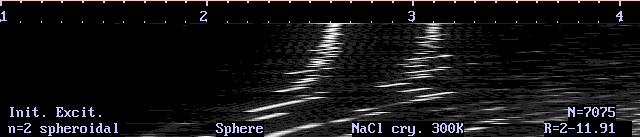
In order to make an approximate calculation of the vibrational frequencies, I use the average of C12 and C44. The results are shown in Figures 2, 3 and 4.
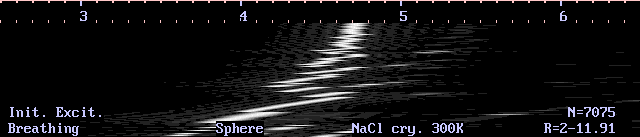
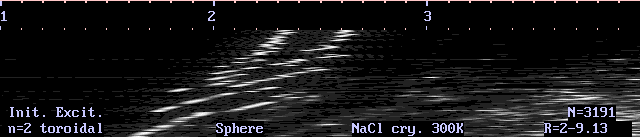
| Figure 2. Dimensionless frequency parameter η for vibrational modes of a sphere of Sodium Chloride (NaCl) are shown. The vertical axis is the reciprocal of the sphere's radius. The upper edge of the chart (above the black band) corresponds to infinite R. The bottom edge of the chart corresponds to R=2. The maximum R and maximum number of atoms used are plotted at the lower right. (cc2mod.cpp cc2nacl1.gif cc2nacl2.gif cc2nacl3.gif cc2nacl4.gif) |
 |
 |
 |
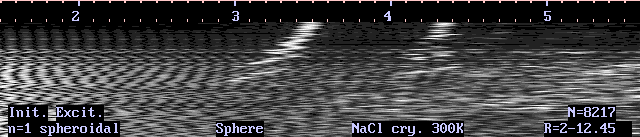 |
For NaCl at 300 K Cs[100] = 2410 m/s. The lowest few values of η are 2.48, 2.64, 2.74, 3.12, 3.60 and its breathing mode is at 4.77. For example, for a NaCl sphere of diameter 30 nm, the frequency of the lowest vibrational mode is ω = (2.48)(2410 m/s)/(1.5e- m) = 3.983e11 rad/s, or 6.34e10 Hz or 2.11 cm-1.
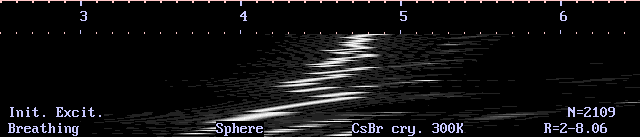
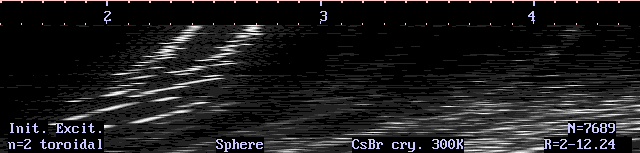
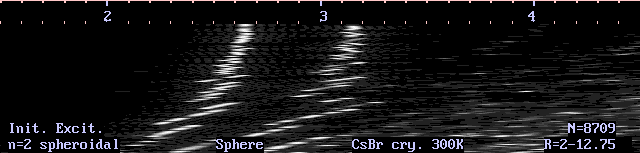
| Figure 3. Dimensionless frequency parameter η for vibrational modes of a sphere of Cesium Bromide (CsBr) are shown. The vertical axis is the reciprocal of the sphere's radius. The upper edge of the chart (above the black band) corresponds to infinite R. The bottom edge of the chart corresponds to R=2. The maximum R and maximum number of atoms used are plotted at the lower right. (cc2mod.cpp cc2csbr1.gif cc2csbr2.gif cc2csbr3.gif cc2csbr4.gif) |
 |
 |
 |
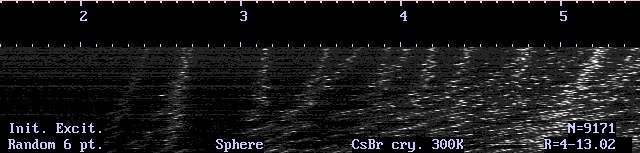 |
For CsBr at 300 K Cs[100] = 1310 m/s. The lowest few values of η are 2.54, 2.67, 2.80 and 3.17. The breathing mode is at η = 4.79. For a 30 nm diameter sphere of CsBr, the frequency of the lowest vibrational mode is 1.18 cm-1.
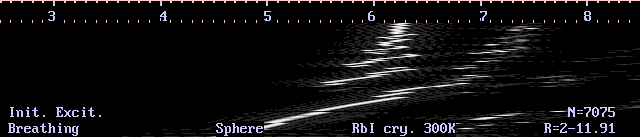
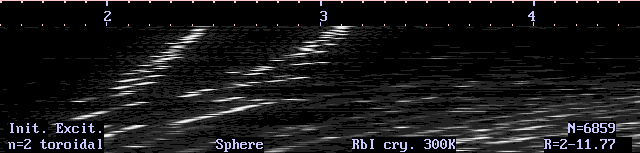
| Figure 4. Dimensionless frequency parameter η for vibrational modes of a sphere of Rubidium Iodide (RbI) are shown. The vertical axis is the reciprocal of the sphere's radius. The upper edge of the chart (above the black band) corresponds to infinite R. The bottom edge of the chart corresponds to R=2. The maximum R and maximum number of atoms used are plotted at the lower right. (cc2mod.cpp cc2rbi1.gif cc2rbi2.gif cc2rbi3.gif) |
 |
 |
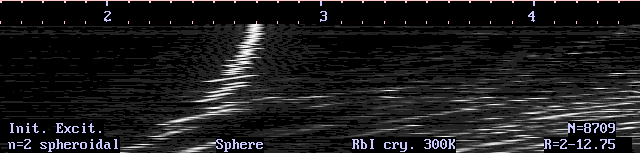 |
For RbI at 300 K Cs[100] = 904 m/s. The lowest few values of η are 2.58, 2.73 and 3.25. For the breathing mode, η = 6.27. For a 30 nm diameter sphere of RbI, the lowest frequency vibrational mode is 0.82 cm-1.
Finite Size Dependence As radius varies, a given mode appears as a sloped but approximately straight line on the graph. In every case, η increases as R gets bigger. This is likely a result of decreased phase velocity of phonons as the boundary of the Brillouin zone is approached, in other words, when the wavelengths are comparable to atomic distances. Thus, the finite size dependence of the mode frequencies is of the form
where constant D depends on the mode, and Cs is the speed of transverse waves. Some modes have stronger finite size dependence than others. Apparently, D is always positive. For most modes, D is on the order of 1 or less. But remember that I am using microscopic distance units. If R was in metres, then D would be on the order of 0.3 nm or so.
Researchers studying nanoparticles normally adapt results from continuum elasticity theory without considering finite size effects [Cerullo, De Silvestri and Banin 1999 pdf ::] [Geller et al. 2001 pdf ::] [Patton and Geller 2001 abstract, preprint pdf ::] [Portales et al. 2002 pdf ::].
Finite size dependence of vibrational modes has been seen in nanospheres [ Cerullo, De Silvestri and Banin 1999 pdf :: ].
References:
H. Lamb, "On the vibrations of an elastic sphere" Proc. London Math. Soc. 13, 189 (1881-1882).
A. E. H. Love, A Treatise on the Mathematical Theory of Elasticity, (Dover, New York, 1944).
Y. Sato and T. Usami, Geophys. Mag. 31, 15 (1962)
C. Kittel, "Introduction to Solid State Physics" Wiley 4th Ed. 1971, see table 4 on page 38
B. A. Auld, Acoustic Fields and Waves in Solids, (John Wiley & Sons, New York, 1973).
N. Nishiguchi and T. Sakuma, Sol. Stat. Comm. 38, 1073 (1981).
Sergey I Bastrukov, Phys. Rev. E 49, 3166 (1994).
F. K. Graff, Wave Motion in Elastic Solid, (Ohio University Press, Ohio, 1994).
S. Bastrukov, Phys. Rev. E (1996)
Bastrukov et al., Physica A 250, 435 (1998).
Zhen Ye, "On the Low Frequency Elastic Response of a Spherical Particle" Chinese Journal of Physics Vol. 38, pages 103-110, (2000). pdf
J. Gregory McDaniel and R. Glynn Holt "Measurement of Aqueous foam Rheology by acoustic levitation" Phys. Rev. E Rapid Communications volume 61 R2204 (2000). pdf ::
Kelly Patton & Michael Geller "Phonon Spectrum in a Nanoparticle mechanically coupled to a substrate" Journal of Luminescence 94-95 (2001) 747-570 pdf ::
Michael R. Geller et al. "Theory of electron-phonon dynamics in insulating nanoparticles" Preprint 11 July 2001 t / d where vt is the bulk transverse sound velocity." > pdf ::
Kelly R. Patton, Michael R. Geller, "Phonon Spectrum in a Nanoparticle Mechanically Coupled to a Substrate" (Preprint Tues, June 26, 2001) abstract, preprint pdf ::
G. Cerullo, S. De Silvestri and U. Banin "Size-dependent dynamics of coherent acoustic phonons in nanocrystal quantum dots" Phys. Rev. B volume 60 (July 15, 1999) pdf ::
H. Portales, L. Saviot, E. Duval, M. Gaudry, E. Cottancin, M. Pellarin, J. Lermé and M. Broyer "Resonant Raman Scattering by Quadrupolar Vibrations of Ni-Ag Core-shell nanoparticles" (Preprint Mar 22 2002) pdf ::
Daniel T. Simon and M. Geller "Electron Phonon Dynamics in an Ensemble of Nearly Isolated Nanoparticles" (Preprint June 8, 2002) To appear in Phys. Rev. B volume 64 PRB preprint :: preprint pdf ::
Daniel B. Murray, "Molecular Dynamics Simulation of an Elastic Material" 2002 (link to article)
Daniel B. Murray, "Vibrational Frequencies of an Elastic Sphere" 2002 (link to article)
Byeong-Joo Lee "A Semi-Empirical Atomistic Approach In Materials Science and Engineering" pdf ::
also
http://www.postech.ac.kr/~calphad/files/kissme.pdf
http://www.ees4.lanl.gov/nonlinear/iwnem/abstracts.html TJ Ulrich, KR McCall, PA Johnson, TW Darling, A Migliori "Application of Resonant Ultrasound Spectroscopy (RUS) to Determine the Elastic Properties of Rock Samples " Summer Workshop 1999 CdSe nanocrystals with colour
http://home.uchicago.edu/~cwang2/research.html
Physical Properties of semiconductors
http://newton.ex.ac.uk/useful/scp.html
T. Iitaka and T. Ebisuzaki "First principles calculation of elastic properties of solid argon at high pressures" pdf ::
Albert Brown "..Ultrasonics.." ::
Daniel Murray
Associate Professor
Math, Stats & Physics Unit
University of British Columbia - Okanagan
Kelowna, BC, Canada
daniel "dot" murray "at" ubc "dot" ca
For a list of related articles click on the link.