Last updated: January 21, 2008
Vibrational Frequencies of an Isotropic Elastic Sphere

Tables and charts of exact frequencies of vibrational modes of an isotropic elastic sphere are presented both for an incompressible sphere and for spheres with a range of Poisson ratios.

   The classic problem of the vibrational modes of an elastic sphere has been extensively studied. [Lamb 1882] [Love 1944] [Sato and Usami 1962] [Auld 1973] [Nishiguchi and Sakuma 1981] [Bastrukov 1994] [Graff 1994] [Bastrukov et al. 1998] [McDaniel and Holt 2000 pdf ::] [Ye 2000 pdf] [Patton and Geller 2001 pdf ::]. This problem finds diverse application in geophysics [Hanyk, Matyska and Yuen 1998 pdf ::] [geophysics introduction], seismology [simple introduction to earthquake waves], solid stars and the "solid globe" model of the atomic nucleii [Bastrukov 1996], silicon nanoparticles [Patton and Geller 2001 pdf ::] and aqueous foam spheres [McDaniel and Holt 2000 pdf ::]. However, no complete and exact enumeration of the frequencies has ever been presented in a convenient form.
   Consider a freely suspended elastic sphere not subject to body forces. The sphere has radius R, uniform density ρ, shear modulus μ and Poisson ratio ν. These parameters fully describe the problem. If the sphere is disturbed, it will begin to oscillate. A given eigenfunction (i.e. normal mode) has frequency ω (in radians per second).
   The speed of transverse waves (shear waves) is Cs = sqrt(μ/ρ). It is convenient to express normal mode frequencies in terms of the dimensionless variable

η = ω R/Cs

   While the frequencies simply scale with the elastic constants of the material, the spectrum changes qualitatively for different values of the Poisson ratio, ν.

ν = (Y-2μ)/(2μ) = (3B-Y)/(6B) = λ/(2(λ+μ))

where Y is Young's modulus, B is the bulk modulus and λ is the first Lamé constant. The second law of thermodynamics requires that the Poisson ratio lie in the range

-1 < ν <= 0.5

    The limit of ν = 0.5 corresponds to an incompressible elastic material, such as soft rubber or Jello[Trademark]. Poisson's ratio for most ordinary materials is approximately 0.3. (see table)
   The formulas for the frequencies [Ye 2000] have as a parameter the ratio Cs/Clong where Clong is the speed of longitudinal waves. The dimensionless wavevectors of the longitudinal and shear waves are ξ and η respectively. Thus ξ / η = Cs / Clong. In terms of this,

ν = (1/2)(1-2(Cs/Clong)2)/(1-(Cs/Clong)2)

Cs
---
Clong
 =  [ 1-2ν
------
2-2ν
] (1/2)

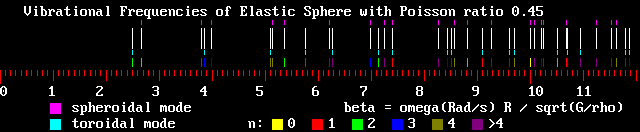
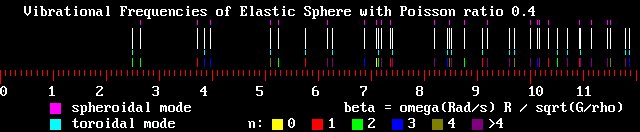
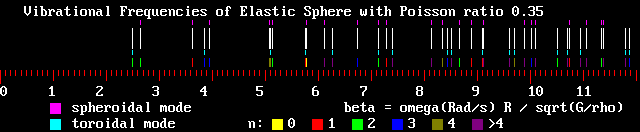
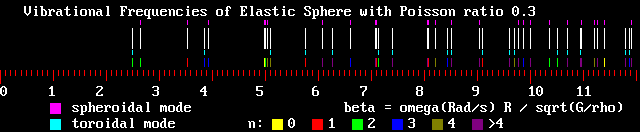
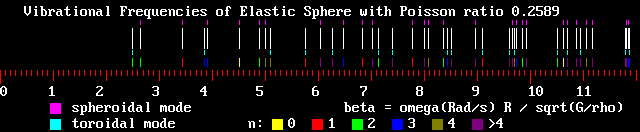
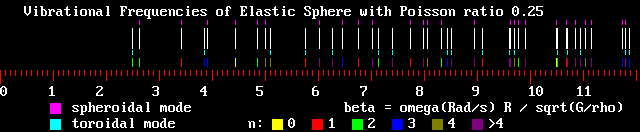
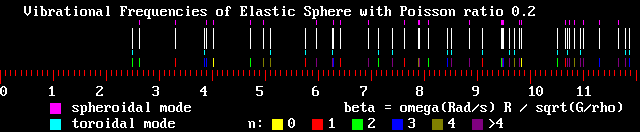
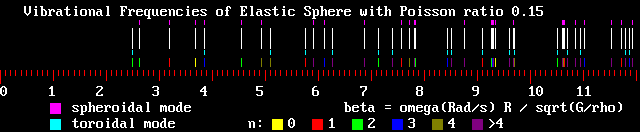
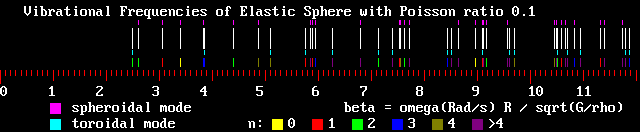
   Figures 1(a-j) show the value η for each normal mode. All modes with η from 0 up to 12 have been plotted. Coloured ticks have been added to show the value of "l" for each mode. But in some cases several modes are overlapping. In addition, each mode can be classified as "spheroidal" (Rayleigh waves, P-waves in seismology) or "torsional" (called "toroidal modes", Love waves or S-waves in seismology, with velocity at the surface tangent to the sphere surface) [ geophysics introduction ] [ simple introduction to earthquake waves ] [Ye 2000].

Figure 1(a)
Poisson ratio = 0.5
(spectr2.cpp, spectr4.txt, showspc2.cpp, spectr4.gif)
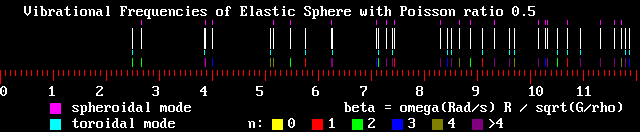
Figure 1(b)
Poisson ratio = 0.45
(spectr2.cpp, spectr3.txt, showspc2.cpp, spectr3.gif)
Figure 1(c)
Poisson ratio = 0.4
(spectr2.cpp, spectr9.txt, showspc2.cpp, spectr9.gif)
Figure 1(d)
Poisson ratio = 0.35
(spectr2.cpp, spectr8.txt, showspc2.cpp, spectr8.gif)
Figure 1(e)
Poisson ratio = 0.3
(spectr2.cpp, spectr7.txt, showspc2.cpp, spectr7.gif)
Figure 1(f)
Poisson ratio = 0.2589
(spectr2.cpp, spectr6.txt, showspc2.cpp, spectr6.gif)
Figure 1(g)
Poisson ratio = 0.25
(spectr2.cpp, spectr10.txt, showspc2.cpp, spectr10.gif)
Figure 1(g')
Poisson ratio = 0.2249
(spectr2.cpp, spectr13.txt)
(no figure) This corresponds to isotropic "average silicon", with direction averaged sound speeds of 9017 m/s (longit) and 5372 m/s (transv), corresponding to ν = 0.2249
Figure 1(h)
Poisson ratio = 0.2
(spectr2.cpp, spectr5.txt, showspc2.cpp, spectr5.gif)
Figure 1(i)
Poisson ratio = 0.15
(spectr2.cpp, spectr11.txt, showspc2.cpp, spectr11.gif)
Figure 1(j)
Poisson ratio = 0.1
(spectr2.cpp, spectr12.txt, showspc2.cpp, spectr12.gif)

   To read off frequencies from the above charts, you must first know (1) the radius of the sphere, R, in meters; (2) the density of the material, ρ, in kg/m3; (3) the shear modulus of the material, μ, in Pascals; (4) the Poisson ratio of the material. Then choose the chart which is most appropriate. From the red scale, note the values of η at which the vertical white ticks are located. Then, convert to frequency using,

f = 0.15915 η sqrt(μ/ρ) / R (f in Hertz)

ω = η sqrt(μ/ρ) / R (ω in radians/second)

   For practical engineering situations involving ordinary materials for which the Young's modulus (Y or sometimes E, also known as tensile modulus) is known, and only an approximate frequency is needed, then the following formula can be used, together with the chart figure 1(e):

f[Hz] = 100 η sqrt(Y[GPa] / density[g/cc] ) / radius[m]

(This formula makes the reasonable assumption that the Poisson ratio is 0.30.)
   For example, for an aluminum ball bearing of diameter 2 cm (R=0.01 m), elastic modulus 73 GPa, Poisson ratio 0.33 and density 2.7 g/cc, we refer to chart 1(d) and find the lowest frequency mode at η=2.5. The frequency in Hertz is

f = (100)(2.5) sqrt(73/2.7) / 0.01 = 265185 Hz

   The difference between these results and those reported earlier [Ye 2000] are apparently due to that author employing inconsistent normalizations for the spherical Bessel functions. In his algebraic results, as he states in his equation (19), he used the normalization where, for small x, j(l,x) = (xl)/ (2l+1)!!. (Here, "!!" is the double factorial function, such that l!!=l(l-2)(l-4)... .) However, all of his numerical solutions appear to have been obtained using spherical Bessel functions with a different normalization. There is also a misprint in equation (16) of the paper where the expression for cl is missing a factor of η, (which should be placed in front of j(l-1,η)) as may be seen by comparison with equation (17). Lastly, the "N" in equation (16) should be lower case.
   Bastrukov [Bastrukov 1994] has proposed approximate formulae for the lowest η for each l (given l>1). Table I below shows how well they work:

Table I: Bastrukov Approximants
Spheroidal modes
(incompressible ν=0.5)
η=sqrt(2(l-1)(2l+1))
lExact ηBastrukov Appoximate η% error
2 2.6663.16219%
3 4.0025.29232%
4 5.1617.34842%
5 6.2479.38150%
6 7.29511.40256%
Torsional modes
(valid for any ν)
η=sqrt((l-1)(2l+3))
lExact ηBastrukov approximate η% error
2 2.5022.6465%
3 3.8654.24310%
4 5.0955.74513%
5 6.2667.21115%
6 7.4048.66017%

   From Table I it can be seen that the Bastrukov approximant for the lowest spheroidal mode rapidly fails at increasing l, while the Bastrukov approximant for the lowest torsional mode is more accurate.
   Some general comments can be made about the spectrum. η for the torsional modes does not depend on the Poisson ratio, but the spheroidal mode frequencies do vary as the Poisson ratio changes. The most dramatic example is the l=0 spheroidal mode, which corresponds to radial expansion and contraction of the sphere. When Poisson's ratio is 0.5 the material is incompressible and so the frequency of this mode is infinite.
   It is a bit of a surprise (for me, anyway) that the lowest frequency modes have l=2. In spherical symmetry boundary value eigenvalue problems in quantum mechanics and electromagnetism one always seems to find that the "ground state" or "lowest frequency mode" has l=0. A partial resolution of this is that there is a l=1 spheroidal mode at η=0 (not shown in figure 1) corresponds to rectilinear motion. The l=1 torsional mode with η=0 corresponds to rigid body rotation.

Vibrational Mode Displacement Fields
   In Table II, the dimensionless frequencies (η) of the spheroidal modes of an elastic sphere with ν=0.301575 are shown. The uncertainty of the last digit is shown in brackets. Uncertainties may be underestimated in some cases. The factor in red is the ratio of the amplitudes (Bl/Al) of the two displacement functions. Again, uncertainty of the last digit is shown in brackets. For these modes, the displacement field u is of the form

u total = Al zero-curl part + Bl zero-divergence part
explicitly
u(r,θ,φ,t) exp(-i ω t ) = Al [ j(l, klong r ) P(l,cos(θ)) ]
+ Bl ∇×∇× [ r j(l, ks r ) P(l,cos(θ)) ]
or, equivalently,
u(r,θ,φ,t) exp(-i η Cs t / R ) = A l grad [ j(l, ξ r / R) P(l,cos(θ)) ]
+ Bl curl curl [ r j(l, η r / R ) P(l,cos(θ)) ]
for r<R. ξ = η Cs/Clong.
   These are exact solutions of the dynamical equations, and they satisfy the no-stress boundary conditions that σXX=0, σXY=0 and σXZ=0 where the X axis is normal to the surface at a given point on the sphere. It is important to emphasize that these modes are NOT zero-curl modes, even though the term "spheroidal" is often used to refer to Rayleigh waves in which the velocity field has zero curl.

 Table II. Spheroidal modes: η   (Bl/Al in red)
 Poisson ratio ν=0.301575 (sphmode4.cpp, July 8, 2002; beta2b.cpp gives l=0 exactly)
 l Zero
curl?
η
1st mode
η
2nd mode
η
3rd mode
η
4th mode
 0Yes 5.0161
0
11.4315
0
17.450
0
23.404
0
 1 No 3.533(1)
-0.932(3)
7.110(4)
+1.02(3)
8.094(1)
-0.455(3)
10.7151
+4.69
 2 No 2.646(1)
-0.4651(3)
5.0144(2)
-0.3730(3)
8.532(2)
+0.861(3)
10.4008(2)
-0.213(1)
 3 No 3.9382(5)
-0.1921(3)
6.613(1)
-0.2117(6)
not clear for η>9.8
 4 No 5.047(5)
-0.094(3)
8.215(4)
-0.148(3)
not clear for η>11.3
 5 No 6.09(1)
-0.0480(3)
9.77(1)
-0.118(1)
not clear for η>11.6

   The next table is for ν=0.49 which is close to the incompressible limit.

 Table III. Spheroidal modes: η   (Bl/Al in red)
 Poisson ratio ν=0.49, Cs/Cl=0.1400. (sphmode4.cpp, July 8, 2002; beta2b.cpp gives l=0 exactly)
 l Zero
curl?
η
1st mode
η
2nd mode
η
3rd mode
η
4th mode
 0Yes 22.259
0
44.78
0
67.26
0
89.72
0
 1 No 3.8565
-0.5715
7.4384
+4.102
10.710
-11.04
13.918
+20.45
 2 No 2.6680
-0.05437
5.454(6)
-0.0770(2)
8.868
+0.5595
-
 3 No 4.0002(3)
-0.0064(1)
7.081(5)
-0.0152(3)
10.29(3)
+0.10(2)
-
 4 No 5.156(1)
-0.00088(2)
8.655(1)
-0.0360(2)
11.72(5)
+0.02(2)
-
 5 No 6.241(1)
-0.00013(1)
10.16(2)
-0.00090(9)
-

Acknowledgements:
   Sergey Bastrukov is thanked for a careful reading of this article as well as for making a number of helpful comments.

References:

H. Lamb, "On the vibrations of an elastic sphere" Proc. London Math. Soc. 13, 189 (1881-1882).
A. E. H. Love, A Treatise on the Mathematical Theory of Elasticity, (Dover, New York, 1944).
Y. Sato and T. Usami, Geophys. Mag. 31, 15 (1962)
B. A. Auld, Acoustic Fields and Waves in Solids, (John Wiley & Sons, New York, 1973).
N. Nishiguchi and T. Sakuma, Sol. Stat. Comm. 38, 1073 (1981). [Modal series expansion]
Sergey I Bastrukov, Phys. Rev. E 49, 3166 (1994).
F. K. Graff, Wave Motion in Elastic Solid, (Ohio University Press, Ohio, 1994).
S. Bastrukov, Phys. Rev. E (1996)
Bastrukov et al., Physica A 250, 435 (1998).
L. Hanyk, C. Matyska and D. A. Yuen "Initial value approach for viscoelastic responses of the earth's mantle" 1998. (pdf ::)
Zhen Ye, "On the Low Frequency Elastic Response of a Spherical Particle" Chinese Journal of Physics Vol. 38, pages 103-110, (2000). pdf

Daniel Murray
Associate Professor
Math, Stats & Physics Unit
University of British Columbia - Okanagan
Kelowna, BC, Canada
daniel "dot" murray "at" ubc "dot" ca

For a list of related articles click on the link.

http://www.asap.unimelb.edu.au/bsparcs/physics/P000554p.htm
http://www.astro.oma.be/SBC/sedi/SediWebA_12.html
LAMB, Horace M. A.
"On the vibrations of an elastic sphere". London Mathematical Society. Proceedings., 13 (1881-82), 189-212.
"On the vibrations of a spherical shell". London Mathematical Society. Proceedings., 14 (1882-83), 50-56.

Eur. Phys. J. D 16, 197- (2001) H. Portales, L. Saviot, E. Duval, M. Gaudry, E. Cottancin, J. Lerm�2, M. Pellarin2, M. Broyer2, B. Pr�vel3 and M. Treilleux3 "Resonance and composition effects on the Raman scattering from silver-gold alloy clusters" link to page

A. C. Eringen and E. S. Suhubi in Elastodynamics (Academic Press, N.Y. 1975)

J. Gregory McDaniel and R. Glynn Holt "Measurement of Aqueous foam Rheology by acoustic levitation" Phys. Rev. E Rapid Communications volume 61 R2204 (2000). pdf ::
Kelly Patton & Michael Geller "Phonon Spectrum in a Nanoparticle mechanically coupled to a substrate" Journal of Luminescence 94-95 (2001) 747-570 pdf ::

Daniel T. Simon and M. Geller "Electron Phonon Dynamics in an Ensemble of Nearly Isolated Nanoparticles" (Preprint June 8, 2002) To appear in Phys. Rev. B volume 64 PRB preprint preprint pdf ::
H. Portales, L. Saviot, E. Duval, M. Gaudry, E. Cottancin, M. Pellarin, J. Lermé and M. Broyer "Resonant Raman Scattering by Quadrupolar Vibrations of Ni-Ag Core-shell nanoparticles" (Preprint Mar 22 2002) pdf ::

G. Cerullo, S. De Silvestri and U. Banin "Size-dependent dynamics of coherent acoustic phonons in nanocrystal quantum dots" Phys. Rev. B volume 60 (July 15, 1999) pdf ::

Hosted by www.Geocities.ws

1