Created: April 18, 2004
Last updated: April 20, 2004
D. Directional Dependence
Warning: All of these figures assume an extremely simplified
model of inelastic scattering where the incident field is a scalar field (like a
sound wave) rather than a correctly described X-ray or neutron beam).
These are "toy model" calculations only.
In all cases here the incident beam of X-rays or neutrons
is propagating along the z-axis, and the z-axis comes out of the page.
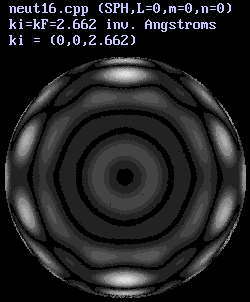
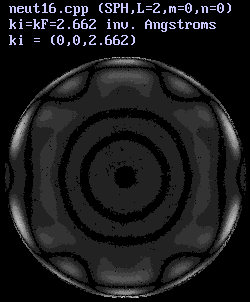
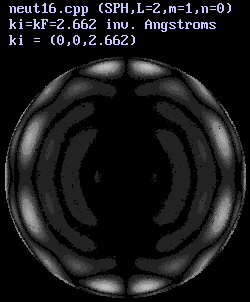
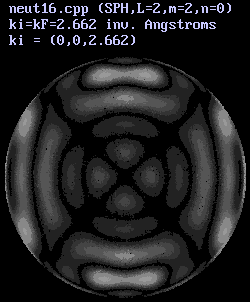
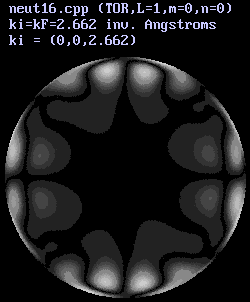
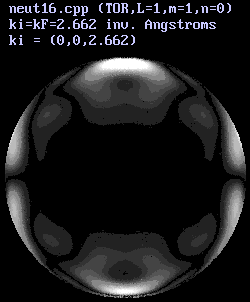
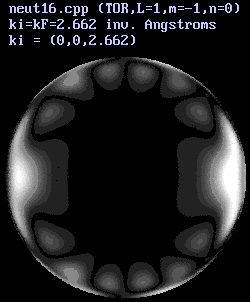
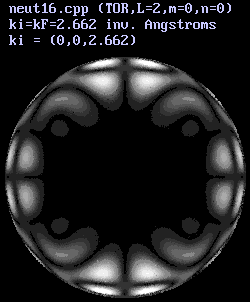
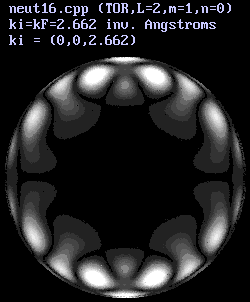
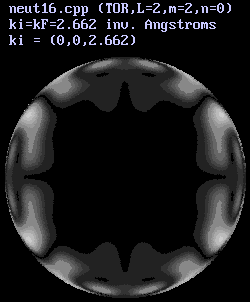
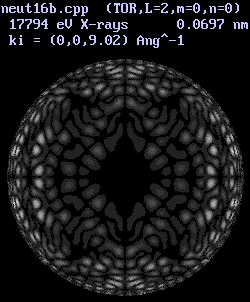
Each figure depicts the angular dependence of the X-ray exposure on
a hemisherical detector due to inelastic scattering from vibrational modes
of a AlPdMn PMI. Note that the hemispherical "film" has not been
bent flat. The gray scale indicates intensity. It is actually
scaled to the square root of intensity to emphasize features. The same
scale is used for all figures here. Note that all of the modes have on angular
average comparable inelastic scattering ability.
Alternatively, each figure can be thought of as a plot of
kFy versus kFx. Scattering through an angle
greater than 90 degrees is not shown.
The incident beam is propagating along a 2-fold symmetry
axis of the quasicrystal.
Wavelength = 2.36 Angstroms:
(SPH,l=0,m=0,n=0) mode:
(SPH,l=2,m,n=0) modes for different m
(TOR,l=1,m,n=0) modes for different m
(TOR,l=2,m,n=0) modes for different m
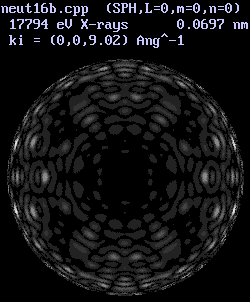
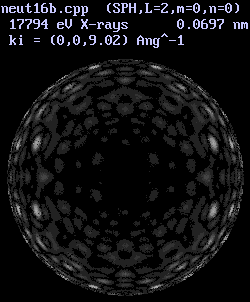
NEW: (April 19) 17794 eV X-rays
This continues the approximation that all atoms have equal
scattering ability. The X-ray wavelength is 0.0697 nm.
As in:
M. Krisch, R.A. Brand, M. Chernikov, H.R. Ott
"Phonons in the icosahedral quasicrystal i-AlPdMn studied by inelastic X-ray scattering"
PRB 65, 134201, 2002
New April 20:
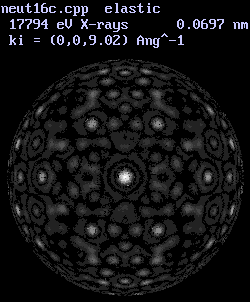
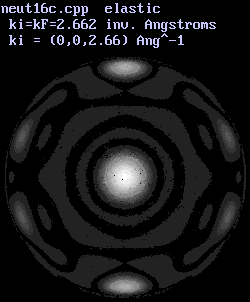
Elastic Scattering Patterns
The greyscale for these patterns is much different than
for the above figures, since the elastic scattering is much more intense
than inelastic scattering. From these figures it is apparent that the elastic
scattering pattern is totally unrelated to the inelastic scattering patterns
from the various modes.
Back to:
A. Inelastic scattering from a vibrating PMI
B. Confined Vibrations of a PMI
C. Simple examples
See animations of a vibrating PMI
Daniel Murray
Associate Professor
Math, Stats & Physics Unit
University of British Columbia - Okanagan
Kelowna, BC, Canada
daniel "dot" murray "at" ubc "dot" ca
For a list of related articles click on the link.