Created: April 10, 2004    Last updated: April 13, 2004   

A. Inelastic scattering from a vibrating PMI

   Inelastic scattering as considered here could involve neutrons or X-rays. We consider primarily the example of X-rays for purposes of discussion. For simplicity, the scattered wave is treated as a scalar field, so that realistic effects of wave polarization are ignored. As a result, these calculations need to be modified for an accurate treatment of either neutrons or X-rays. The X-ray source is assumed to be far away. The incident X-ray beam is a plane wave with wavevector ki (the magnitude) with Cartesian components (kix,kiy,kiz). The sample (a single PMI) is located close to the origin. The X-ray detector is located at a definite position, rd,very far away from the origin compared to the size of the PMI. As a result, the scattered beam reaching the detector is a plane wave with wavevector kF (the magnitude) with components (kFx,kFy,kFz). We are not interested in the elastic scattering. The sample is executing vibrational motion corresponding to a confined phonon mode with frequency ωp. Energy conservation of the process relates ki, kF and ωp. The scattering process can be Stokes or anti-Stokes. (I forget which one gives ki > kF and which one gives ki < kF)

  Figure A1. A pseudo Mackay isohedron (PMI) for a quasicrystal such as AlPdMn
58b.gif icosid6b.cpp
 
   The PMI consists of 51 atoms as shown in Figure A1 at right. There is an inner cluster of nine atoms (shown in yellow) at the center and 8 vertices of a cube. I assume the distance from the center to a vertex is 2.0 nm, even though there is no information to guide this. There are 12 more atoms on the vertices of an icosahedron (shown in purple). The radius is 0.456 nm [Yang 2002, page 165]. Finally there are 20 more atoms on the vertices of an icosidodecahedron (shown in blue). The radius is 0.479 nm [Yang 2002]. (Click here to see a rotating version of Fig. A1)

   A number of idealizations are made about the scattering of the X-rays from the PMI:

- The atoms each act as point scattererss of X-rays (located at each atom's center)
- X-rays scatter independently from eachh atom in the PMI
- Each of the 51 atoms scatters with equual cross section
- Any form factor (directional dependencce of scattering cross section from an atom) is ignored.
- Only single-scattering processes are cconsidered; scattering involving two or more atoms is ignored
- Polarization of the beam is ignored - The phase of the scattered wave matchees the phase of the incident wave at the position of the center of the scattering atom

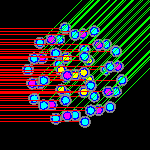
  Figure A2. The incident X-ray beam is shown in red. The scattered X-rays going in a selected final direction are shown in green.
58c.gif icosid6c.cpp
 
   First, consider only a single atom, number j. Index j will later be summed over 1 to 51. Atom j has position rj with coordinates (xj,yj,zj). Because of the confined phonon oscillations in the PMI, this position oscillates with time with frequency ωp. The average position of atom j is roj. Its instantaneous position rj(t) oscillates with time.

   The beam of X-rays is simplified as a scalar field ψ(x,y,z,t). The incident beam is a plane wave:
ψi = exp(i (kix x + kiy y + kiz z ))
(A1)
Let ψscj denote the scattered X-rays that result from the incident plane wave bouncing off atom j. This is approximately a spherical wave with its center at r0j. Since atom j is in motion, the scattered wave ψscj is not exactly a spherical wave. By the time ψscj reaches the detector, it becomes well approximated as a plane wave. This detected plane wave due to the scattering from atom j is ψdj. It is of the form
ψdj(x,y,z) = Bj exp(i (kFx x + kFy y + kFz z ))
(A2)
where Bj is a complex-valued amplitude. The position of the detector is (xd,yd,zd). The experiment is designed only to observe ψ at the detector
ψdj(xd,yd,zd) = Bj exp(i (kFx xd + kFy yd + kFz zd ))
(A3)
The complex amplitude Bj is of the form Cj |Bj|, where |Bj| depends on the distance to the detector but has completely negligible variation due to the motion of atom j. It may considered to be a constant. The complex number Cj has magnitude 1, and it does vary as atom j moves due to the phonon in the PMI. Once again, approximating the detector to be at a great distance relative to the atom's distance from the origin, unimodular phase factor Cj is related to the atom motion through:
Cj = exp(i(ki·rj(t))) exp(-i(kF·rj(t)))
(A4)
Cj = exp(i([ki-kF] ·rj(t)))
(A5)
Cj = exp(i(Q ·rj(t)))
(A6)
where Q = ki - kF is the momentum transfer. (i.e. the amount of momentum transferred to the quasicrystal)

   Although it will normally be assumed that |Bj| is the same for all 51 atoms in the PMI, we include the possible j-dependence formally here. Since the PMI consists of atoms of Al, Pd and Mn which scatter X-rays (or neutrons) to differing degrees, |Bj| may vary with j. Furthermore, the scattering structure factors could have directional dependence, so that |Bj| could depend on ki and kF as well. In addition, it is possible that there could be a phase shift as a result of the scattering, whereas our formalism assumes a phase match at the scattering point.
   The received signal D(t) is
D(t) = 51
Σ
j=1
|B|j Cj(t)
(A7)
If the atoms were not in motion, the received signal at the detector would be
Do = 51
Σ
j=1
|B|j Coj
(A8)
where
C0j = exp(i(Q ·roj))
(A9)
   We are not interested in elastic scattering from the PMI. Only the inelastic scattering gives information about confined phonon vibrations in the PMI. The detector is tuned to a frequency corresponding to kF. Therefore, only the difference E(t) = D(t)-Do is observed in the experiment. Since the frequency of the atomic motions is ωp, E(t) will also have frequency ωp. There are no higher harmonics as long as the atomic vibrations are very small compared to the wavelength of the X-rays. Since the detector is not phase sensitive, the recorded signal is the X-ray intensity (or neutron flux) which is proportional to
F = time average( |E(t)|2 )
(A10)
   The next step is to consider the actual form of rj(t) in order to get specific results for confined phonons in a AlPdMn PMI. See the next page.

Material Scattering Properties:

bcoh in the table shown at right is the atomic coherent scattering length. See equations (3.5) and (3.6) on page 298 of Quilichini et al. 1997. Neutron scattering is proportional to the square of bcoh. The mass of the atom also plays a role.
Table A1: Neutron scattering parameters:
After Table II on page 299 of M. Quilichini and T. Janssen
"Phonon excitations in quasicrystals"
Rev. Mod. Phys. 69, 277�314 (1997)
element bcoh
(10-15 m)
Al  3.449
Mn -3.73
Pd  5.91
Table A2 at right is for X-rays with a wavelength of 0.200 nm, for which the energy is 6200 eV. Note of the atoms is close to a resonance at this energy, so these values do not depend strongly on X-ray frequency. For details see
www-cxro.lbl.gov/optical_constants/
Table A2: Atomic X-ray scattering properties at 6200 eV
www-cxro.lbl.gov/optical_constants/pert_form.html
element atomic
number
Z
Photo
absorb
cross
section
cm2/g
Inelastic
Cross
Section
(cm2/g)
f1 f2 density

(g/cc)
Aluminum 13 100.2 0.0786 13.29 0.3984 2.70
Paladium 46 395.6 0.0439 46.00 6.203 12.0
Manganese 25 64.92 0.0617 22.32 0.5255 7.30


References:

W. Yang, M. Feuerbacher and K. Urban, "Cluster structure and low-energy planes in icosahedral Al-Pd-Mn quasicrystal" Journal of Alloys and Compounds 342 (2002) 164-168. on-line pdf

M. Quilichini and T. Janssen "Phonon excitations in quasicrystals" Rev. Mod. Phys. 69, 277�314 (1997)


Other articles that might be relevant

Zhang, Y; Ehrlich, S N; Colella, R; Kopecky, M; Widom, M
"Inhomogeneous, disordered, and partially ordered systems - X-ray diffuse scattering in the icosahedral quasicrystal Al-Pd-Mn"
Physical Review. B, Condensed Matter, 2002; 66 (10) 104202

Hartwig, J; Agliozzo, S; Baruchel, J; Colella, R; Boissieu, M de; Gastaldi, J; Klein, H; Mancini, L; Wang, J
Anomalous transmission of x-rays in quasicrystals
Journal of Physics. D, Applied Physics, 2001; 34 (10 A) page A103

M Boudard, M de Boissieu, C Janot, G Heger, C Beeli, H -U Nissen, H Vincent, R Ibberson, M Audier and J M Dubois
"Neutron and X-ray single-crystal study of the AlPdMn icosahedral phase"
J. Phys.: Condens. Matter 4 (14 December 1992) 10149-10168
Perfect single grains of the AlPdMn icosahedral phase have been used for structure determination by X-ray and neutron diffraction. Owing to the large difference between X-ray and neutron scattering factors, information is gained on the atomic positions of the three elements. A model is proposed as deduced from a six-dimensional (6D) Patterson analysis. Six different atomic hypersurfaces are located on node and body-centre sites of the 6D lattice. The superstructure that leads to a face-centred lattice is mainly due to a strong chemical ordering, all the palladium being on the even node and odd body centre of the 6D cube. The resulting 3D structure contains icosahedral clusters similar to the external shell of the Mackay icosahedron, with two kinds of chemical decoration. The structure may also be described via a quasi-periodic stacking of fivefold planes. Each set of planes is characterized by an average chemical composition and local order. This kind of description helps in the understanding of quasi-crystal growth, formation of dislocations and dynamic properties. [ ordered via ILL April 11th ]

Jach, Terrence; Zhang, Y; Colella, R; Boissieu, M de; Boudard, M; Goldman, A I; Lograsso, T A; Delaney, D W; Kycia, S
"Dynamical Diffraction and X-Ray Standing Waves from Atomic Planes Normal to a Twofold Symmetry Axis of the Quasicrystal AlPdMn" Physical Review Letters, 1999; 82 (14) 2904-2907

Y. Zhang, R. Colella, S. Kycia and A. I. Goldman
"Absolute structure-factor measurements of an Al-Pd-Mn quasicrystal"
Acta Cryst. (2002). A58, 385-390
Abstract: A number of X-ray reflections from an icosahedral quasicrystal Al-Pd-Mn have been measured with great accuracy on an absolute basis by making use of Bragg-case diffraction. Since the specimen had high crystal quality, the dynamical theory was used for analyzing the results and to extract structure factors from measured integrated intensities. Good agreement was found between theory and experiment for strong reflections. Anomalous transmission was found to be strong in the `good' regions of the quasicrystalline specimen and it was measured on an absolute basis, but the small residual strains present in the specimen prevented an accurate comparison between theory and experiment. A detailed discussion is presented on the parameters that mostly affect anomalous transmission in relationship to the adopted structural model.
Daniel Murray
Associate Professor
Math, Stats & Physics Unit
University of British Columbia - Okanagan
Kelowna, BC, Canada
daniel "dot" murray "at" ubc "dot" ca

For a list of related articles click on the link.
Hosted by www.Geocities.ws

1