 |
|
|
|
 |
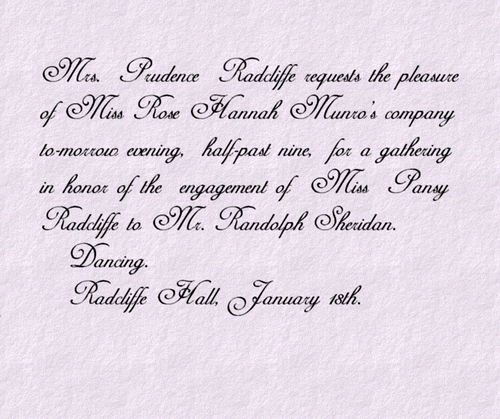
the paper boy in the gutter and read the news under the awning of a chemist�s shop, bad arm tucked under his coat. He might be home after months away but he was on business still, business to be spied in lesser headlines and tracked through alleys and pursued through the sidestreets of slums�and, if he were worth his pay, chased back across the Channel. If all went well, London would never know what he did for a living. But here came the horses in the gloom and the slush: �Where to, doctor? Back to the flat?� �No, � he said, folding the newspaper into his pocket. �Munro House.� Rose Hannah Munro came home from a late tea, stamping the snow from her boots in the front hall as she set down her bag. Mrs. Radcliffe always wanted her medical advice even though she had a perfectly good doctor of her own; she would whisper to Rose Hannah that she would rather have �a woman�s confidence,� even though all she ever complained of was an imagined case of pleurisy. There wasn�t much room for a female doctor in London, though, so Rose Hannah took her opportunities when they came. She stopped by the ormolu console to thumb through the mail, stepping around her father�s pair of mechanical peacocks. (The one on the right shrieked tinnily. I don�t care if they rust, she thought; he needs to put them back in the garden.) Since she had come home from her year in the States, the salver had been piled high with calling cards and invitations from old friends: Pansy Radcliffe�s engagement ball; dinner with the Misses Morland, Catherine and Caroline; a letter from Aunt Jessamine, saying that the old Murray house wasn�t the same without her now; a quick note from Camilla Kirke, reminding her about the cinema; more invitations to dances and supper and tea; and another letter from Caspar Osborne, the address in his urgent, spiky hand. Rose Hannah slipped it to the bottom of the stack, to deal with it later. And then she saw a strange trunk a few feet away. It was strange enough that, after musing over the mail for a good five minutes, no one had come to take her wraps. Which was fine; at the Murrays� house in New York, her mother used to insist that everyone take care of themselves, but Rose Hannah was accustomed to her father�s crowd of servants in Kensington. Only now, there was no one to be seen, not even her maid Nell. More curious than put out, she hung up the cloak herself, pocketed her letters, and made her way through the narrow corridor into the main hall. The great staircase split at a landing halfway up; the second story overlooked the first, and that was where she found a bee swarm of activity�Mary Ann trotting down the stairs with a basket of laundry and a tatterdemalion pair of boots as Jane passed her going up with a heap of fresh linen. She saw Nell (who tended to resent any requests not made directly by her mistress) and her towering chignon hustling by with a hot-water bottle and a scowl. James and Thomas, the footmen, started Rose Hannah then by brushing past her with the trunk. She just managed to catch Jane on her way down: �We have a guest�?� �Dr. West, Miss,� said Jane, not even pausing before hurrying off towards the kitchen, and in the distance Rose Hannah heard Mrs. Parkes calling, �What did the young doctor say he wanted for dinner?� She tried to think�she had been gone a year, to be sure, but had been home nearly a month already. Her late mother had always insisted on living in New York, so Rose Hannah had been the lady of the house in Kensington since she had come out at sixteen, and she knew most of her father�s friends from playing hostess. �Dr. West� rang no bell at all for her, and yet she�d never seen one of her father�s friends so fully entrenched in the household routine. And then her father ran into her, plainly jubilant, coming down the stairs himself. �Rose, Rose! Dr. West is back in London.� �Dr. West�?� she prompted, maybe more pointedly than she intended. It was as if she had walked into an alternate universe, starring a character everyone knew but her. �I didn�t even mention him? I forget, Rose, now that you�re home, what I have and haven�t told you. He comes round to the Inventors� Club sometimes, gives us little assignments�always a treat.� His eyes danced at the very thought. �I hope he does have some good ideas for us. I�ve nearly finished the�well, shouldn�t say anymore about that. He�s just come in, about half an hour ago�just turns up, he does, when you least expect him, and looking like what the cat dragged in. You�ll have to come upstairs and let me introduce him�� �No, it�s all right,� she said, pulling away uneasily. �If he�s just arrived, he might want some time to himself before dinner�I could meet him then just as well�� �Oh, no, no no no, come and meet him now!� Dr. Munro cried, eager as always to inflict his friends on Rose Hannah. You�d never find a sweeter man, she reflected, but sometimes she wondered if he wasn�t better with machines than people. Dr. West had been installed in the guest room nearest Dr. Munro�s library; the elder man barely knocked before he barrelled in, daughter in tow (whose eyes were clenched shut lest their guest be ill-prepared for their intrusion). But the man was simply laid up in an armchair, his feet up on an ottoman and one wrist thickly bandaged, reading by the fire in his shirtsleeves. Medical training had given Rose Hannah an eye for observation. The man, who seemed to be in his mid or late thirties, was unshaven; his beard looked stubbly rather than cultivated. His hair was shaggy and unkempt as well, a bit wet around his face from a recent splash in the washbasin. Lean�perhaps gaunt, even�and travel-tanned, he had several light scars and two reasonably fresh cuts on his face. His clothes, while dark and plain, were out of fashion�not ridiculously so, but he had the look of a man who put no pains into his appearance and might have been wearing the same few suits of clothes for several years. And then there were those awful boots. An open valise on the sofa suggested that he was a light traveler (but then there was that trunk downstairs�). At the same time, he slouched very comfortably in the chair by the fire; she did not recognize the shelves of books against the wall, and with some interest realized they must be his own. Somehow, in her absence, this man had become a frequent guest at the house. What had her father been up to while she was away? �Dr. West�Zephaniah West,� Dr. Munro said with a flourish, and Rose Hannah raised an eyebrow. �Please imagine that I am standing,� said Dr. West dryly. �And this is my daughter, Rose Hannah�also a doctor,� Munro added very proudly; it was West�s turn to give her a look. �Miss Munro,� she corrected; she found it easier to drop her title socially. �Ah, one of those ornamental degrees, then,� said Dr. West. Rose Hannah narrowed her eyes�paused, and thought better of what she wanted to say. �Will you be coming down to dinner, Dr. West?� �No, unfortunately, on account of my present condition.� He gestured with his good hand to his bandaged wrist. She started to say something bland and polite about the loss of his company, but he had already turned back to his book, had already dismissed her, had already stopped listening. The sprain was real, but also very convenient; it was easy to slip out of the house once the Munros had gone down to dinner. Munro�s daughter seemed like a nice, cheerful, busy sort (redheaded�that was unexpected), but West had no time for people who were not useful to his work. He had told Ham to bring the hansom around at eight, and Ham�who made a living as a cabbie when West was out of the country�never disappointed. �I brought the papers, sir,� said Ham, handing them down as West climbed in. �Where to?� �Victoria Park,� he said, �and then down to the bank.� The Globe, the Standard, the Echo, the Pall Mall Gazette. The things he was looking for weren�t in the headlines�they were buried deep in the columns, stories about common �dirty� people cut down in alleys, a dime a dozen to West End readers. They were something for old men and socialites to cluck their tongues over, feel superior about, thank God they didn�t live down there in the slums with those animals. He had seen better conditions than this, disease and pollution and starvation, in India sneaking down to the servants� quarters as a boy to play with the housekeeper�s children� but that had been a long time ago. He had spent so many months criss-crossing Europe that he didn�t have the network of spies he�d once had. They were easy enough to come by, though. West tapped the roof of the cab��Stop near the gates, Ham��and, climbing down, set out for a stroll. Tuesday night, with a fresh crunch of frost on the ground as well: no one would be out at the park who didn�t have to be. It was easy to pull a young streetsweeper aside here, a costermonger there, tip him a sixpence, and promise him more for word of anything� unusual. �Unusual, sir?� asked the pieman�s boy. �Strange, out of the ordinary�� �I know what it mean, sir,� said the boy stiffly. West smiled. �Unsavory lurkers, then. Shifty eyes. Shadows in alleys, in the park. But unusual ones.� The boy cocked an eyebrow, but took the coin anyway. And so West had Ham drive him through East End, the newspaper open on the seat beside him with various stories circled: Factory Worker Disappeared, Young Girl Accosted, Mystery in Bethnal Green, Hampstead Horror, Sailor Found Dead. Once he had a dozen boys on pay, he rapped on the cab roof again and told Ham to make for the Houndsditch embankment, and waded through the mud there until he found a gaggle of mudlarking children, and lured them over with a shilling apiece. �Now,� he said, crouching down at their eye level, �is there anything you�ve found today? That a doctor would want to see?� �Yes sir!� chirped the smallest girl. �The raggedy!� �What�s that, now?� A boy�most likely her brother, muddy-cheeked and wiry�put a hand on her shoulder and drew her back. �She means the body, sir,� he said. |
 |
 |
 |
 |
 |
 |
 |
 |
 |
 |
| EST STEPPED OFF THE TRAIN as the lamps were being lit, into the battering chill�the yellow fog, soot harsh in the throat, a lull between snowfalls. He loved the city like a favorite battered pair of shoes, for its flaws as much as its comfort. He was home. His driver would bring the cab soon; there was time to toss a penny to |
 |
 |
 |
 |
 |