|
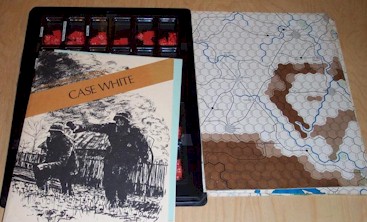
GDW opened the second generation era for Europa with Case White
in 1977, the first Europa game to feature multi-color maps (the maps of
the original Europa games were limited to white, black, and blue, with
most terrain other than clear shown in patterns of black or blue).
A Personal Note: I bought Case White at the GDW booth at
the Origins convention the year the game was published. I was hesitant
about getting the game at first. The historical campaign meant that the
Poles in the game wouldn't have much of a chance. Also, other games
I'd played on the Polish campaign (both stand-alone games and larger
games that included the invasion of Poland as a part) were
not very interesting, with the Germans stomping the Poles flat in no
time. Still, I knew a bit about the historical campaign, and, while it
was a decisive German victory, a lot of interesting things went on. The
Poles fought very hard and caused the Germans a lot of problems. So, I
bought it.
And never regretted my decision! Yes, the Germans
almost always overwhelm the Poles , but the game played quite interestingly. The
Germans have
to maneuver, pocket the Poles, race to Warszawa, risk losses, and even
worry about the French launching an off-map offensive against the
Westwall. Further, the game did not ignore the Soviet intervention but
treated it as an innate part of the campaign, with massive Soviet
invasion forces of rifle divisions, cavalry, tanks, and aircraft.
It was fun to play the game against over-confident German players
who didn't know much about the actual operations of the Polish campaign
and played assuming the Poles couldn't do anything except run away and
die. More than once I managed a small invasion of East Prussia (the
Germans there would lunge south toward Warszawa, giving the Poles
around Wilno a chance to move west into East Prussia. Once, a German
player quickly semi-pocketed a large force of Polish units in the
Polish corridor and started moving forces eastward, clearly expecting
the Poles to try to run. There was considerable shock when the Poles
moved west, crossed the lightly-defended German border, and headed
toward Berlin. Sure, none of these Polish counteroffensives ever
captured any big city in Germany, but it was worth it for the
consternation and disruption of plans they caused.
Case White was also an excellent game to teach new players the
basics of Europa. It had all the important rules: armor effects,
support, air power, etc., with a manageable number of units and a
reasonable game length for newcomers. Interesting games could occur
when an experienced Europa player took the Poles and the newcomer took
the Germans.
Case White's size also made it very amendable for examining
what-if possibilities for the Polish campaign. I eventually got to:
what if the Poles simply abandoned all territory west of the Vistua
River and deployed in "Fortress Poland" along the river. They
would be more concentrated and have a much better defense line. Alas,
the Germans could quickly close to the river line and soon force
bridgeheads, break out, and destroy the Polish forces. Two things
became clear:
-
The German had concentrated overwhelming forces
against the Poles.
-
With forces invading from East Prussia, Germany
proper, and puppet Slovakia, the Poles were being hit from the north,
west, and southwest. Poland was over half surrounded from the outset,
and all parts of western and central Poland were in easy reach of the
Germans.
Whether or not an early and successful French
offensive would have saved the Poles in 1939 will never be known.
Without one, however, the Poles have little chance at all.
--John M. Astell
|
 |
|
The 1985 update replaced Maps 1A and 3A of the 1977 edition with Maps
1B and 3B that first appeared in 1984 FITE. The 1977 rules were
updated to the 1985 Europa state of the art. The counters were
unchanged. Officially, GDW called the changes an update, not a
revision: The 1977 edition remained completely playable, and no
counters were changed.
A Personal Note: Updating this game brought back fond memories
of playing the game before I went to work for GDW (see above).
By 1985, Case White had gone out of print, and GDW wanted to
reprint it. Since Fire in the East had come out the previous
year, the reprint would use Maps 1B and 3B from FITE rather than
Maps 1A and 3A of the 1977 edition. Since the rules and OBs would have
to be done with the new map numbers (which by itself was not a trivial
production task, since the 1977 was not done on electronic media), it
made sense to update the rules based on FITE. (The game still
retained its specialized rules, such as movement costs to enter enemy
ZOCs, due to the shorter-than-standard time scale. It was a lot of fun
updating this game; little did I know that I would eventually redo it
in a completely new edition for GRD, as First to Fight.
--John M. Astell
|
 |