CRSRS referendum a success for student leaders
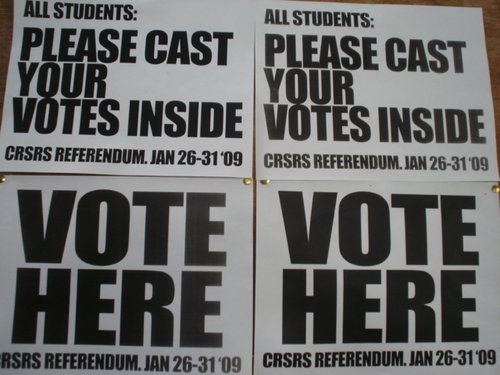
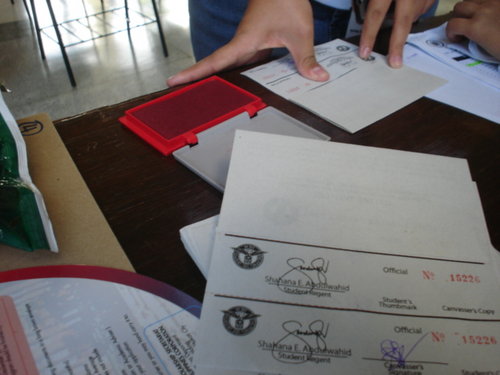
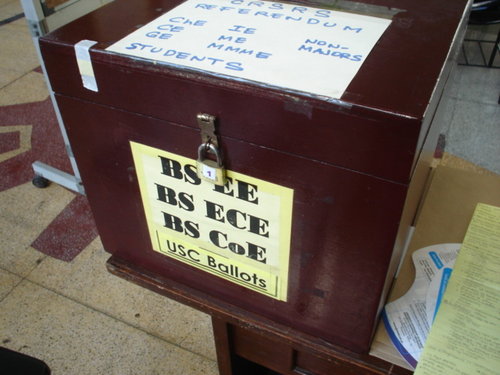
The success of the Codified Rules for Student Regent Selection (CRSRS) referendum last January 26-31 was dependent on the yes and no votes of UP students.
And this time, they delivered.
According to the final tally released by the Philippine Collegian, about 26,818 or 55 percent of the 47,365 total UP students voted. Among those who voted, 19,608 or 73 percent voted yes, while 6,747 or 26 percent voted no.(See final results of CRSRS referendum at the Philippine Collegian�s Multiply site)
For student leaders like present Student Regent Shan Abdulwahid, the referendum was a success. In an interview with the Collegian last February 6, she said that students showed they are not apathetic and are ready to protect institutions they themselves have established.
In the new UP Charter (RA 9500), the rules of selecting the Student Regent, or the sole representative of the student body to the Board of Regents, the highest decision-making body of the university, must be ratified by majority of the UP students in a referendum. The new Student Regent is expected to begin his or her term in April.
The 13 year-old CRSRS makes use of the process of nomination, screening and a system-wide election through the General Assembly of Student Council. Institutions such as UP Diliman and UP Manila have two votes while those who are not classified as �autonomous units� get one vote each.(See Sidebar 2 of Collegian article)
Within UP Diliman, 54 percent or 12,097 out of 22,348 students voted. Among those who voted, 66 percent checked the �yes� box, while about a third (33 percent) voted otherwise.(Final Results on Priming the Mandate on the Collegian)
Student empowerment
According to College of Human Kinetics representative Lester Yupingkun, the referendum in their college was generally peaceful. The sports science senior attributed the �peacefulness� of the process to the �apolitical� character of their college. He said that although 40 percent of the students came to the CHK library to vote, more work needs to be done.
�Political maturity comes with individual willingness. If ayaw ng mga tao maging politically active then it simply means hindi pa sila handa,� he said.
CHK is among the 18 colleges in UP Diliman who have voted yes overall.
Meanwhile, College of Fine Arts Student Council Chairperson Ralph Guibani said that the referendum was successful because of the more than 50 percent voter turnout. But, according to him, more students participated in the referendum compared to student council elections because it was a week-long process compared to the latter, wherein only about a day is given for the students to vote. When asked if they used roaming ballots to boost voter turnout, he said no, adding that not too many students are at the college at any given time.
Yupingkun, a Nagkakaisang Iskolar Para sa Pamantasan at Sambayanan or KAISA member, admitted that their party supports the no decision. But, according to him, this did not influence the CHK students� choices. �Regardless if a yes or a no vote is won, the important thing is that CHK realizes the Office of the Student Regent is a vital in the university,� he said. �May kakulangan pa ang student councils sa pagpapagalaw sa kanila. Political action should stem from the students, not from student councils.�
Guibani, a Student Alliance for Democratic Rights in UP or STAND-UP member, advocates the use of room-to-room and dorm-to-dorm discussions, online journals and organizing other events like debates to bring the issues closer to the students.
Alyansa ng mga Mag-aaral Para sa Panlipunang Katwiran at Kaunalran or ALYANSA member Andrew Parungao said that their party recognizes and respects the majority turnout of the CRSRS referendum, but they will still push for reforms that would ensure wider student participation.-30-
|