
A true example of Lichtenstein�s work in the comic genre he titled Image Duplicator. Painted in 1963, it displays many of the issues prevalent in Lichtenstein�s work. This includes the use of the staring face of a reproduced X-Men figure. Lichtenstein�s critics at the time attempted to use the origin of the painting, in this case different comic book heroes, to discredit his work as unoriginal and therefore not art. This attempt failed because by comparing the original imagery used as the basis for the painting to the finished product, anyone can see the many changes Lichtenstein made in the development of the work (Lobel 9). Critics at the time could not determine any meaning in Lichtenstein�s paintings because they could not see beyond the use of the comic book style that they were so appalled by. Critics of Lichtenstein did not attempt to see a message in the painting because they did not want this �low� art to be popular or accepted by the art world. Life magazine even asked the question as the title of a piece on the artist in 1964, "Is He [Lichtenstein] the Worst Artist in the U.S.?" The piece does also point out that he did not have only negative reviews of his work. Some critics, and much of the public, found his work, �fascinating�forceful�starkly beautiful� (Lobel 14). In his own way through this piece Lichtenstein confronts his audience. Through this piece, Lichtenstein, by using the aggressive stare of one comic book character, combined with the mask of a well known comic book villain, Magneto, characterized the figure as both angry, and as a villain for anyone who has ever read an X-Men comic book. Now that Lichtenstein set up the figure, he emphasized the message of the painting by including (in the comic book clich� talking bubble) the phrase: �What? Why did you ask that? What do you know about my Image Duplicator?� Original to the artist, this statement contains a multi-faceted message. First of all, the artist himself wished to convey the conflict between hand made and machine made in the way he creates his paintings. As an artist, Lichtenstein feels conflict in the way he duplicates already made images using machines, in this case a projector (Lobel 12). The qualities of art are that it is original and made by the artist�s hand, but Lichtenstein made this painting by copying other images and with the aid of a machine. To express this feeling of conflict, he �angrily confronts the viewer�s understanding of his art� (Lobel 13). Lichtenstein refers to himself as the image duplicator by saying �my.� Therefore, Lichtenstein challenges viewer and critic alike. He asserts with his alter ego, the masked villain, the question, what does the viewer really know about the artist�s intentions or process? Lichtenstein and critics felt this conflict in his art, and he confronts the conflict with this piece, challenging the viewer to accept the painting for what it is. Though many critics did not see Lichtenstein�s art as relevant, the message of Lichtenstein�s early comic strip art was truly the emerging threat of the machine, which was becoming more and more popular during the consumer revolution, to artistic practice (Lobel 159).
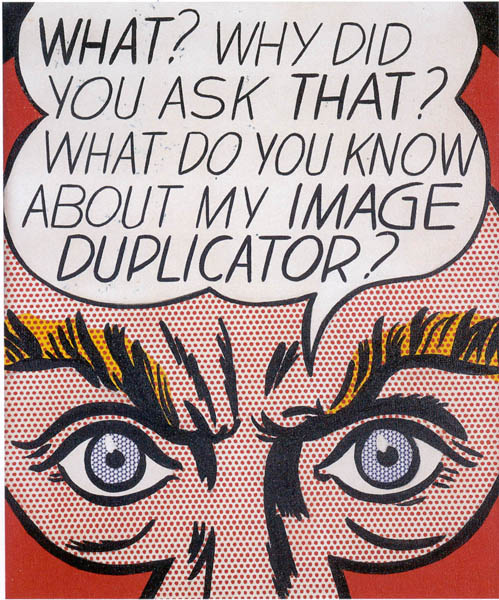
Simonyll Collection
Lobel, Michael. Image Duplication. New Haven: Yale University Press, 2002 pg. 2.


Roy Lichtenstein, Brushstroke, 1965, screenprint on paper, image: 56.5 x 72.4 cm, Tate Gallery, London.
http://www.artlex.com/ArtLex/p/popart.html