JASPER JOHNS
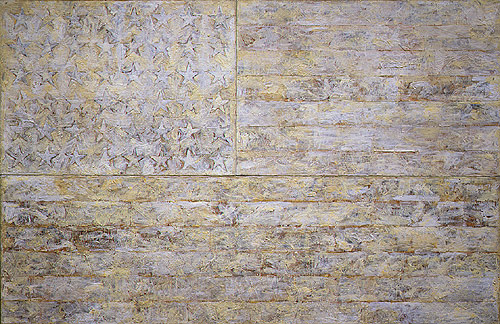
The first principal artist to use American popular culture in his work, Jasper Johns, contributed to the development of Pop art in its true form (Kleiner 1092).  Beginning with the foundations of popular culture�s collective images, Johns explored the American vernacular.  Johns held his first exhibition as the freshness of Abstract Expressionism declined with the second generation of painters in the movement.  Michael Crichton comments, �His assured and finely worked paintings of flags and targets offered an alternative to Abstract Expressionism, and reintroduced representation--the recognizable image--into painting� (37).  Not only did he begin using images in his work, he also began using recycled images before Andy Warhol and Lichtenstein based their paintings on advertisements and comic strips (Hughes �Sacred Aura�).  Johns mainly concerned himself with bringing attention to commonplace objects, familiar, but not really seen (Kleiner 1092).  While the later Pop artists concerned themselves with the �new� and the images of popular culture seen in advertising and movies, Johns, �carried forward his exploration of the American vernacular� (Hughes �Sacred Aura�).  Johns incorporated the most widely known aspect of the "American vernacular" when he used the American flag as a vehicle for a series of paintings.  Hughes comments on the commonplaceness of the American flag, writing, "it continued to be the property of all Americans, the climax of their stock of public symbols" (Hughes �Sacred Aura�).  Many Americans see the flag as a symbol of patriotism and devotion, but it seeing any object so much and so often can cause it to lose its meaning. Johns painted White Flag in 1955.  In this painting, he calls attention to this loss of meaning in the American flag by ignoring the flag as a national symbol.  He accomplished this by eliminating the colors of the flag, the main indicator of its symbolism.  Relating this effect, Hughes writes, "By treating its sacred form as mutable, he undermined it as a conventional symbol� (�Sacred Aura�).  In the era in which Johns depicted the flag, feelings of nationalism pervaded in the face of communism and the cold war.  According to Hughes, Johns reflected this in his flag series.  Hughes writes, "They [Johns flags] were cooler than the culture wanted them to be, in the midst of the cold war" (Hughes �Sacred Aura�).  Johns depicted the flag without showing any devotion to the flag, or by treating it as people normally see it, as a flat abstraction of stars and stripes.  Hughes describes the flag by writing, "The American flag is the best-known abstraction in the world; is a painting of an abstraction a representation?" (�Sacred Aura�).  Johns even went so far in this painting as to mute the shapes of the stars and stripes, by bringing the viewer's main attention to the surface of the painting.  This treatment causes a significant change in how people normally see the flag blowing lightly in the air, as opposed to Johns' depiction of the flag as an object.  Hughes describes this writing, "Flag is designed like a flag, but it's made of paint, not cloth, and it cannot 'fly'; it is static, stretched, rigid" (�Sacred Aura�).  Johns created his flag on a canvas, with a heavy build up of wax and newspaper to create the shapes of the stars and stripes and with encaustic, a fast drying medium, to make each brushstroke of white oil paint stand out (Metropolitan).   

Johns did not only use the flag in his experimentation with the American vernacular.  He also explored other public symbols, such as the target.  Using the ready-made image of the target gave Johns more freedom than the American flag.  The American flag always has the same meaning, while a target has a more versatile meaning.  A Johns biographer Michael Crichton writes, �a flag is bound to one nation; a target is universal� (31).  Symbols such as the flag and a target imply some kind of message to every American who views the symbol.  Hughes recounts the effect of a target by writing, "Everyone 'knows' what a target is�a test of a marksman's skill.  A target is supercharged with an imagery of aggression: every target implies a weapon and someone aiming� (�Sacred Aura�).  In Target With Four Faces, also painted in 1955, Johns continued to disillusion the viewer about the symbol, while also making a cool commentary on popular culture.  Johns made the target in similar way as he made White Flag.  He incorporated paint, encaustic, and newspaper to build up the surface of the painting.  In the upper area of the painting, Johns compartmentalized four faces made from a plaster mold of the lower portion of a model's face.  By forcing together the implications of the target itself with the four faces in the upper portion of the painting, Johns allowed for the viewer to determine the actual meaning of the ambiguous relationship between the two main aspects of the painting (Crichton31).   Though the viewer can determine the meaning of the painting, Hughes defines the painting by the time and place in which it Johns made it.  Hughes writes, "This had an inescapable point in the mid-'50's, when politicians and all the American media were pounding into the collective imagination...the message that the whole nation was a target for Russian thermonuclear weapons� (�Sacred Aura�).  Hughes determines that because of the cold war, the orientation between the target and the faces reflects the propaganda of the time.  Another orientation of this painting Hughes finds in the artist's personal life.  He explains, "Johns was a reserved, closeted gay, and a work like Target with Four Faces...is all about threat and concealment� (Hughes �Sacred Aura�).  Hughes sees in the compartments of the four half hidden faces, the message that Johns concealed them to reflect the concealment of his true self because he felt he was threatened, that he as a gay person was a target.  This assessment makes sense because of the time in which Johns painted target there was a growing uneasiness toward gays, or anyone to the left or the right of the consensus, but to the viewer this assessment of the painting may not be immediately apparent.
Jasper Johns
White Flag, 1955
Encaustic, oil, newsprint, and charcoal on canvas

From the Metropolitan Museum of Art
�Jasper Johns/Licensed by VAGA, New York, NY

http://www.metmuseum.org/Works_of_Art/viewOne.asp?
dep=21&viewMode=0&item=1998%2E329
Jasper Johns
Target with Four Faces,1955
Encaustic and collage on canvas with plaster casts

From the artchive website

http://www.artchive.com/artchive/J/johns/target_4.jpg.html
Backgraound Image 0 Through 9 print by Jasper Johns
From the Art Institute of Chicago website
Lithograph, 1967; 64.1 x 51.6 cm

� 1999. The Art Institute of Chicago. All text and images on this site are protected by U.S. and international copyright laws. Unauthorized use is prohibited.
http://www.artic.edu/aic/collections/prints/93pc_johns.html
Hosted by www.Geocities.ws

1