
Pop Art and Popular Culture
In today's modern society, billboards, television commercials, magazine advertisements, and movies bombard us with the imagery of American popular culture. This was not always the case. Those born after World War II would think the tumult of advertising strategies and new products that hit them everyday occurs naturally, as a part of everyday life. People born earlier, who experienced the maturation of America's consumer culture, perceived a completely new landscape at that time (Hughes �Mass Media�). The artists of this new era of consumerism reacted to the optimism of the new cultural attitudes in their art works. By examining the emergence of Pop art and the work of Jasper Johns, Roy Lichtenstein, and Andy Warhol one can see how these artists used the imagery of popular culture of the 1950�s and 1960�s to change the face of Modern art and reflect their society.
To begin exploring the connection between Pop art and popular culture, one first examines the way Pop art developed. Pop art emerged in response to the late Modern art movement known as Abstract Expressionism. Before Pop art, Modern art of the twentieth century was primarily an upper class or an upper middle class interest. The post-war years gave Modern art more publicity and acceptance than ever before. Even the older generation, who did not like or understand Modern art, had to accept that this was the art of the day. Modern art appealed to young people, upper class, middle class or lower class, because they saw something rebellious about this art--partly because the older generation did not understand it. This generation of young people had to create a new way of life for themselves because, �young people everywhere had more leisure and education than ever before� (Lucie-Smith 20). Pop art began to address this change.
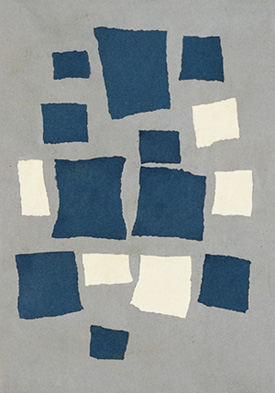
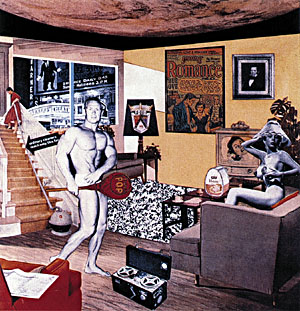
The shift from Modern art to Pop art began in Great Britain. With the influx of young people into the higher educational realm, the number of art schools expanded, especially in Great Britain. Unlike American universities, art schools and liberal arts schools were not linked. If a young person wanted to study art, that person obtained a freer education, with less formal study in Great Britain (Lucie-Smith 21). Because of this freedom, Pop art emerged in London first, with the Independent Group at the Institute of Contemporary Art. Here, the reaction to Abstract Expressionism and the re-exploration of collage began (Lucie-Smith 119). The collage technique, already explored by the Dadaists, employed the usage of the idea of the �ready-made.� The �art of assemblage� means literally �creating works of art almost entirely from pre-existing elements� (Lucie-Smith 119). The art does not lie in the elements, but the links found between the elements. The artists of the Independent Group sought meaning in the symbols and advertisements of mass culture. The early development of Pop art in London centered on the art of assemblage as the artists juxtaposed popular imagery in such a way as to force the viewer to consider how popular advertising can shape modern attitudes (Kleiner 1091). This new way of creating art differed greatly from Abstract Expressionism. Instead of making paintings about the process of painting, the artists reoriented the subject matter to an association with their environment (Lucie-Smith 121). Richard Hamilton exemplified this in the first known instance of true Pop art in 1954 with a work entitled, Just What Is It That Makes Today's Home So Different, So Appealing? Like most artists in the Independent Group, Hamilton was fascinated by the new urban popular culture in America (Lucie-Smith 133). Using the collage technique discussed earlier, Hamilton defined one of the main conventions of Pop art�the use of borrowed imagery (Lucie-Smith 135). He also employed the main qualities of Pop art, �popularity, transience, expendability, wit, sexiness, gimmickry, and glamour. It must be low-cost, mass produced, young, and Big Business� (Lucie-Smith 135).
Pop art developed differently in America. Since the artists in the Independent Group were inspired by the culture of America, Pop art found its greatest success in America. American culture was changing at this time. American culture went through a consumer revolution beginning in the 1950's, with the end of World War II. Americans rushed out to buy all the new products business made to fill their homes in the suburbs. The American middle class reveled in the new material benefits of this consumer revolution. The new popularity of television gave Americans, "a steady diet of shared images" (Gillion 1092). This consumer revolution affected the Pop art movement. The emerging consumer culture in America embraced Pop art because, �It was art about consumption, and it sat up and begged to be consumed� (Hughes �Mass Media�). The market for these paintings consisted of young people who may not have been able previously to buy paintings. Since Pop art pieces were, �easily, and at time misleadingly, reproducible,� they were able to attain the pieces, making Pop art a part of popular culture in a way that Abstract Expressionism could never have been (Hughes �Mass Media�).
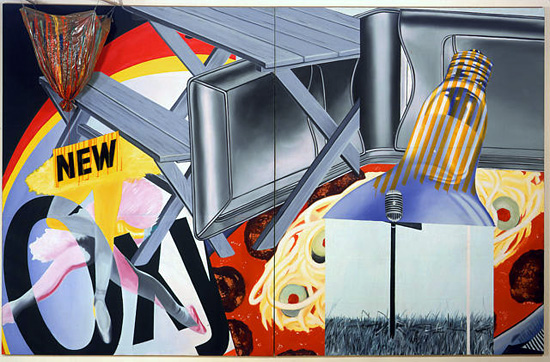
The post World War II consumer revolution created a new audience for Modern art. As Pop art emerged, artists struggled to define the movement. Due to this struggle, the artists of the American Pop art movement vary widely from each other. Carrying the tenets of Pop art put forth by Hamilton, these artists explored �ready made� imagery in different ways. Art critic Robert Hughes writes, �a number of young artists emerged in New York City who had little in common beyond their curiosity about the largely disparaged sea of mass media and commercial persuasion: ads, billboards, newsprint, TV montage and all kinds of kitsch� (Hughes �Mass Media�). One of the more formal Pop artists, James Rosenquist, created his own style, labeled �New Realism,� in reaction to Abstract Expressionism. A former commercial artist, Rosenquist, �developed his own brand of New Realism--later to be coined Pop art--by fragmenting and recombining images drawn from advertising� (Guggenheim). One of his works, made in 1963, displays this technique and reflects ideas of 1960's popular culture. In this painting, Nomad, Ronsenquist uses the word �new� emblazoned in the left corner of the painting along with consumer items such as the detergent brand name in the background, and signs of leisure activities exemplified by the picnic table, and ballet dancers to reflect the aspect of 1960�s America that, �Everything was �new� in this affluent, mass-producing, and consumer-oriented society� (Smith). Though these early Pop artists contributed to the movement, there are three principal artists that employed the images of 1950�s and 1960�s popular culture in a truly significant way.
Laser print from Yale Bulletin
http://www.yale.edu/opa/v32.n17/story7.html
� Copyright 2002 The Museum of Modern Art
http://moma.org/collection/depts/drawings/
blowups/draw_010.html
Oil on canvas, plastic, and wood, 90 x 141"
Gift of Seymour H. Knox, 1963
�James Rosenquist./Lincensed by VAGA, New York, NY
http://www.albrightknox.org/ArtStart/Rosenquist.html


Edward Ruscha (American, 1937-), Large Trademark with Eight Spotlights, 1962, Whitney Museum of American Art, New York, NY
http://www.artlex.com/ArtLex/p/popart.html