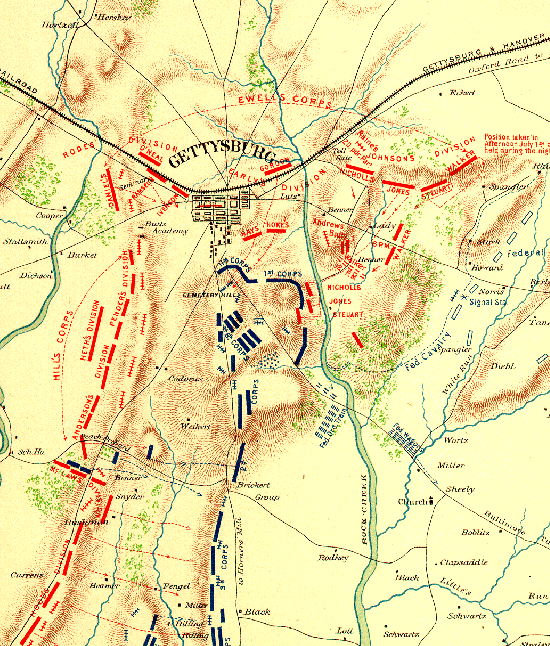
| At nearly midnight on July 1st, Major General George Meade, who had taken command of the Army of the Potomac less than a week, arrived in Gettysburg to observe the Union position. General Meade came to the conclusion that his position was weak but unchangeable. The I Corps and the XI Corps received reinforcements from the XII Corps and parts of the III Corps, which arrived from Emmitsburg Road at 9AM. The artillery reserve arrived by 10AM. Brigadier General Samuel W. Crawford�s 3rd Division of the V Corps arrived at about noon. Major General John Sedgwick�s VI Corps didn�t reach Rock Creek until 4PM when it completed a 34-mile march from Manchester, MD. Due to the absence of a large portion of the Army, the Federals were kept on the defensive. Thinking that an attack by the Confederates would take place on his right flank, Meade posted the entire XII corps on Culp�s Hill to Rock Creek by 6AM. The V Corps were placed in reserve along Baltimore Pike, southeast of town. General Robert E. Lee knew that the Union Army would more than likely not attack but he also knew he couldn�t wait letting the enemy reinforce their lines. Lee decided to strike, planning to hit both flanks. Rodes, Early and Johnson were to attack on the Union�s right flank while General John Bell Hood, Anderson and McLaws Division�s would attack on the left. Early, Rodes and Johnson, already in position, would wait for Hood, Anderson and McLaws for a combined assault on the Union�s two flanks. In order to hide their flanking movement from the Union Signal Station located on Little Round Top, it took the Confederate Troops until 3:30PM to get into position on Warfield Ridge. The Federal Left Assaulted The III Corps under Major General Daniel Sickles held the left flank and had sent out skirmishers in the form of Berdan�s Sharpshooters and the 3rd Maine. In Pitzer�s Woods they were met by Wilcox�s Brigade of Anderson�s Division out past Emmitsburg Road and after a quick engagement withdrew to report the encounter to Birney�s Headquarters. Sickle�s decided to hold the high ground to the west because of strong Confederate strength on his front. Birney�s Division under orders by General Sickles moved along the southern flank and Humphrey�s Division, to the west, to the bewilderment of the remaining Union line. Ward�s Brigade was placed on Devil�s Den to secure Birney�s left and Graham�s Brigade in the Peach Orchard. Detrobiand�s Brigade remained in column formation in the Wheatfield to support either flank in case of attack. Graham�s Brigade joined up with Humphrey�s Division to extend the line close to the Codori Farm. With Sickles line in a V-shape formation and distances in between, Little Round Top was left unoccupied with a large gap between Humphrey�s right and Gibbon�s left while the III Corps stood alone against a larger Confederate force. General Meade inspecting the new position was greatly displeased and ordered the V Corps to support the left, and the arriving VI Corps would support the right. By the time General Sickles offered to withdraw, the firing of skirmish and artillery were already increasing and a withdrawal was not possible. So General Meade ordered the entire V Corps and a division of the II Corps into action to reinforce the III Corps line. Little Round Top, Devils Den & Wheatfield General John Bell Hood�s Division of General James Longstreet�s Corp, at 4 PM, launched their assault on the southern flank of the III Corps. Hood�s protest to change the orders for the attack went to no avail but did have Law�s Brigade bear further right to attack Little Round Top. Ward�s Brigade, deployed on the hill above Devil�s Den was the focal point of the attacking Confederates, who came under heavy shelling by Smith�s New York Battery. Robertson and Law�s Brigade soon found themselves flanked by Detrobiand�s 17th Maine and had to fall back, giving Ward�s men the opportunity to take their lost position after having been swept by Law and Robertson. Now in a wide arc formation, Law�s Brigade pushed aside three Union Regiments who were defending the valley just in front of Little Round Top. Brigadier General Gouverner K. Warren had seen the strategic importance of Little Round Top and rode out to meet the approaching V Corps and met with Colonel Vincent Strong�s Brigade and moved them to Little Round Top just in time as Law�s right flank, the 15th Alabama, under Colonel William C. Oates, began it�s assault on the slopes of Little Round Top. Here, the 15th Alabama came against the 20th Maine, led by Colonel Joshua Lawerance Chamberlain, a former professor at Bowdoin College. The fighting was brutal and at several times, hand to hand among the hill�s boulders. The Union troops had a defensive advantage on the hill but the oncoming, relentless Confederates made things extremely difficult for Vincent�s right. The Texans were reaching the top when they were charged by the 140th New York Regiment and repulsed down the hill. Colonel Patrick O�Rorke, along with 133 casualties in the regiment were killed in the struggle but in doing so secured the Union right on Little Round Top. On the left of the round top, the 20th Maine fought heroically against the 15th Alabama. Led by its charismatic Colonel, the 20th Maine repulsed the Alabamians after Chamberlain ordered a bayonet charge when the regiment ran out of ammunition. This sent the Confederates, scattering and disorganized, retreating. Though Devil�s Den was in possession of Confederate forces, the Union�s left flank was secured, saving the Union line from collapsing. Robertson�s two brigades, after being repulsed by Ward and Detrobiand, were in trouble and called on Hood for support. But General Hood had been badly wounded, leaving Law�s in command. Law�s himself was at that time in advance on Little Round Top, and so the division was left commandless. Luckily Bennig�s Brigade appeared and Anderson�s Brigade showed up on Robertson�s left to turn the tide on Ward and Detrobiand. Ward�s left was then shattered by Bennig and Robertson and the Union forces surrendered Devils Den. Detrobiand was pushed back in The Wheatfield by Anderson�s Brigade and retreated as the II Corps Division formed at the northern end of the Wheatfield. They charged Anderson�s Brigade and with Tilton and Sweiter�s V Corps Brigades, hit Anderson�s flank and forced them back through the Wheatfield. Moving in support of Hood was Lafayette, McLaw�s 2nd Division. Kershaw�s Confederate Brigade, followed by Semme�s Brigade advanced out and Kershaw hit the southern flank of the Peach Orchard and Tilton and Sweitzer�s position near �The Loop�. Kershaw was then forced back by artillery fire on his left and Cadwell�s Division on his right. But an error by Tilton and Sweitzer by withdrawing allowed Kershaw and Semmes to push the Union brigades into a retreat and yield the Wheatfield to the Confederates. After another Union push by General Cadwell back through the Wheatfield, the Union line was again stable only to be smashed by McLaws men. Now almost completely surrounded, Brooke and Sweitzer fell back. The losses were great and not long after the Union forces were routed. General Sickles was severely wounded by his headquarters at the Trostle Farm when he had his right leg shattered by a solid 12-pound cannonball. The entire III Corps salient had given way. The Assault on Culp�s Hill At Culp�s Hill the synchronized assault of General Richard Ewell and Longstreet did not go as planned. General Longstreet�s assault had been underway for well over an hour. And Ewell, being short two brigades, still didn�t send his men to assault. Early had sent Gordon�s and Smith�s brigades to pursue an erroneous report of Union troops which turned out to be only a Union Cavalry screen. With General J.E.B. Stuart�s Cavalry having finally arrived after his whereabouts were unknown for the first day of battle, it was not much of a concern. But Smith�s Brigade remained to assist Stuart and only Gordon returned. Unable to wait any longer, Ewell ordered General Edward Johnson�s whole division to move against Culp�s Hill. The Union XII Corps was at this being withdrawn by Meade�s orders to assist the collapsing Union left. General George Greene�s Brigade extended to fill the vacated breastworks left by the removed XII Corps just as Johnson�s Confederates came storming up the hill. Jones� Brigade hit Greene�s center while Steuart�s and Walker�s Brigades moved around to the right. Jones� men were having a difficult time and were relieved by Nicholl�s Brigade. For Steuart and Walker the assault went much easier and they moved into the empty Union trenches. A small group of Union troops were the only thing between the Confederates and Baltimore Pike. Made cautious by the darkness however, the Rebels stayed in the trenches. Greene received reinforcements by General John Geary�s Division and Nicholl�s last assault was repulsed and the fight for Culp�s Hill ended. The Struggle for Cemetery Hill The Attack on Cemetery Hill began with General Jubal Early assaulting the east and Rodes, the west. Early�s Brigades of Hays and Avery formed near the Culp House and marched over the rise and were hit with artillery from Cemetery Hill and Stevens Knoll, with Colonel Avery being of the first to fall. Barlow�s old XI Corps Division were charged and retreated from the wave of Confederates who took East Cemetery Hill. But reinforcements were coming to the Union lines. After pushing back several Union attacks in the dark, the Rebels fell back slowly with over 600 casualties. Cemetery Hill in Confederate hands could have wrecked the Union line but Rodes failed to attack and Early, to support Avery and Hays. With seven brigades available but only two engaged, a victory so close for the invading Confederates was lost, and the second day of bloody, brutal combat ended. |
| The Battle of Gettysburg: Day 2 By Joe Knotts December 2002 |
 |
 |
 |
 |
|
 |
 |
 |