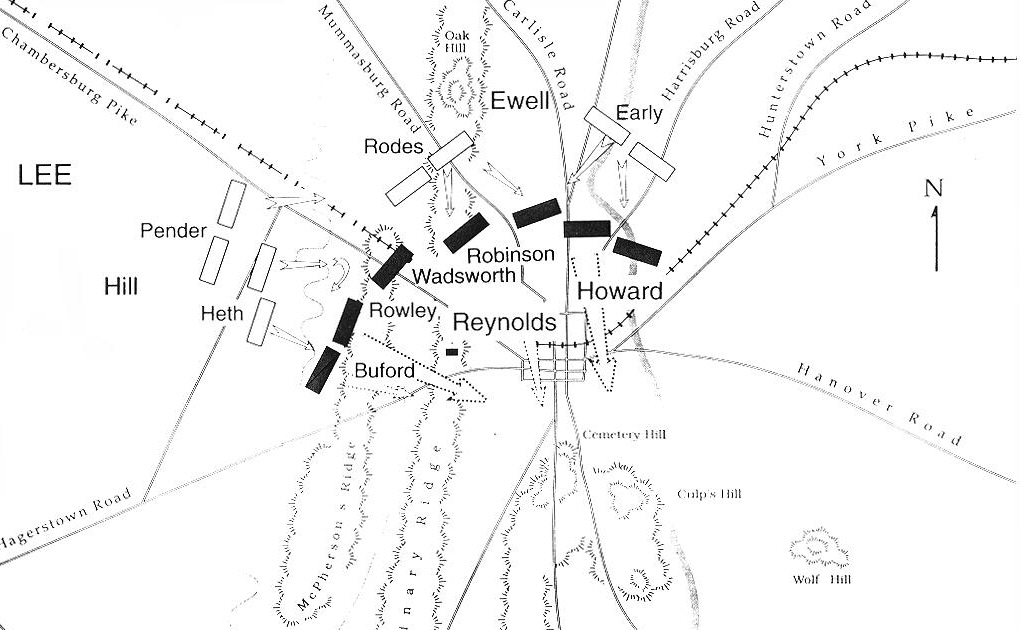
Meanwhile, Robinson�s two brigade�s were located near the Luthern Seminary in reserve. Brockenborough struck the flank and front of Biddle�s Brigade while moving into position. This threatened to turn the Union left. Pettigrew had picked up the remaining troops of Davis� Brigade and attacked Stone�s Brigade, who was outnumbered, on Meredith�s right. But this Brigade fought valiantly and held their ground against the oncoming Confederates. After about an hour, General Heth accepted that the Union line could not be broken and ordered his men to fall back from the enemy. With the entire Corps 80 artillery pieces, A.P. Hill arrived with General Pender�s Division and began to shell the Union lines at 12:30 noon. Doubleday received the signal that the Union XI Corps was approaching and 15 minutes later Schurz�s Division arrived into Gettysburg.
Oak Hill
Once on the field Maj. Gen. Oliver Howard took command of both Corps and command of XI Corps was turned over to General Schurz and with Barlow�s was orderd to expand the line to Oak Hill while Von Steinwher�s Division was ordered to a position in reserve on Cemetery Hill. Advancing on Newville Road was Maj. Gen. Robert Rodes� Division with five Brigades strong just as the XI Corps was moving into the fields north of Gettysburg. Rodes� was ordered to occupy Oak Hill by Lt. Gen. Richard Ewell. This placed Rodes immediate move on the right flank of the I Corps and denied the XI it�s anticipated position. General Howard now ordered Schurz�s Division, now under Schimmelfennig, to put it�s left flank on the Mummasburg Road and Barlow�s Division was ordered to lift up the line and expand it to the Almshouse, which left a � mile opening between Barlow�s and Schimmelfennig�s two Corps. Seeing the hazard that Rodes offered to the I Corps, Doubleday ordered Baxter�s Brigade to lengthen the right flank to Mummasburg Road. Three regiment�s of O�neal�s Brigade was thrown at Baxter who was assisted by Wheeler�s and Dilger�s batteries and O�Neal�s troops retreated in disarray. After O�Neal was repulsed, the North Carolinians of Iverson�s Brigade began firing toward Baxter�s flank across Forney�s Field. Moving unnoticed, Paul�s Brigade took up position and covered Baxter�s flank and hidden by a stonewall, the Federals rose over and Iverson�s men where hit hard by three Union Brigades costing the Confederates over 800 losses. Daniel�s Brigade was supposed to cover Iverson�s right but became confused and weren�t able to support Iverson�s men. Rode�s assault had been a failure and serious casualties resulted. By 3pm Rode�s had been unsuccessful.
Confederates Rout Union Troops
General Heth trying to assist Rode�s once again assaulted the Federals in McPherson�s woods and Brockenborough was repulsed by the Iron Brigade. A.P. Hill ordered three of Pender�s Brigades to move up putting pressure on the Union lines. The XI Corps receiving intense shelling from Rode�s artillery from Oak Hill, advanced north with Confederates on their right flank. Overlooking Rock Creek, Barlow sent his line to the right to meet an attack and to flank Dole on his left. In doing so, Barlow exposed his rear and right flank to outnumbering Confederate forces. When Jubal Early arrived with his Division it brought calamity to the Union Corps. The Georgia Brigade under General John Gordon was on the right of Early�s line, waded through Rock Creek and charged Ame�s Brigade on what is known today as �Barlow�s Knoll�. The Brigade made an orderly withdrawl in the Almshouse line but soon after their flank was hit by Hays and Avery. Devin�s Cavalry and Coster�s Brigade, who came down from Cemetery Hill, to assist halting the Rebels, found their attempts in vain as their line was flanked and broken and the XI Corps was thrown into a rout. Baxter and Paul were forced to withdraw under the heavy fire of the Confederates around the Seminary Ridge railroad cut. Pender�s Division now assaulted McPherson�s Ridge only to be repulsed by Meredith�s Brigade while Biddle�s exposed regiments had to retreat causing the �Iron Brigade's� left flank to be exposed. Soon Meredith and Stone began to fall back to Seminary Ridge. Now Pender�s Division along with O�Neal, Daniels and Ramseur attacked Seminary Ridge but with startling losses on the Rebels. The battle continued for ten minutes at point-blank range with men fighting with bayonets, cannon swabs, rocks and even fence rails, with huge losses on both sides and the Union troops were soon forced to retreat back to Cemetery Hill. Union troops ran through the streets of Gettysburg in confusion and disorder but the Confederate troops did not follow in force. Union losses exceeded 9,000 men, 5,000 captured, many from the rout by the Confederates. The victorious Confederates casualties were not at all better. General Robert E. Lee arrived by 4:30pm and observed his surroundings from the Seminary cupola and by nightfall, Ewell nor Early followed up with anmore assaults on Cemetery or Culp�s Hill. In doing so, Ewell lost an exceptional opportunity to break the Federal lines. Thus ended the first days struggle at Gettysburg. |