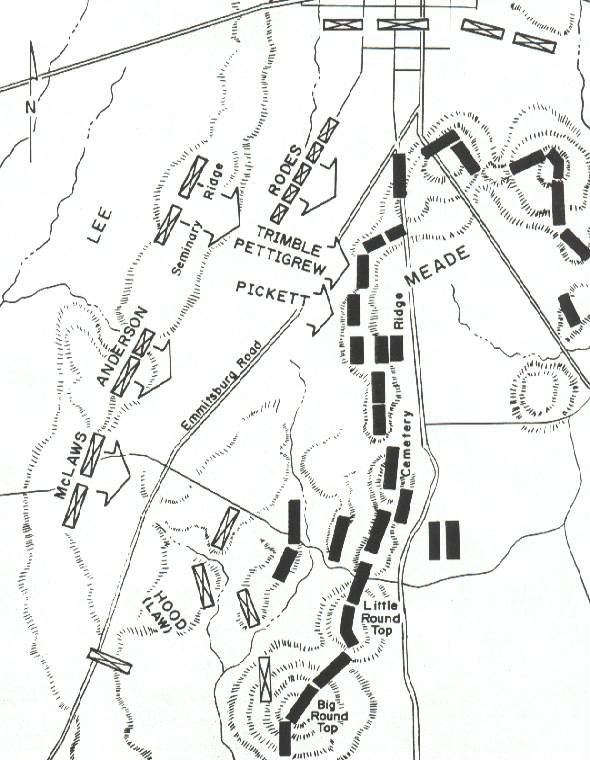
| On the night before July 3rd 1863, Corps Commanders of the Union Army voted to stay and fight at Gettysburg but would not take an offensive action against Lee�s forces. For General Lee, his choice was to either take the offensive or retreat. General Lee felt that with the closeness of victory from the previous two days battles, retreat was not an option. With the assault on the Union flanks the day before, Lee knew that the Federals would be reinforced there and that the center of the Union line had to be weakened because of that. So the decision was made. The Confederates would strike the center of the line, split Meade�s force in two and destroy the Army of the Potomac. General James Longstreet was opposed to the plan of marching nearly a mile across open ground and believed that they should attack to the Union�s left flank. The Fighting at Culp�s Hill and Spangler�s Spring While Lee was planning the assault against the Federals center, musket fire erupted in the area of Culp�s Hill. General Meade, favoring the no offensive tactic, was forced to order the XII Corps to eliminate the Confederate troops who threatened Baltimore Pike. Slocum�s Corps would attempt to reclaim their trenches from Johnson�s Division, which had been reinforced by a brigade from Rodes Division and a brigade from Early�s Division. Around Spangler�s Spring the fighting became vicious. The 2nd Massachusetts and the 27th Indiana attacked Confederate earthworks unsuccessfully and with frightening losses but managed to repulse a Confederate counterattack. Back up on Culp�s Hill, Greene�s men held against the Rebels and after one great counterattack by Union troops, the Confederates gave way and Johnson withdrew his troops beyond Rock Creek, leaving the earthworks in Union hands. The battle for Culp�s Hill had ended. The Confederate Cannonade Now, with Culp�s Hill in Union hands, Johnson could not assist Longstreet in the assault, adding to Longstreets uneasiness with the plan. Despite this General Longstreet ordered General George Pickett�s fresh division into position in front of Spangler�s Woods. Pettigrew and Trimble moved into the woods along Seminary Ridge. The assault was focused on a clump of trees on Cemetery Ridge. For th coming assault, Confederate artillery had been deployed on the high ground from north of the Peach Orchard to the McMillian House. The cannonade that followed is one of the greatest in the history of the Civil War. The cannons commenced at One o�clock in the afternoon throwing shells into and shaking up the Union line on Cemetery Ridge. With over a hundred guns raining shells on the Federal line, Union artillery began returning fire but with great losses of men and horses due to being exposed. The guns on Little Round Top however, had better cover and began hitting the concealed Confederate infantry. Many Confederate guns were overshooting the Union line causing General Meade to evacuate his headquarters and relocate to Power�s Hill. This was unfortunate as the purpose was to disable Union batteries that would defend against the assaulting Confederates. After nearly two hours, Colonel Edward Alexander, commander of the I Corps artillery, observed Union batteries withdrawing and sent word to General Longstreet that now was the time to begin the assault. But what Alexander saw were only batteries withdrawing to resupply while reserve batteries were moving up to take their place. Longstreet�s men would be marching against fresh artillery. The Confederates Make the Charge Confederate troops began moving forward from the trees and forming their lines on Seminary Ridge about 15,000 strong. Pettigrew�s and Trimble�s Divisions lined up a half a mile long and in front of Spangler�s Woods came three brigades of General Pickett�s Division. Some surviving Union troops would later describe the incredible site of marching Confederate troops as looking like a �grand parade.� The awesome sight of the advancing Confederates soon became a horrific spectacle as Union artillery opened fire. Large holes began being ripped into the ranks of Confederate troops. Davis and Brockenborough�s Brigades on the left flank were taking heavy losses from the shelling by batteries on Cemetery Hill. By the time they had reached the Bliss Barn, which was now in flames, Union artillery had taken it�s toll and Davis� and Brockenborough�s men broke ranks and retreated back to Seminary Ridge. Pickett�s men were hit hard as well from guns on Little Round Top, but executing a series of oblique movements, marched on. Nearing Emmitsburg Road, the Confederate troops were slowed down by fences. Once over and through they dressed their ranks and proceeded on across the road to the sloped ground leading toward the Copse of Trees. Moving at the double-quick, the Confederates let out the chilling Rebel Yell as Union troops increased their musket fire along with the artillery. The charge slowed and groups of Confederates reached the stone walls and crossed them only to be met by double canister from waiting batteries and shredded. Whole companies were annihilated. Brutal hand to hand fighting took place between the two sides as the Confederates clashed into the Union lines. General Lewis Armistead, who had placed his hat on his sword and shouted to his men �Who will follow me?� as he crossed over the stone wall, led 200 men into the angle to capture Cushing�s guns. General Armistead fell mortally wounded near Cushing�s battery and the surviving troops were pushed back. The attack had failed and the rebels began retreating. Many Confederate troops retreated boldly, walking backwards facing the Federal troops, refusing to be shot in the back. �It�s All My Fault.� General Lee observing the assault and retreat rode out to meet his defeated men. Here, while preparing his troops for a possible counterattack, Lee exclaimed, �You have done all that men can do, the fault is entirely my own.� As night fell, General Lee ordered that his lines be pulled back in case Meade attempted an attack with the morning light. The town of Gettysburg had been ravaged by the battle and suffered a casualty of it�s own, 20 year old Mary Virginia Wade, who was struck by a bullet in her sisters home while making bread for Union soldiers on the morning of July 3rd. The next day on July 4th, in a rain that fell all day, Lee began making his retreat back into Virginia. Since these three tragic days in July of 1863, the battle of Gettysburg has been called the turning point of the Civil War and the High Water Mark of the Confederacy. The defeat at Gettysburg was a harsh blow to the Confederacy and the image of southern invincibility had been shattered. But the war would continue on for two more devastating years and Lee, along with his men, would make life hell for U.S. Grant until the surrender at Appomattox on April 9, 1865. |
| The Battle of Gettysburg: Day 3 By Joe Knotts January 2003 |
 |
 |
 |
 |
|
 |
 |