common ground
| HOME | PREVIOUS | NEXT | LINK | CONTACT US |
|---|
Our Skins Cannot Be Willed Away
By Sulak Sivaraksa
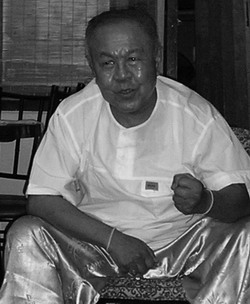
| Sulak Sivaraksa is a prominent and outspoken Thai intellectual and social critic. He is a teacher, publisher, activist, and author. In 1987, Sivaraksa and other leading Buddhists including the 14th Dalai Lama, the Vietnamese monk and peace-activist Thich Nhat Hanh and the Theravada Bhikkhu Maha Ghosanandaone, founded the International Network of Engaged Buddhists. Sivaraksa was awarded the Right Livelihood Award in 1995 and has twice been nominated for the Nobel Peace Prize. For more information about Sulak Sivaraksa’s life and work, please visit http://www.sulak-sivaraksa.org. |
|
Contrary to popular misinterpretation, in Buddhism self-reliance does not imply an autonomous, asocial, ahistorical, perfectly translucent, and transcendental self. So it is neither like the Cartesian self, nor like the rugged neoliberal and consumerist self of late capitalism. Rather, there is a certain “naturalism” or immanence in the Buddhist notion. By this I mean that there’s no supernatural intervention in human activities and that although the self is ‘ambiguous’ and shaped by nature, culture, and history, it is amenable through self-training and experimentation such as via meditation and proper breathing—hence the “not-self” in Buddhism. I have stressed on countless occasions that the Buddhist response to Descartes is “I breathe therefore I am,” and this constitutes what may be called spirituality—which entails the care of the self—or the ‘simple magic’ and ‘small wonder’ of Buddhism. This immanence, which is without guarantees since there is no metaphysical comfort, becomes a preliminary condition for the persistent cultivation of generosity, compassion, and wisdom; that is, the transformation of greed into generosity, hatred into compassion, and delusion or ignorance into wisdom. Again, these are tied to humility and simplicity. The Buddha after all was a simple monk. And they all cannot be cultivated without being engaged with the world, without having virtuous companions, and without confronting the sufferings in the world mindfully and nonviolently.
Since there is no autonomous self, self-reliance is then about being in and with the world, about what Thich Nhat Nanh calls “inter-being”. Self-reliance does not mean self-attachment or clinging to the self. Put more mundanely, it’s about interdependence since we are all vulnerable and life is precarious or fragile, and we are not perfectly sovereign. This condition cannot be willed away—our skins cannot be willed away—even if we live in gated or fortified communities patrolled by private security firms, acquire immense wealth, etc. In Buddhism, happiness entails traveling on the Middle Path without self-attachment. Devotees of the Buddha (lay or otherwise) are expected to examine themselves on a daily basis. And the things to be contemplated on a daily basis (Abhinhapaccavekkhana) are as follows.
1. One should again and again contemplate: I am subject to decay and cannot escape it.
2. I am subject to disease and I cannot escape it.
3. I am subject to death and cannot escape it.
4. There will be division and separation from all that are dear to me and beloved.
5. I am owner of my deed, whatever deed I do, whether good or bad, I shall become heir to it.
Greed, hatred, and delusion are tools to foster a perfectly sovereign self, which is roguish by nature. We kill others, we dominate others, represent various isms we hold dear as absolute, etc. to feel sovereign, for instance. Self-reliance thus posits a non-possessive and non-domineering kind of agency, one that shuns from fixed hierarchies or totalities such as structural violence. Once again, many have pointed out that nonviolence or ahimsa is ‘the master precept’ in Buddhism.
am Nation A short film by Sara Schaumburg