common ground
| HOME | PREVIOUS | NEXT | LINK | CONTACT US |
|---|
Rethinking the Radical
Finding the Defrocked Buddhist or the Anarchist within
By Katherine Ciecko
| NEXT>> | 2 |
 |
 |
 |
 |
 |
You leave school, get a crap job, then have to work there and contribute to a society you don't even believe in,” says Gavin Simpson, “or become a student, then get a crappy job you thought you wanted, but really are forced to work there to pay the mortgage, rent, etc.” Gavin squats in a building along with thirty other people. Squatting, or living on someone else’s property, is legal in the Netherlands.
Gavin takes me for a tour of Nijmegen, the oldest city in Holland and home to the chapel of Charlemagne. He laughs at the red and black colors of the city flag: “A city made for anarchists.” We visit a bookstore that we can’t afford, walk for miles to visit a friend’s new home —still needs plumbing and she can’t quite get the lone space heater fixed—and sit in on a meeting for immigrants’ rights until I’m too hungry to pay attention. Later, I ask Gavin why he, or anyone, would choose to live this way. In short, he told me, it’s about control.
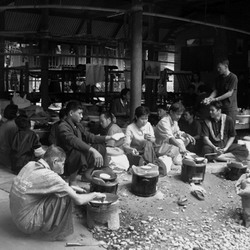
A hemisphere away, a drastically different kind of community is finding similar solutions to the same problem. “I can buy your life if you are in the capitalist economic system. You will be my slave. If you won’t work for me, you'll be done for....If you don’t have money, you are worse than a dog.” I sit patiently while someone implores me to see how we isolate ourselves in modern society and offer ourselves up as “wage slave” putty. But this time it isn’t Gavin, or any of his squatter friends. Gaenfah Sanmuang, Secretary of the Asoke political party, leans back and gestures around with a smile, “I will never be jobless in my whole life.” We are sitting in an “engaged Buddhist” village nestled in Northeast Thailand, surrounded by bamboo trees and happy teenagers chopping vegetables for the communal morning meal. The Asoke are a Buddhist reform movement that emphasizes social engagement through meditation while working. Gaenfah says that capitalism is like a cyclone: once you get into it, you’ll spin faster and faster until it becomes too hard to leave.
am Nation A short film by Sara Schaumburg
Both the anarchists and these Buddhists can trace the problems in their lives to the market that capitalism built. It really seems a bit too easy; how can a method of exchanging goods be to blame to the extent that these, and countless other discontents, proclaim? Many people would find it difficult to relate to claims about “the system” as an all-pervasive force. Is there really any viable alternative to capitalism, given our unceasing desire as humans for newer and better-performing goods? To even begin to tackle such an issue, I decided to look at exactly what these anti-capitalist groups are doing to change society.We take it for granted that our lives are full of conflict, and that every conflict results in both winners and losers. According to Adam Smith, everyone should win at some things and lose at others, and this will magically balance out for the common good. But in the real world, wins dwindle, with the gap growing between the “winners” and the “losers” of the world. What does losing really mean?
For millions of people around the world, “losing” in capitalist economics means not being able to provide oneself with the basic necessities for survival. When the workings of mainstream society fail the people, either by taking away their source of livelihood or by controlling them to the point of breaking, how can they try to change their own situation and become more self-reliant? It should come as no surprise that the people who have been failed by the system—homeless people and refugees, indebted farmers and wage workers—are among the first to try to make it better.
What is really remarkable is the way in which both the squatters and Buddhists are responding. It begins with changing the idea that people should become more isolated as they become more self-reliant. “You cannot isolate yourself from the community,” says Gaenfah. “In [a capitalist society], you isolate yourself, you be