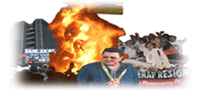
In 1986, the Filipino
people were successful in ousting President Ferdinand Marcos from his
position. The event was called the People Power Revolt at Edsa. On February
2001, the Filipino people were once again successful in ousting President
Joseph "Erap" Ejercito Estrada. Their success was termed "People
Power II." After only 2 years in office, Erap succeeded to be the
perpetrator of so many injustices against the people he was supposed
to be serving. For example,
" He launched an
"all out war" in Mindanao, resulting in the displacement of
nearly one million civilians.
" Under his orders,
the Armed Forces of the Philippines and the Philippine National Police
forcibly repressed workers in picket lines and urban poor communities.
" He created an
economic crisis leading to widespread unemployment and unprecedented
peso devaluations. Estrada surrendered control of the Phil economy to
the International Monetary Fund, WTO, and the World Bank; in so doing,
he reduced the nation to a state of absolute mendicancy. While he and
his mistresses lived lavishly off his riches, the people suffered even
more and were forced to move out of the country in search for work at
even higher rates than before.
" His administration
led to the increased funneling of women and children into the global
and domestic sex trade. He showed extreme disregard of the situations
of all migrant workers and their hardships, for his priority was the
monetary gain that was made.
" Estrada persistently
claimed that his main objective as President and as chairman of the
National Anti Poverty Commission was to help the poor, but he did the
exact opposite. Instead, he stole $8.7 million from the people through
his involvement in "Jueteng-gate," an illegal gambling operation.
These funds were meant to be put into programs that would help the poor
and the youth of the country.
" In sum, the charges
brought against him in the impeachment proceedings were "bribery,
graft, corrupt practices, betrayal of public trust, and culpable violation
of the Constitution."
To see how Filipinos were successful in bringing justice to the people:
we have provided for you a timeline of events that led up to the ouster
of President Joseph Estrada.
The Oust Erap Timeline
June1998
Joseph "Erap" Estrada elected President of the Philippines
September 1998
Estrada launches "Operation Plan Makabayan," a counter insurgency
program condemned by people's organizations. Results in rising militarization,
human rights violations and intimidation by the Armed Forces of the
Philippines, Philippine National Police, vigilante groups, and Citizens
Armed Forces Geographical Units (armed paramilitary forces)
1999
Value of the peso: P38.95 to $1
May 27,1999
RP US Visiting Forces Agreement ratified, allowing the US Military to
return to the Philippines after the US military bases, troops and facilities
were ordered out of the islands in 1991
Summer 99
GABRIELA Network begins its "Oust Erap" campaign. BAYAN follows
in February 2000.
Nov. 1999
KARAPATAN Human Rights Alliance releases Estrada's human rights record
in the first 16 months of his term: 538 documented human rights violations,
190 political prisoners, 7 involuntary disappearances, 74 civilians
killed in counterinsurgency operations.
Apr.27, 2000
Erap signs a cease-fire agreement with the Moro Islamic Liberation Front
(MILF).
Apr. 28, 2000
Erap's Armed Forces of the Philippines launches a military offensive
in Mindanao, breaking the cease fire. He subsequently declares "all
out war" in Mindanao effectively ending any hopes of peaceful negotiations
with the MILF. The number of civilians displaced from their homes as
a result of the military conflict eventually rises to over 700,000.
July 14, 2000
Erap's allies in the House introduce HB 11833,the Mindanao Crisis Bill,
which would grant Erap emergency powers such as moratoriums on strikes
and lockouts, suspension of the issuance of temporary restraining orders
against government projects, and the declaration of economic zones.
July 24, 2000
The State of the Nation Address is met with massive protest; the Estrada
regime responds brutally marking the 2000 SONA the most repressive in
Philippine history since the Marcos dictatorship.
July 24, 2000
Erap travels to the US to request $135 Million in military aid to fund
the newly aggravated war in Mindanao. The request is granted.
July 25, 2000
The militant peasant organization KMP releases a statement declaring
2,000 trade union and human rights violations committed in the first
two years of Erap's term.
Oct. 2 10, 2000
The Jueteng scandal uncovered.
Oct. 11, 2000
Cardinal Sin makes a public statement calling for Erap's resignation.
The Catholic Bishops Conference of the Philippines and leaders of the
Protestant churches in the Philippines echo the call.
Oct. 12, 2000
Gloria Macapagal Arroyo resigns as a Cabinet member. On Oct. 17, Arroyo
declares she would lead a united opposition to Erap. Other politicians
n various calls, from snap elections to resignation.
Nov. 2000
Value of the peso: P52 to $1
Nov. 13, 2000
The House of Representatives votes to impeach Erap.
Nov. 14, 2000
Welgang Bayan brings the Philippines to a standstill. Solidarity protests
take place in San Francisco and all over the world.
Dec. 7, 2000
An impeachment hearing was held to determine whether or not there was
grounds to remove Erap from the office of the President midterm. During
the hearing, surprise witnesses testified that Erap had funneled undocumented
income to several bank accounts under different name: The dramatic trial
climaxed when senators loyal to Erap voted to disallow the opening of
bank records containing potentially condemning evidence against him.
The prosecuting team resigned from the case in protest, bringing the
trial to an abrupt end; also in protest, the Senate President resigned
from his post.
Jan. 17, 2001
People Power 2 began escalating, as the united front against Erap mobilized
a peacefully militant rally at EDSA Shrine. Hundreds of thousands of
people massed at the EDSA, refusing to leave. All over the country,
tens of thousands more people also rallied in protest.
Jan. 20, 2001
In a last ditch effort to save himself, Erap called for snap elections.
The people responded with escalated protests and the united front unilaterally;
rejected the idea. Realizing the gravity of the situation, the members
of Erap's Cabinet resigned one by one. At the last possible moment,
top officials of the Armed Forces of the Philippines (AFP) and the Philippine
National Police (PNP) withdrew their support and acknowledged the sovereign
will of the People. Bowing to the pressure of popular protest and the
threat of the storming of Malacanang, Erap "stepped down"
from the Presidency. Vice President Gloria Macapagal Arroyo was sworn
in as the next President of the Philippines.
by Christine Cunanan