| |
|
.
|
|
"A
Life-Changing Journey"
|
|
by Christine Cunanan
|
| . |
| Each year, CHRP sponsors what is
called an annual exposure and integration trip to the Cordilleras
in the Philippines. Members of the community, embark on this life-changing
journey to educate themselves about the struggles of the Cordillera
people and of all who struggle in the Philippines to learn how to
support the movement for human rights and self-determination. In April
of this year, fifteen committed individuals left their families, their
jobs, and their schools to experience for themselves what types of
human rights abuses were going on in the Philippines. For some, this
was a return to their birthplace. For others, the trip was their first
to witness with their very own eyes the impoverished living conditions
of our brothers and sisters in the Philippines. The trip was a long-awaited
one and involved a preparation period of 5 months. From this alone,
it is clear what an enormous sacrifice the delegates made and how
dedicated they were to this cause. |
| |
| On June 2nd, the delegates reunited
after the trip for the first time to assess what they learned from
the trip and how they were affected. More importantly, they also planned
activities to educate others and mobilize support. It was through
this gathering that I learned just how profound the impact of their
month in the Philippines had been. |
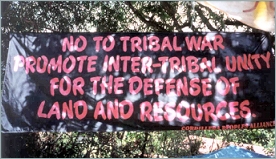 |
Cordillera Day, 2001
The centerpiece of the trip was what is known as "Cordillera
Day," which took place in Mankayan, Benguet on April 24 and 25.
The Kankanaey, the indigenous peoples of North Benguet, are situated
along Central Luzon. The celebration of "Cordillera Day"
began in April of 1985 as a commemoration of the death of Kalinga
pangat Macliing Dulag who led and succeeded the struggle against the
Chico dam. It has evolved from Maching Memorial Day into a commemoration
of all heroes and martyrs who have fought for their lands and lives
and has become a summit of over 3,000 people where the indigenous
people, as well as concerned individuals and organizations, discuss
issues of land, militarization, and resources. |
For many years, the Cordillera people have been victims to corporate
mining and dam construction projects. Big multinational mining corporations
and World Bank funded dams have kicked tens of thousands of indigenous
people off their ancestral land. They've also polluted the rivers
and groundwater, making it impossible for the people to survive. The
Cordillera people have been forced to move to the cities, in search
of jobs that don't exist, or go abroad to work. The Kankanaeys' livelihoods
have been threatened by the environmental degradation of such corporate
projects. If that were not enough, they have been and continue to
be threatened with displacement. The theme of Cordillera Day this
year, therefore, was "RESIST THE PLUNDER OF THE INDIGENOUS PEOPLES'
LAND AND RESOURCES."
In this solidarity gathering, CHRP delegates participated in discussions
of the issues that were affecting the Cordillera people through various
workshops, speeches, and cultural presentations. Glen Aquino and Greg
Morozumi described the event as a "coming together of all the
lands and tribes," and as a "celebration of the strength
of the movement." Although language barriers existed, the ability
of art to be used as a universal mode of communication broke down
many walls. All were moved by the people's ability to express themselves
through song, dance, and literature and by how much their identities
came across in their art. CHRP delegates also engaged in the exchange
of their own talents. They provided a workshop on the "Fil-Am"
experience and performed a skit to demonstrate their understanding
of the situation of the Cordis and their solidarity with the struggle.
|
|
|
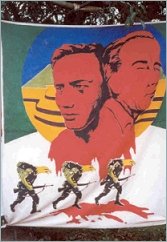
| Martyrs in the struggle against
imperialism and for self-determination in the Cordilleras |
|
|
Realizations
|
| |
| Aside from
Cordillera Day, much of the impact of their journey came from simply
living amongst the masses of peasants, farmers, workers, and poor
people. There was a consensus among CHRP delegates that their numerous
visits to the Urban Poor, specifically to Tondo, affected them the
most. Paul Bolick vividly remembered the "images, smells, and
the heat." Perhaps, Jasen Ildefonzo said it best when he said,
"What I thought I needed to survive was completely blown away."
He talked about the simple inability to take a shower or to flush
a toilet because of the lack of water, a point that Oliver Saria also
made some reference to. The abundance of water and many other resources
in industrialized countries such as the United States, inevitably
results in its being taken for granted. CHRP delegates were brought
to that realization. |
| Of enormous
emotional propensity were unforgettable, vivid images of the poor.
A powerful example, shared by Jasen and Christianne Duggan, was the
eager anticipation of men, women, and children at dumpsites as they
waited for dump trucks to arrive. As the trucks unloaded, they witnessed
the poor excitedly rushing to gather food or any form of sustenance.
This is a sight that many of us cannot even fathom or even begin to
imagine. |
| Many delegates
reported returning and feeling extremely depressed. They saw for themselves
the impoverished and unjust conditions that the Cordillera people,
as well as many others, had been subjected to. The images that remained
in their minds were still hard for them to take in, even after departing
the Philippines. What was only a month in their lives was the entire
existence of the Cordillera people and of many of our brothers and
sisters. |
|
| |
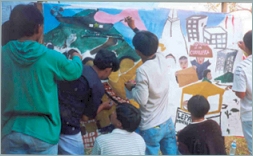 |
| Youth helped paint the Cordi
Day 2001 mural. |
|
|
Resistance
in the Midst of
Despair
|
| In the midst of all this,
however, CHRP delegates witnessed the power of resistance. For
the Cordillera people, specifically, Paul felt that seeing them
still practicing their culture was "revolutionary in itself."
He talked about the relative ease of countries and peoples to
be influenced by the majority or those in power. He was inspired
with the indigenous people's maintenance of their culture and
expressed the need for us here in the US to help keep the traditions
of our respective cultures alive. |
Rachel Redondiez, who went on the
trip last year as well, was inspired by an elderly woman who fought
for her people despite her husband's desire for her not to do so.
She fondly remembered the lessons she learned from sitting and speaking
with a 14 year old boy and hearing his views. Jasen also expressed
the joy he felt from merely waking up to the sounds of his native
language. What joy can be found in such seemingly ordinary events.
|
| |
Mia Villanueva, along with the others,
was inspired by the "fluidity" of the Cordillera people.
Their unity, organization, and the making of conscious decisions were
a matter of life and death for the indigenous peoples. What came through
for Jasen was the people's need for one another, for the communities
to "work together" as whole entities. It is our hope that
through the continued strength of the Cordillera people and through
the help of many of us who care, our brothers and sisters will one
day truly be lifted from the injustice and oppression that they have
been subjected to.
The indigenous people have vowed time and time again that they "will
not be party to their own death." As a united people, they have
fought tirelessly to regain their right to self-determination and
will continue their fight until their inherent human rights are once
again restored. |
|
Currently, CHRP delegates are working
together to produce a zine, a mobile photo exhibit, and various
other projects to help raise people's awareness about what they
learned. It is our hope that through our future publications, we
can bring justice to the Cordillera people and mobilize individuals
like yourselves to share in the fight against such inhumane conditions.
|
Mining
|