Thomas enrolled as sergeant in the NSW Corps in 1789. He was promoted to Quartermaster in 1790. He sailed on the frigate HMS "GORGON" under the command of Captain Parker. It was part of the Third Fleet and left England on 15-3-1791 with 31 male convicts aboard. It arrived at Port Jackson on 21-9-1791.
Governor Phillip recommended Laycock for a vacant insignia in April 1792, but this was refused because he already held a commission. When Deputy Commissary Thomas Freeman died in November 1794 Lieut-Governor Grose appointed Laycock to the vacancy.
In 1796 Laycock was involved in the shooting of John Boston's pigs and was ordered to pay damages, along with other members of the Corps charged with the offence. He resigned as Deputy Commissary in December 1800 but retained his position as Quartermaster.
He had been granted 80 acres at Parsley Bay, later the site of Vaucluse House, in February 1793, 100 acres by the upper part of the harbour in September 1795, 160 acres at Liberty Plains in May 1799, and two other grants of which no records survive. By 1802 his total acreage was 1655 acres.
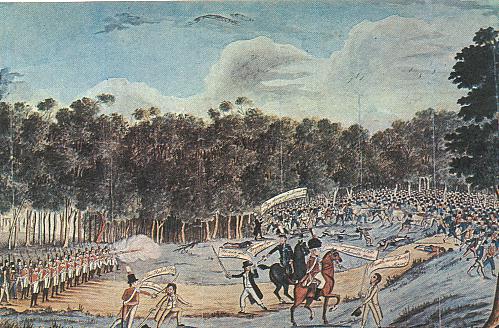
He was praised for his part in putting down the Castle Hill uprising in March 1804, when he led a detachment of soldiers to Major George Johnston�s aid in his encounter with the rebel leaders, and later was a member of the court-marshal which tried the rebels.
Laycock's wife, Hannah, who arrived on the "GORGON" in 1791, left again for England about 1805. After her departure Laycock came under severe censure for his indecent behaviour, and next year was found guilty of using mutinous language. In February 1808 he was replaced as Quartermaster by the War Office, but not entirely disgraced. In April Lieut-Governor Johnston appointed him to assist in making a survey of the Government Store, but John Macarthur advised against appointing him a Magistrate and Police Officer.
In October 1809 members of Laycock's family made representation to Leiut-Governor Paterson that he was labouring under mental derangement and unable to manage his affairs. After a report on his health by D'arcy Wentworth, Paterson appointed his sons, William and Thomas, to manage his estate and effects. He died on 27-12-1809, at Sydney, NSW, Australia. |