Hannah Pearson
HANNAH LAYCOCK
1758-1831
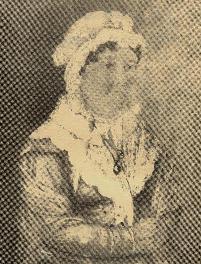
Hannah Laycock, wife of the Quarter-master and soldier, Thomas Laycock came to the colony in September 1791. Hannah returned to England in 1805, and no doubt her husband took advantage of her absence and was severely censured for indecent behaviour. He lost the office of Quarter-master in 1808 and subsequently became so mentally deranged, that his affairs were placed under his sons, William and Thomas, and two others. Laycock died in 1809, leaving an extensive estate which he had acquired by both grant and purchase.
Hannah and two of her three sons, William and Samuel, had received land grants from Governor King in August 1804. She named her 500 acres, the largest of the Canterbury grants, "King's Grove" in honour of the Governor, and returned to settle there in September 1810.
Later, on the 13th of December, Governor Macquarie, during the course of an inspection of farms south of Parramatta road, paid a visit to Hannah's domain and wrote in his diary:
" At 1pm we set out again from Captain Townson's Kogarah cottage for Mrs Laycock's farm near Cooks river, and arrived there at half past two o'clock. We found Mrs Laycock and her two daughters (she had three) at home in a very neat comfortable well built farm house and well furnished, the good lady's farm being also in a forward state of improvement in other respects. After resting for half an hour at Mrs Laycocks we pursued our journey to Canterbury, thus crossing Cooks river twice over a very slender bad bridge within two miles from Mrs Laycocks farm and is rather dangerous for a carriage."
Macquarie must have been greatly pleased with Hannah's bent for farming for in August 1812, he granted her the 120 acres lying between "King's Grove" and her son, William's, Northumberland farm. A year later a further 100 acres was granted at Putty, in the Hunter River district.
Among themselves the Laycock's then held a continuous area of 820 acres, stretching in the north from South Campsie, Clement Park through to Stony Creek road in the south.
Hannah must have found her properties too difficult to manage herself or too costly to pay an overseer, for during September 1815 weekly advertisements offered "Immediate possession" of the "very fine and beautiful farm of King's Grove" to renters.
At that time the farm contained some 700 acres, of which 90 acres were cleared and fenced in paddocks. A year later, Hannah went further and advertised the farm for either renting or sale. It was then described as "An extensive farm", of 620 acres of which 100 acres were cleared and fenced in paddocks. It contained a "good orchard", gardens and outhouses and could be had immediately for a deposit and sound security.
Later Hannah left "King's Grove" to reside in Pitt street, Sydney, where she died in 1831. The farm had been sold in 1829 to Simeon Lord, an emancipated convict. As a result of Lord's death in January 1840, his properties were offered for sale in the following year. Parts of Hannah's "King's Grove" and adjoining land were subdivided into forty "very eligible farms", suitable for market gardeners, cowkeepers, milkmen, husbandmen, and all the industrial classes. The sale offered purchases a "favourable chance" to become "upcountry proprietors".
- Hannah is first mentioned in "The Australian Dictionary of Biography" with reference to her returning
to Sydney in September 1810, where she settled at "King's Grove"
- By 1825 she had moved to Sydney where she is listed as a house keeper.
- In 1828 at the age of 69 she was living with her son, William, in her own house in Pitt street.
Her grandaughter Eliza Pitt was lodging with her.
|