Home
Open Space
Home What
is OST?
Stories
Links Training
OSonOS IX
Chris Corrigan
108-1035 Pacific
Street, Vancouver B.C., Canada V6E 4G7
Phone: 604.683-3080
Fax: 604.683.3036 [email protected]
British Columbia Association
of Aboriginal Friendship Centres
Executive Directors and
Presidents retreat
Whistler, BC September 10-12,
2000
The British Columbia Association of Aboriginal
Friendship Centres (BCAAFC) represents almost 30 "Friendship Centres"
here in BC. Friendship Centres are
organizations that have been around since the 1950s, providing services
to
Aboriginal people in the towns and cities
of Canada. During the 1950s, there was a mass migration of First
Nations
people away for isolated and remote reserve
communities to the cities as people set out to look for jobs and better
lives for their families. In short
order, these people formed communities and then community organizations.
Friendship Centres were among the first to
be formed, to provide assistance to individuals and families making the
transition from reserve life to city life.
These days Friendship Centres provide a huge range of services and programs
and in many ways, look like Aboriginal YMCAs,
although not as well funded, and generally not attracting as much of a
middle class clientele.
Here in British Columbia we are embroiled
in disputes about land rights, aboriginal title and self-government.
Friendship Centres, as Aboriginal organizations,
are trying to find a role for themselves in this debate. In order
to
further their ideas and vision, the BCAAFC
hired me to facilitate a 2.5 day Open Space around the theme: "Aboriginal
Friendship Centres and Self-Government in
BC." Executive Directors and Presidents from each Centre were invited
as
was the BCAAFC Executive Committee and the
staff. In short, most of the BC Friendship Centre leadership was
gathered in one place.
DAY ONE
We had 41 people, who proposed 36 topics during
the opening on day 1 (31 topics were eventually reported upon). I
had the two meeting days divided in the four
sessions of 1.5 hours each with 1.5 hours for lunch. My opening was
complimented by a prayer from our Elder and
an official welcome to the territory of the Lil'wat Nation, on whose land
we met in Whistler, BC, north of Vancouver.
(We were actually meeting in the same facility where I first experienced
OST five years ago). As has been my
experience, people took to the process immediately and got down to work
on the
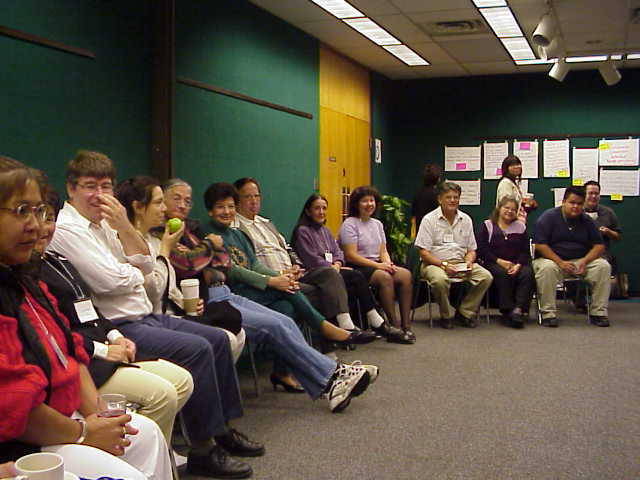 issues
with no trouble at all. I had a partner working with me who was learning
OST, and he helped to organize the
issues
with no trouble at all. I had a partner working with me who was learning
OST, and he helped to organize the
agenda wall and see about an even distribution
of topics throughout the 8 time slots we had available. He also
remained in charge of the proceedings for
the entire event.
I received several comments during the first
day about the process including comments about how well it allows
everybody to participate and how free of
conflict the discussions were. One woman said that she had been coming
to
these meetings for years and met the same
people and never heard any of them speak. This was the first time
she
heard from some of them. I asked her
why she thought that is and she said it had to do with the safety that
was
created. She felt that because individuals
proposed topics that they were passionate about, a great deal of respect
was brought to the discussions, and that
the whole group held the space, not just the facilitator. When facilitators
work in controlling processes, participants
sometimes feel that they can lose themselves in conflict. Not so
in Open
Space, where the whole group takes responsibility
for keeping the space safe and therefore, conflict is often
eliminated, as was the case for this meeting.
And there were some contentious issues!
Another interesting comment came for a seasoned
veteran of the Friendship Centre movement, an Elder who has
served on the Executive at all levels, local,
provincial and national. He said that this was the first meeting
where he
learned something.
(As an aside, and by way of demonstrating
how easy it is to get into Open Space, comes this story: My three year
old
daughter was with me and at one point, while
groups were moving around, she came into the room with her mother,
and asked what the paper and the nice coloured
markers were doing on the floor in the centre. I told her that people
used the markers to write down things that
they wanted to talk about on the paper. She then proceeded to dictate
to me a list of topics she wanted discussed.
She was interested in the following:
-
How pens work
-
How she can get her
friend's allergies to go away
-
How buildings are built
-
How colour goes in
-
How the inside of your
body works
-
How hinges work
-
How bones grow back
together crooked.
She then returned to our hotel room with
my partner where I am told that they held their own discussion groups on
these topics. I relate this to make
the point that OST is easy enough for a three year old to understand with
very little
instruction.)
We gathered in the circle for a closing prayer
at the end of the day, as is our tradition.
DAY TWO
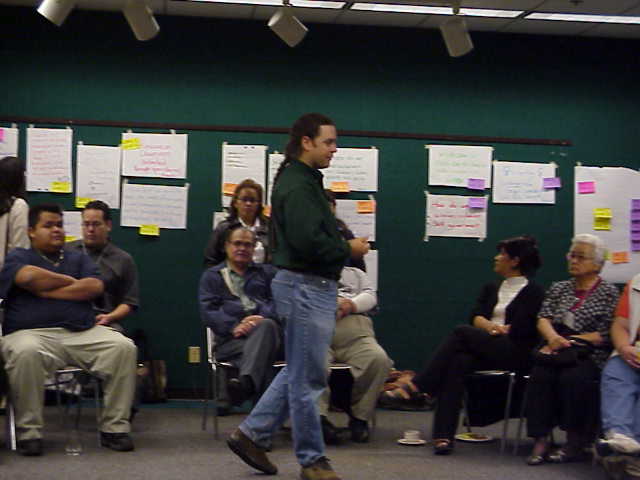 Day
two began in a novel way for me, because we had to change rooms.
Our large meeting room had been overtaken
Day
two began in a novel way for me, because we had to change rooms.
Our large meeting room had been overtaken
by a conference of McDonald's Restaurant's
managers from Western Canada (more on this below). We moved to a
smaller room which involved some work to
prepare, but, despite my anxieties, worked out fine. Day two began
early
with a sage smudge and a prayer. The
smell of sage permeated the facility, and its bittersweet (and slightly
cannabis-like) smell confounded the McDonald's
managers who were by now virtually swarming around our meeting
space.
Playing fast and loose with time, the groups
met at 9 instead of 9:30 and finished at 10:30 for the first session, taking
a
half hour break before convening the 11:00
sessions on time. As the news started to go up on the wall, one woman
commented how different the reports were
from the actual discussions in the groups. I have always suspected
that
this is the case and I wonder if anyone else
has figured out how to capture the energy and passion that forms in the
groups and is not reflected in the reports?
It seemed as the second day progressed, that
the group discussions became more intense and the breaks between
discussions became lighter. This was
in contrast to day one, when people seemed to be feeling their way around,
and
were more aloof in both the groups and the
breaks. I can really see how extending the discussions over two days
brings a totally different quality of experience
to people. It is deeper and richer and the relationships become
stronger so that people feel freer with each
other outside of the meeting.
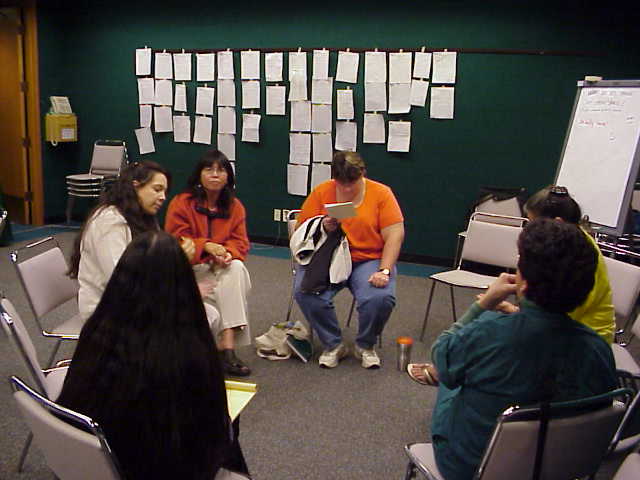
The whole notion of personal responsibility
intensified over day two. One participant, who missed convening her
session because she was actually attending
to another participant who was suffering a nasty reaction to a bee sting,
used the evening news to apologize for "acting
irresponsibly" by not convening her session. The apology was offered
with great respect and humility to the group.
It opened my eyes to how serious the "responsibility" part can get
taken.
As day two came to a close, I checked my "Open
Space Evaluation" sheet: a piece of blank chart paper with the
question "What do you think of Open Space?"
on the top. The paper contained a couple of doodles of a happy face
and
a light bulb and these telling words: "It's
really round!"
DAY THREE
Again, we opened with a smudge and a prayer.
I'm lucky to have these openings available to me as it aligns people's
thoughts nicely at the beginning of the day
and helps ground the crown for the work ahead of them.
Convergence consisted of the following steps:
-
posters with topic names and numbers were placed
around the room
-
participants read reports (roughly 50 pages)
for a half hour
-
reflect and use the dots to indicate passion
-
some topics were converged
-
top dot getters were brought off the wall and
placed in the centre of the circle (there were ten of them)
-
I invited champions to come forward to see these
through the action planing phase
-
Nine champions came forward and a few more topics
were converged. Convergence was highly conservative,
as is my preference. Only topics that were closely related were converged.
-
The orphaned topic was placed with the others
with a meeting space post it note on it in case anyone
wanted
-
to take the issue forward. As it turned
out, no one did.
-
Discussions lasted 45 minutes. Several
participants wished that they could have had the whole day to actions plan.
(Note to OST facilitators who may be working
with Carrier speaking people: the word "dot" sounds a lot like the Carrier
word "D'ogh" which is a rather vulgar term
for female genitalia. So when I suggested that folks grab seven dots
and
indicate where their passion lay, it resulted
in a truly inspired outburst of belly laughs from one person!)
The closing circle was profound. I had
wanted to use a talking stick (a real one!) for the closing circle, but
the
organization did not bring theirs.
Instead I used a piece of lava rock. The Whistler area is covered
in old lava flows and
the rocks lie everywhere, pitted from air
bubbles that were trapped in the molten lava. As it turns out these
rocks are
great for using in sweat lodges as they hold
heat. So when a number of people went out on day two to collect sweat
rocks for future use, the BCAAFC ED gave
me one. And I used it for the closing circle.
 I
opened by stating that lava is rock made from material that has welled
up from deep within the earth and taken form.
I
opened by stating that lava is rock made from material that has welled
up from deep within the earth and taken form.
It does not crack under extreme heat and
it is malleable and flexible. In my mind this summed up the organization
nicely.
As the rock went around, people shared very
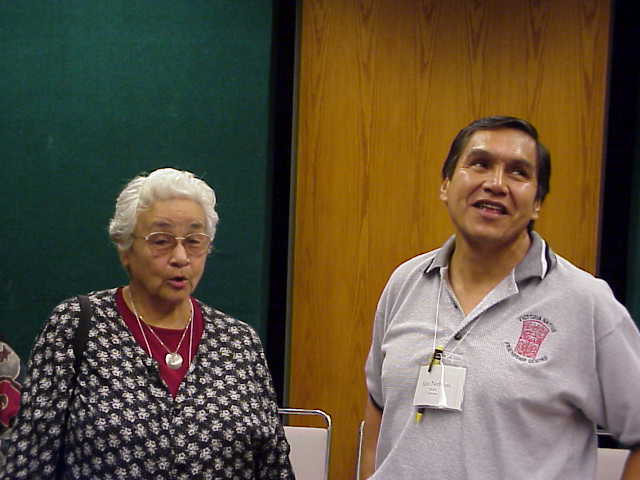
deeply. I was especially touched by the Elder who said that the process
was a new role model for First Nations communities
to show us how we could be together. Another participant said
that she was tired from the mental strain
of the past few days, and had even forgotten where we were in the month
("somewhere in the middle!" she said).
Later the ED of the organization remarked that he thought that this comment
represented the fact that she was no longer
thinking linearly. It fact, the ED recognized OST as a tool with
tremendous possibility for decolonizing First
Nations people and communities because it creates the environment for
people the THINK in traditional ways.
I have said that before, and I am buttressed in that belief now.
Several people saw possibilities for using
OST and have vowed to use it. There was an almost fiercely protective
sense
that came over the group regarding the process.
They recognized it as theirs, as one which is, in both form and
content, real indigenous self-government.
We closed the third day with a prayer.