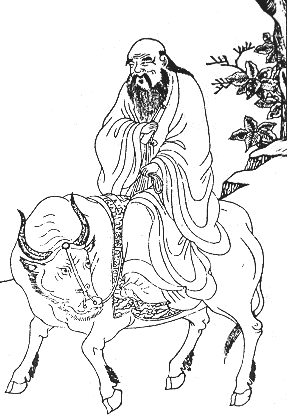
604 B.C. - ?


Lao-tzu lived twenty-five centuries ago in ancient China. Even though the details of his existence are shrouded in the mist of time, we know with a fair degree of certainty that his name was Li Er.
Legend has it that King Wu of Zhou appointed him head librarian of the imperial archives at Luoyang. In this capacity Lao-tzu was able to immerse himself in the study of history, philosophy and literature, gaining wisdom and insights along the way.
According to another well known legend, Confucius visited with Lao-tzu and came away in awe of Lao-tzu's intellect. Confucius recognized in Lao-tzu a deep understanding about the world that was above his own, and went so far as to liken Lao-tzu to the mysterious dragon.
Lao-tzu decided to leave civilization behind when the House of Zhao began its decline. He departed Luoyang and headed through the Hangu Pass to some destination beyond the Great Wall.
Before leaving the gate at the Great Wall, a guard at the gate asked him to write down his thoughts on the Tao for posterity. Lao-tzu agreed, and wrote a small book in two parts, expressing his accumulated learnings in brief, concise yet profound language. This book survived over 2,500 years and came to be known as the Tao Te Ching.
Some of Lao Tzu's most significant teachings are as follows:
- Non-conflict. Lao Tzu noted that violence and conflict, no matter how tightly controlled, could not help but cause negative side effects. The Taoist ideal is to solve problems through peaceful means.
- Non-action. The foolish expend a great deal of energy and time trying to do everything and end up achieving nothing. On the other end of the spectrum, the truly wise don't seem to do much at all and yet achieve whatever they want. This magic is possible, indeed unavoidable, when one is in tune with the Tao.
- Non-intent. So often we perform virtuous deeds hoping to receive praise or recognition. That's no virtue at all. True virtue is a state where such actions flow forth naturally, requiring no conscious effort or thought.
- Simplicity. The basis for our reality and our existence is elemental and uncomplicated. Human beings create a lot of trouble for themselves by making everything more complex than they need to be. If we learn to simplify our lives, we can experience a profound satisfaction that is infinitely more meaningful than the rewards of the material world.
- Wisdom. Logic has its place in human affairs but isn't everything. There is a limit to what we can understand through rationality and reasoning. To transcend that limit, we need to engage our intuition fully. This is the key to insights as opposed to knowledge, and the difference between living the Tao and reading all about it.
- Humility. The more you learn, the more you realize there's still so much more to learn. This tends to make you humble. Arrogance and egotism come from ignorance - knowing a little bit and assuming you know a lot.
- Duality. Lao Tzu pointed out that all qualities in the world possess meaning only by the existence of their opposites. Something can only be big if there is something else that is small by comparison. "Good" exists in the world so long as "evil" exists as well. One cannot do without the other.