 A sacred cat worshiped as a deity and embalmed and buried after its death at Bubastis. According to the Greek historian Herodotus, Aelurus was identified with Artemis, Greek goddess of the hunt.
A sacred cat worshiped as a deity and embalmed and buried after its death at Bubastis. According to the Greek historian Herodotus, Aelurus was identified with Artemis, Greek goddess of the hunt.
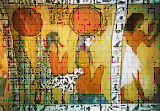
The superior Egyptian deity Amon-Ra was a combination of Amon, a local Theban god, and Ra, the sun god. Amon-Ra is depicted with a hawk's head surmounted by a sun disk in this painting from the Tomb of Sennedjum, in Luxor, Egypt. The painting was created around 13 BC.
Erich Lessing/Art Resource, NY
Amon, in Egyptian, means "hidden". Amon is an ancient Egyptian deity, who was originally a local Theban god of reproductive forces, represented as a ram. Amon, his wife, Mut (Meaning "the mother" in Egyptian), and his son, the moon god Khon (Meaning "to traverse the sky" in Egyptian), formed the divine triad of Thebes. Later Amon was identified with the sun god Ra of Heliopolis, and was known as Amon-Ra, "the father of the gods, the fashioner of men, the creator of cattle, the lord of all being." As a universal god he became the god of the Egyptian nation and the empire. The power of his high priest rivaled that of the pharaoh, provoking political problems similar to modern church-state rivalry. The most massive temple ever built was constructed for Amon-Ra at Al Karnak. Amon was worshiped in the ancient Greek colonies of Cyrene, where he was identified with Zeus, and in Rome, where he was associated with Jupiter.
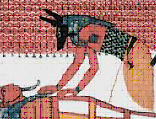
Anubis, is the god of the dead. He was considered the inventor of embalming, the guardian of tombs, and a judge of the dead. The Egyptians believed that at the judgment he weighed the heart of the dead against the feather of truth. In art he is represented as jackal-headed. Anubis was sometimes identified with Hermes in Greek mythology.
Apis, was the sacred bull of the ancient Egyptians. It was known to them as Hapi and was regarded as the incarnation of Osiris or of Ptah. A court was set apart for Apis in the temple of Ptah at Memphis. It was believed that when Apis died, a new Apis appeared and had to be searched out; he would be recognizable by certain sacred marks upon his body, such as his color (mainly black) and a knot under his tongue. Apis is sometimes represented as a man with the head of a bull.
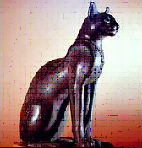
Bast is a benevolent Goddess of fertility, motherhood, sensuality as well as sexuality, healing, and the sun. Later on in her worship, Bast was also considered a moon goddess as well. Bast was considered to be a daughter first born of Amun by some, and Ra and Isis by others. Bast was considered to be married to the creator God Ptah (Ptah-seker-ausur). Some other names for Bast are "The Lady of the East" (Referring to her solar aspect), Bastet, Ubastet, and Pasht. There are stories that link Bast to with Horus as well. Bast was also equated with the Greek Goddess Artemis.
Bast was also thought to be a ferocious protectress as well, however this is not a well know aspect. Bast was known under different names in this state, one of which being Pasht. She was thought to protect expectant mothers, people from disease and famine, and of course... her earthly representations... cats and her followers. Bast was thought to be a extremely patient mother, but to deal extremely harshly with those whom harm her children or otherwise anger her. Imagine an enraged lioness... now make that on a cosmic scale... now you got the idea.
Bast was thought to take the form of a domestic cat, a cat headed woman in a long green gown, a large winged feline or a hawk headed cat, among the most popular forms. She was thought to hold a sistrum or a basket in her semi human form, and was also depicted as a full human with a litter of kittens playing at her feet. Occasionally she is also depicted as a lion-headed human, though this is more common in early depictions of her or in her protectress role, or a depiction of her sister Sekhmet who is also thought to be another aspect of Bast. During the New Kingdom (1539-1075 BC), Bast began to become equated with Sekhmet.
Some of the correspondences for Bast are the following. Cats of any color or breed, although black especially, and of course catnip. Also sacred to Bast are the color green (fertility), the city of Bubastis (the ancient site of her temple), a simple woven basket or sistrum, the sun and moon, and for those so inclined... kohl colored eyeliner. Bast was also associated with Lower Egypt as it was then known. Bast was also an important goddess of the hearth. Both Monday and Sunday are good days to work magick with her for the most impact.
Bast has a festival that takes place in mid-April that was reportedly very popular and similar in nature to Mardi Gras. It was according to accounts of the time a "parade like" time that included singing,playing music, dancing, and partying with an occasional flashing of a passerby. Bast devotees were known to have a good time at her festival.
Hathor, to the Egyptian's, was a goddess of the sky and queen of heaven. Daughter of the sun god Ra and wife of the sky god Horus, she was the goddess of fertility and patron of women and marriage. Hathor was also the goddess of love and beauty; for this reason, she was identified often with the Greek goddess Aphrodite. Worshiped throughout Egypt, she was often represented as a star-studded cow or as a woman with a cow's head. Her name also appears as Athor or Athyr.
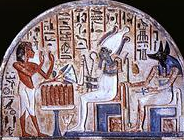
Horus, in Egyptian mythology, god of the sky and of light and goodness. One of the major Egyptian deities, Horus was the son of Isis, the nature goddess, and Osiris, the god of the underworld. After Osiris was murdered by his evil brother Set, the god of darkness and evil, Horus avenged his father's death by killing his uncle. Worshiped throughout Egypt, Horus was usually depicted as a falcon or a falcon-headed man. Another representation of him, an infant with a finger held to his lips, was known as Harpocrates by the Greeks and Romans.
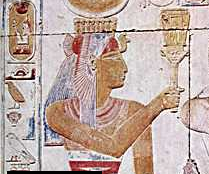
Isis (mythology), in Egyptian mythology, goddess of fertility and motherhood. According to the Egyptian belief, she was the daughter of the god Keb ("Earth") and the goddess Nut ("Sky"), the sister-wife of Osiris, judge of the dead, and mother of Horus, god of day. After the end of the New Kingdom in the 4th century BC, the center of Isis worship, which was then reaching its greatest peak, was on Philae, an island in the Nile, where a great temple was built to her during the 30th Dynasty. Ancient stories described Isis as having great magical skill, and she was represented as human in form though she was frequently described as wearing the horns of a cow. Her personality was believed to resemble that of Athor, or Hathor, the goddess of love and gaiety.
The cult of Isis spread from Alexandria throughout the Hellenistic world after the 4th century BC. It appeared in Greece in combination with the cults of Horus, her son, and Serapis, the Greek name for Osiris. The Greek historian Herodotus identified Isis with Demeter, the Greek goddess of earth, agriculture, and fertility. The tripartite cult of Isis, Horus, and Serapis was later introduced (86BC) into Rome in the consulship of Lucius Cornelius Sulla and became one of the most popular branches of Roman religion. It later received a bad reputation through the licentiousness of some of its priestly rites, and subsequent consuls made efforts to suppress or limit Isis worship. The cult died out in Rome after the institution of Christianity, and the last remaining Egyptian temples to Isis were closed in the middle of the 6th century AD.
Osiris, in Egyptian mythology, one of the principal deities. Originally the local god of Abydos and Busiris, Osiris, who represented the male productive force in nature, became identified with the setting sun. Thus he was regarded as the ruler of the realm of the dead in the mysterious region below the western horizon. Osiris was the brother and husband of Isis, goddess of the earth and moon, who represented the female productive force in nature. According to legend, Osiris, as king of Egypt, found his people plunged in barbarism and taught them law, agriculture, religion, and other blessings of civilization. He was murdered by his evil brother, Set, who tore the body to pieces and scattered the fragments. Isis found and buried his scattered remains, however, and each burial place was thereafter revered as sacred ground. Their son Horus, sired by a temporarily regenerated Osiris, avenged his father's death by killing Set and then ascended the throne. Osiris lived on in the underworld as the ruler of the dead, but he was also, through Horus, regarded as the source of renewed life.
Phoenix, a legendary bird that lived in Arabia. According to tradition, the phoenix consumed itself by fire every 500 years, and a new, young phoenix sprang from its ashes. In the mythology of ancient Egypt, the phoenix represented the sun, which dies at night and is reborn in the morning. Early Christian tradition adopted the phoenix as a symbol of both immortality and resurrection.
Ra or Re, in ancient Egypt, was a sun god depicted with a human body and the head of a hawk. Ra was usually considered the creator and controller of the universe, his chief symbols being the sun disk and the obelisk. Originally a local cult, the worship of Ra first became widespread during the Old Kingdom in Egypt. The chief temple of Ra was at the city of Heliopolis, which became an important center when the cult was adopted as a state religion. Ra later became associated with other important deities, particularly Amon and Horus.
Serapis, also Sarapis, in Greek and Egyptian mythology, a deity (variously associated with Osiris, Hermes, and Hades) introduced in the 3rd century BC as a state god for both Greeks and Egyptians. Serapis was believed by Egyptians to be a human manifestation of Apis, a sacred dead bull that symbolized Osiris. In Greek mythology, Serapis was represented as a god of fertility and medicine and the ruler of the dead in Tartarus. The worship of Serapis spread throughout the ancient world and the Roman Empire. The cult waned with the ascendancy of Isis, the Egyptian goddess of motherhood and fertility. The destruction of the temple to Serapis in Alexandria in the second half of the 4th century AD marked the virtual end of paganism in the Roman Empire.
Sekhmet was thought to be the other side of the spectrum from Bast, her counterpart / sister. Sekhmet is thought to be fearsome, which was reflected in a few of her other titles. A few such titles are "The Terrible One", "She Who Is Powerful", and "The Eye of Ra", which were hers in her protectress roll. Sekhmet is considered by some to be a Mistress of magick and human fate.
Sekhmet was considered to be a war Goddess by warriors of the time, and was prayed to bring about the defeat of enemies. Once on a rampage, there is little to nothing that stops her. Sekhmet also has positive qualities as well. Though her methods are sometimes harsh or forceful, Sekhmet brings closure, and brings new beginnings. She is extremely protective of her children, very wise, and alert to possible danger. Sekhmet is an excellent Goddess to call upon to protect the home, family, or way of life. As long as you are respectful of her, she will also come roaring to your aid in times of negative energy or psychic attack.
Sekhmet was considered to be associated Upper Egypt as it was then called. She is also commonly associated with red (symbolizing the sun and blood shed during battle), fire, destruction, and war. some correspondences of Sekhmet are the a cobra, a lioness, Sunday or Tuesday for the solar or warrior aspect respectively, noon, and during the waning moon. The scorching heat and tempertures of summer also please her. Statues or pictures of a lion are common representations of Sekhmet.
Sekhmet was commonly depicted as a lion-headed woman, sometimes wearing the solar disk (sun) and a cobra. She was also thought to take the form of a black-skinned woman with a beautiful face and flaming red eyes.
Sphinx, in Greek mythology, monster with the head and breasts of a woman, the body of a lion, and the wings of a bird. Lying crouched on a rock, she accosted all who were about to enter the city of Thebes by asking them a riddle, "What is it that has four feet in the morning, two at noon, and three at night?" If they could not solve the riddle, she killed them. When the hero Oedipus solved the riddle by answering, "Man, who crawls on four limbs as a baby, walks upright on two as an adult, and walks with the aid of a stick in old age," the sphinx killed herself. For ridding them of this terrible monster, the Thebans made Oedipus their king.
In ancient Egypt, sphinxes were statues representing deities, with the body of a lion and the head of some other animal or of man, frequently a likeness of the king. The most famous of all Egyptian sphinxes is the Great Sphinx of Giza, near the pyramids. Dating from before 2500 BC, the Great Sphinx is about 20 m (about 66 ft) high and about 73 m (about 240 ft) long