


Lesson 1:1
All abstract concepts: emotions, faith, spirits (like in ghost), life, etc. Back
Lesson 1:2
To study concepts we have to start with basic units to make the study simple and precise. Back
Lesson 1:3
- Everything that is not abstract. Matter is something you can measure quantitatively. Science study matter and has no emotion. It cut across culture, race or creed. Science is neither good nor evil.
- No. We have subatomic particles like proton, neutron, electron, α-particle, β-particle, γ-particle, etc.
- Atoms are the building blocks of molecules. Back
Lesson 1:4
Chemicals that are not stable at room temperature have to be kept at lower temperature. Chemicals that react easily with water moisture in the room have to be kept dry in a dessicators. Back
Lesson 2:1
Atomic Number for neon = 10, for argon = 18.
Ne : 1s2; 2s2, 2p6
Ar : 1s2; 2s2, 2p6; 3s2, 3p6 Back
Lesson 2:2
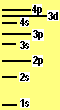
Energy levels
The electron configuration for krypton is:
1s� ; 2s�, 2p6 ; 3s�, 3p6 ; 4s�, 3d10, 4p6
Even though 3s, 3p, and 3d are assigned the M shell, the energy of 3d is closer to the N shell. Please note that the energy diagram is not to scale. It is intended to give an idea of the energy differences. Back
Lesson 3:1
Reagents Noble gas e-config Products H : {1s} + Br : {[Ar] ; 4s�, 4p5} � H+ + Br‾ : {[Kr]} � H+Br‾ Li : {[He]; 2s} + F : {[He] ; 2s�, 2p5} � Li+ : {[He]} + F‾ : {[Ne]} � Li+F‾ Na : {[Ne]; 4s} + Cl : {[Ne] ; 3s�, 3p5} � Na+ : {[Ne]} + Cl‾ : {[Ar]} � K+Cl‾ It must again emphasised here that these exercises only serve to underscore the principle that atoms react in order to reach the electron configuration of the noble gases. They are hypothetical (make believe) reactions as some of the reagents are not available in the laboratory. For example hydrogen exist as H2 in its natural state. Back
Lesson 3:4
The π-bond and δ-bond are pair-bonds and so rotation is not possible. Back
- N2 has a σ-bond and a δ-bond. First the two pz-orbitals overlapped, as they collide with each other, to form the σ-bond. Then the two sets of the other p-orbitals overlapped, folding towards each other to form the δ-bond.
- O2 has a σ-bond and a π-bond.
- Phosphorus is below nitrogen in the Periodic Table, we would expect P2 to have a σ-bond and a δ-bond.
- Sulphur is below oxygen in the Periodic Table, we would expect S2 to have a σ-bond and a π-bond .
- Chlorine has a σ-bond, just like fluorine.
Lesson 3:5
CH2CH2 The carbon underwent sp� hybridisation. The pair of p-orbitals then overlap to form a π-bond.
CHCH The carbon underwent sp hybridisation. The two pair of p-orbitals then overlap to form a δ-bond. Back


Lesson 5:1
Fe = 56g, H = 1g, and 32g. Back
Lesson 5:2
O = 16g. Back
Lesson 5:3
- An element is a matter that cannot be broken down into simpler matter by chemical reactions.
- A compound is a matter made up of two or more elements in a definite proportion.
- A mole is the number of atoms in 23 grams of Na-23.
- Unless we know exactly what we are talking about, we do not know what we are talking about.
- Half the Avogadro's number of molecules is half a mole. Back
Lesson 5:4
When we write 0.5 O2 it reads 0.5 mole of oxygen gas.
When we write (O2)0.5 it reads half a molecule of oxygen gas.
A molecule is the smallest unit and so there cannot be half a molecule. Back
Lesson 5:5
Water is a compound (or molecule) made from hydrogen and oxygen. Mixture is very different from molecules. If I mixed two molecules of hydrogen gas and one molecule of oxygen gas in a plastic bag. I will not see water. I see nothing because they are still oxygen and hydrogen gas. The two must react to give water. So water is not oxygen and hydrogen, but made from oxygen and hydrogen having its own properties very different from hydrogen and oxygen. If in a beaker of water there is no other foreign matter (meaning other stuff) then that water is pure.
Sugar is a compound made from carbon, hydrogen and oxygen. It has its own properties different from oxygen, hydrogen and carbon. If a bag of granulated sugar contains only sugar molecule it is pure. Back
Lesson 6:1
- Lithium has an IP of 513.3 kJ mol‾�, the lowest. So it is most likely to give up a valence electron to form an anion. Neon has the highest IP and so the least likely to give up a valence electron
- The IP of potassium is 418.8 kJ mol‾� and the IP of cesium is lower, at 375.5 kJ mol‾�. So cesium should be able to form a hydride. Back
Lesson 6:2
The second ionization potential is defined as the energy used to remove an electron from a gaseous single positively charged atom to give a gaseous ion and a gaseous electron. Example.
Be+(g) + IP � Be+2(g) + e(g)‾ IP = second IP Back
Lesson 6:3
Fluorine: high IP, high EA, small size
Rubidium: low IP, low EA, large size. Back
Lesson 6:4
Elements on the left hand side of the Periodic Table like to give off their valence electrons and that on the right hand side like to take in valence electrons - to form a valence shell of eight electrons. The "Octet Rule".
For the elements on the left hand side those at the bottom will give off its valence electrons most readily since the valence electrons are now shielded from the positive nucleus by the inner shells of electrons. For a similar reason those at the top right hand corner attract valence electrons more easily since the positive nucleus is less shielded as there is less shell of electrons.
Combining these two principles - elements at the bottom left hand corner will form ionic compound with elements at the top right hand corner most easily - as one is very willing to give the other is very willing to take. The answer is potassium flouride. Back
Lesson 7:1
The long non-polar chain will dissolve the organic molecules like oil and grease, while the terminal polar group will dissolve in water via hydrogen bonding. In this way the detergent will help suspend the dirt in water and be removed along with the water. Back
Lesson 7:2
Polar means having two poles and it should behave like a magnet. Molecule means a group of atoms bonded together. So this group of atoms held together must have a positive pole and a negative pole to behave like a magnet.
Now there is a concept known as electronegativity - the different abilities of atoms to hold tightly to its valence electrons. Let us consider a carbon-fluorine σ-bond. Carbon wants to keep its electron and fluorine wants to take it. So they agreed to share with each contributing one electron to form a covalent bond. Like all agreements carbon must read the fine prints. In a covalent bond the electrons are suppose to move around the two atom centers and thus hold the atoms to each other. That is on average each atom must have an equal share of the electrons in the bond. However because of the difference in electronegativity the electron spend more time with fluorine than carbon. So on average carbon experience a lost of electron and fluorine a gain of electrons. Thus the carbon-fluorine covalent bond actually has a slight positive charge at the carbon center and a slight negative charge at the fluorine center.
But the bond is only part of a molecule. In a molecule like carbon dioxide, O=C=O, you have two negative ends and a positive carbon at the center. This molecule cannot behave like a magnet. So the geometry of the molecule is important. Similar carbon tetrafluoride has a tetrahedral structure so is like a ball with carbon at the center, so it is also not polar.
Methylfluoride, CH3F, also has a tetrahedral structure but the surface where fluorine is will be slightly negative, while the other hemisphere is slightly positive. So it is a polar molecule.
In conclusion you need to focus on two concepts.
- All covalent bonds between two different atoms are polar.
- The symmetry of the molecule must be such that there can exist two polar terminals. Back
Lesson 8:1
No Back
Lesson 8:2
Boric acid: 5.07 Carbonic acid: 3.68 Lactic acid: 2.43 Phenolic acid: 9.89
When rain falls through the atmosphere it absorbed the sulphur dioxide, sulphur trioxide, nitrous oxide, nitrogen dioxide, carbon dioxide, etc in the air. By the time it reaches the ground its pH is very less than pH 7. Such rain water is known as acidic rain. You can monitor and keep a record of the acidic of the rain in your region with the help of universal indicator paper. Back
Lesson 8:3
10.1 Back
Lesson 8:4
When an acid anhydride (HA) is added to water it dissociates to give the hydronium ion.
HA + H2O � [H3O]+ + A‾ ; Ka The value of Ka is dependent on the stability of the reagents relative to the products in the equation. That means the bond strength of H-A and the stabilisation of A‾ by coordinating with the water molecules. It is not too difficult to understand why sulphuric acid has a higher Ka value than an organic compound. The acetate ion, CH3COO‾ could only stay in water because of negatively charged oxygen at the end. The hydrocarbon portion do not have any affinity for water. Back
Lesson 8:5
When a compound can release a proton in water, it should be about to react with a base. This reaction is then known as an acid-base reaction. We can add one to the other until they fully react to give the products, leaving no acid or base in the system. This is known as titration. Of course we cannot see molecules so we have to find ways of knowing when they have completely knock off one another. We found that certain compounds when complex with proton changes its colour. Litmus is a blue compound but when complexed with proton it turns red. So we use such complex as markers to monitor the situation. Once it changes colour we know that there is just a slight excess of one of the component. That means a few molecule before that the system is in the others favour. Since a few molecule is within experimental error we consider the change in colour as the end (or neutralised) point. Later with more research we found that certain electrodes can monitor the concentration of protons via the change in conductivity of the solution. So we constructed the pH meter. Answer
Lesson 8:6
- NH4+ + H2O � H3O+ + NH3
pH = pKa - log10{a(NH4+)/a(NH3)} = 9.25 - log10 (1/5.6) = 10- pH = pKa - 0 = 4.75
- CH3COOH + NaOH � CH3COO‾Na+ + H2O
So [CH3COOH] = [CH3COO‾Na+]
pH = pKa - 0 = 4.75, or pKa = 4.75 Back
