


MOLE CONCEPT
So far we were in the microscopic world of atoms and molecules. But it is very important that chemists be able to measure and observe, in order to gather data. To do this we must take sufficient quantities of atoms and molecules. How many atoms or molecules must the chemists take?
Let us not bother about the numbers but instead call this amount a mole. If we start of with one mole of oxygen gas (O2), and it weighs W grams, and react it with carbon to produce carbon dioxide. If the carbon dioxide weighs X grams, then one mole of carbon should weigh (X-W) grams, since we known the formula of carbon dioxide is CO2.
Tutorial 1
Let us weigh 32 grams of oxygen gas (O2) and define this amount of molecules as one mole of oxygen gas molecules. If we react this amount with the following atoms and the weight of the products obtained were as given, how much will one mole of the atoms - Fe, H, and S - weigh?
- Fe + O2 � 2 FeO ; 144 grams.
- 2 H2 + O2 � 2 H2O ; 36 grams
- S + O2 � SO2 ; 64 grams Answer
The most universal atom at the time was oxygen. About 50% of the earth crust is oxygen. It can react with all the other atoms. So it was the best candidate to define a mole.
So chemists agreed that the number of molecules in 32 grams of gaseous oxygen should be known as a mole of molecules. By reacting other atoms with oxygen chemists were able to determine how much a mole of all other atoms weigh.
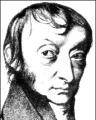 A. Avogadro |
Tutorial 2
If one mole of oxygen gas (O2) weighs 32 grams, how much will one mole of oxygen atom weigh? Answer
The technical difficult is with isotopes. Oxygen has three isotopes; oxygen-16, oxygen-17, and oxygen-18. So to be correct we must say that the amount of atoms in 16 grams of oxygen-16 atoms is one mole. Or the amount of molecules in 32 grams of oxygen-16 oxygen gas is one mole. Of course gases are much more difficult to work with than solid. In the late 1990s chemists decided that carbon was a more suitable standard since it is a solid. So now the number of atoms in 12 gram of carbon-12 is defined as a mole.
Incidentally, the mass of a proton is known as 1 atomic mass unit (amu), which is approximately 1.67 x 10⁻²⁴ grams. Electrons have a mass of approximately 9.05 x 10⁻²⁸ grams. That is a billionth of a billionth of a billionth of a gram. It is not possible for any machine that uses light to actually see a proton using visible light. The wavelength of light is too large to be able to detect anything that small.
Once chemists have agreed to accept the mole, the next logical issue would be to state that the amount of atoms in a mole be referred to as the atomic weight, and for the molecules as the molecular weight.
Since we are moving away from the atomic and molecular world it was also helpful to come up with terms to replace atoms and molecules. Chemists agreed to the term element to replace atom and compound to replace molecule in the macroscopic world. So if we want to refer to one atom we use the term atom. If we want to refer to the entity (of atom) in the macroscopic world we use the term element. The same is with molecules and compound.
Tutorial 3
- Define an element.
- Define a compound.
- Define a mole of sodium.
- Why does science like to define the terms they used?
- If I used half the Avogadro's number of molecules in my experiment, how many moles of the compound am I using? Answer
Note: Define means to state exactly. It is not to discuss or to explain or to describe. I have discussed the terms element and compound but have not defined them.
Tutorial 4
It is correct to write : H2 + O2 � H2O + � O2
But not : H2 + O2 � H2O + (O2)0.5 , why? AnswerTutorial 5
Is purified water pure because it has been purified or is it a mixture because it is made up of hydrogen and oxygen? Also what about granulated sugar? is that pure too or is it a mixture? Anna (12 years old, 1st year high school pupil from Scotland). Answer
