


IONISATION POTENTIAL (IP)
Science always take a systematic approach. If bonding between atoms is by giving, taking or sharing of the valence electrons, it will be useful to find out how tightly the valence electron is held by the protons in the atom. That is how much energy is required to separate the valence electron from the atom.
The parameters that will affect the value will be
- The attractive force of the number of protons in the atom ;
- It will be easier to remove the first valence electron than the second valence electron, for after removing the first electron, the second electron is actually attracted by an anion ; and
- The forces surrounding the atom.
It is important to define exactly how we measure the value. The first ionisation potential is defined as the energy used to remove an electron from a gaseous atom to give a gaseous ion and a gaseous electron. Example.
Note:
The gaseous states are chosen to exclude any energy contribution from inter atomic interactions.
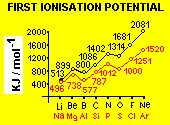 |
As seen from the plot, it requires more energy to remove an electron, as the number of protons in the atom increases.
However there are two dips in the trend. The first drop is for boron. Here the 2s-valence orbital is fully occupied and the electron was placed in the 2p-orbital, which is located outside the 2s-orbital. So the 2s-electrons act as a barrier minimising the electrostatic attraction of the protons upon the 2p-electron.
By the time we reach oxygen, all the three 2p-orbitals have an electron in them. The added electron will have to "share a room" with the electron in any of the 2p-orbitals. Remember that they are both negatively charged and "do not like" each other. So we have another drop. This is commonly known as Hund's First Rule. It says that electrons prefer to have an orbital all to itself.
Tutorial 1
From the graph above, which element in the first row (from lithium to neon) is most likely to give up a valence electron to form an anion? Which element will not give up a valence electron?
If potassium can give off a valence electron to form a hydride, can cesium do the same? Answer
Tutorial 2
Define the Second Ionisation Potential for an element. Answer
ELECTRON AFFINITY
It is natural that we should also study how easy it is for an atom to take an electron. The electron affinity is defined as the amount of energy given off when a gaseous atom takes in a gaseous electron. Example for chlorine it will be;
- The EA written on the right hand side of the equation is to impress that energy is given out. From now on it will be left out.
- It is also important to note the rather confusing notation. For IP a positive value indicates that energy is needed to remove the electron from a neutral atom, whereas for EA a positive value indicates that energy is needed to remove the electron from a negatively charged anion.
- (g) is to state that the matter is in the gaseous state.
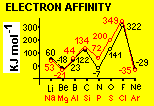 |
It must be noted that unlike ionisation potentials, which were measured directly, electron affinities were measured indirectly and so the values are less accurate. However the values are still helpful.
The principles outlined for ionisation potential hold true also for electron affinity. Beryllium, with the 2s-valence orbital fully occupied, will be forced to accept the electron to give Be‾, so EA is negative. For nitrogen Hund's First Rule applies, and so the value is again negative.
ELECTRONEGATIVITY
Ionic bonding and covalent bonding should be looked upon as two extreme ends of the various types of chemical bonding depending on the IP and EA. If IP is extremely low and EA is extremely high than an ionic bond is formed. If IP extremely high or EA extremely low then covalent bond is favoured.
It will not be realistic to expect that the electrons in the covalent bond be equally shared between the two atoms, except when they are the same atom. Example H2, N2, O2, Cl2. The electron sharing will be based on the IP and EA values for an atom. The net effect is known as the electronegativity of atom. It has not been possible to relate them mathematically yet since we are unable to measure electronegativity directly. It is very subjective, but because of the usefulness of the concept we held on to it.
Electronegativity indicates the degree an element can draw electrons to itself from a covalent bond. In Quantum Mechanics it will mean that on the average the electrons in the bond will spent more time around the atom of higher electronegativity.
Tutorial 3
Explain why fluorine is the most electronegative element and rubidium is the least electronegative element. Answer
Tutorial 4
Given 20 elements - Li, Be, B, C, N, O, F, Ne, Na, Mg, Al, Si, P, S, Cl, Ar, K, Ca, Br, I - which two elements would combine most readily to form an ionic compound? Give reasons. (From: Ms Vivien Li (15), Grade 10, Hong Kong) Answer
PERIODIC TABLE
A careful examination will conclude that the reactions of the elements should parallel the electron configuration of the atoms.
| Li | [He] : 2s | Na | [Ne] : 3s | K | [Ar] : 4s | Rb | [Kr] : 5s |
| Be | [He] : 2s� | Mg | [Ne] : 3s� | Ca | [Ar] : 4s� | Sr | [Kr] : 5s� |
| F | [He] : 2s� , 2p7 | Cl | [Ne] : 3s� , 3p7 | Br | [Ar] : 4s� , 4p7 | I | [Kr] : 5s� , 5p7 |
| Ne | [He] : 2s� , 2p8 | Ar | [Ne] : 3s� , 3p8 | Kr | [Ar] : 4s� , 4p8 | Xe | [Kr] : 5s� , 5p7 |
The complete Periodic Table
Discovery of the Periodic Table
