


From Galileo to Newton, physics was the study of the laws governing the behaviour of visible objects. The classical theory could explain whatever observations that were made.
When Bohr proposed that the electron was circling in a fixed orbit in a hydrogen atom, it was unacceptable to the classical theory. According to classical theory such a motion would force the electron to emit energy, and as a consequence the atom should not be stable. But Bohr could explain the Balmer series of the spectrum of hydrogen using the proposal.
Also up till the early 1900s every subject was viewed either as a particle or an electromagnetic wave. Then de Broglie proved solidly that light could also have particle behaviour.
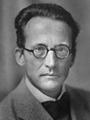 E Schrצdinger |
Quantum Mechanics is the domain of a specific group of physicists and mathematicians. By and large the rest of the scientists just make used of the results obtained. So this is what we will do here without any apology.
From Quantum Mechanics the orbital of the electron in an atom was found to have a set of four numbers (n, l, m, s). n is now known as the Principal Quantum Number, l the Azimuthal Quantum Number, m the Magnetic Quantum Number, and s the Spin Quantum Number.
Max Born, a German, from his study of collision between particles proposed that the intensity of Schrצdinger wave function was a measure of the probability of finding the particle at each point in space.
The study of the behaviour of atomic or subatomic matters is now known as Quantum Mechanics. The classical theory is now seen as a specific aspect of Quantum Mechanics.
HYDROGEN ATOM
Hydrogen atom forms the basis of all the bond theories, since mathematically it is the easiest wave function to solve. It you have two protons you will have to take into account the repulsive interaction between the protons in your computation. If you have two electrons you will also have the same problem. If you have a neutron, what then is the effect on the equation?
With hydrogen atom the mathematics is simpler. We then extrapolate the mathematical solution obtained from hydrogen atom and referred to them as hydrogen-like multi-electron atom, so they are not exact solutions.
Science deals with the exact. It stresses precision and accuracy. However at the same time it had to use inexact solutions because the exact is often too complex.
It is better to know in part and strive to know in full, rather than to be dogmatic and know nothing.
Science is magical but science is not perfect. There can be no end to the progress of science. Science is the truth as we know it, but science is not the absolute truth.
As long as science answers the problems we encounter we hold on to the system of logic as the truth. As we approach the larger picture we will find that some aspects of the logic fails. We then work on it and the truth progresses. I am sure that all science person will agree that this will go on till the end of time.
It is a moving target. As long as humankind is curious and wants to know more, there will always be puzzles to solve. There can be no end to research. It is the most interesting game or toy that God has created for the amusement of humankind.
COVALENT BONDING
Let us start with the bonding between two hydrogen atoms, the simplest covalent bond. Just picture the two atoms approaching each other. When the 1s orbitals of the two atoms interact with each other a new orbital, sigma molecular orbital, is formed between the two hydrogen protons. Sometimes the term overlapping of the 1s-orbitals was being used.
There are many different approaches (or models) used to compute the sigma molecular orbital. The two most popular being the Valence Bond Theory and the Molecular Orbital Theory.
