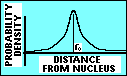
In Mathematics the absolute value of a wave function is interpreted as the intensity of the wave. Max Born proposed that this represented the probability of finding the electron. So by plotting the intensity against the distance from the nucleus of the atom, it would show the probability of finding the electron in the atom.
The chances of finding the electron within a particular location in the atom was referred to as the probability density. For the hydrogen atom, the electron spend most of its time at a distance r0 from the nucleus. This was the value Bohr had worked out as the radius of the hydrogen atom.
The probability for other orbitals were also studied. Needless to say the wave function used was that for a hydrogen atom. One proton with one electron. Atoms other than hydrogen will be too complex. With more protons and more electrons, there will be more interaction - between protons and between electrons - to consider. So for the 2s-orbitals, the hydrogen atom was again used, using the set of Quantum Numbers for a 2s-orbital. Such atoms are here referred to as a hydrogen-like atom.
It was found that all s orbitals have spherical shapes. The only difference is that the sphere has a larger radius.
Orbitals for the Quantum Numbers of p- and d-electrons were also studied and the shapes are displayed below. Again all p-orbitals (2p, 3p, 4p, etc) have the same shapes. Similarly for the d-orbitals. The only difference is they are spread over a larger area, that is further away from the nucleus, with increasing Principal Quantum Number.
Do not be perplexed by Quantum Mechanics, or try to figure out the wave functions or how to work out the intensity of a wave function, at this stage. All you need to focus on are;
- The electron in an orbital has a distance where it is most likely to be found. In the hydrogen atom where there is only one electron, the distance for the 1s-orbital will then be taken as the radius of the atom.
- If you look at the probability density plot you will notice that there is a very slim chance of finding the electron very, very far away from the nucleus. So the 3-dimensional orbital represents an area where there is about 99% chance of finding the electron.
- The shape of the orbital is determined by the Azimuthal Quantum Number, and not dependent on the Principal Quantum Number.
Much, much later in the program we will return to this and referred to the fact that except for the s-orbitals, all p- and d-orbitals (and all others) have a positive and a negative component. The positive and negative signs have nothing to do with electrostatic charges. It is just a convenient symbol to represent a piece of mathematical information.
At an even higher level the fact that the electron will at no time enter the nucleus of the atom (that is the probability density is zero at the nucleus) will be important.