|
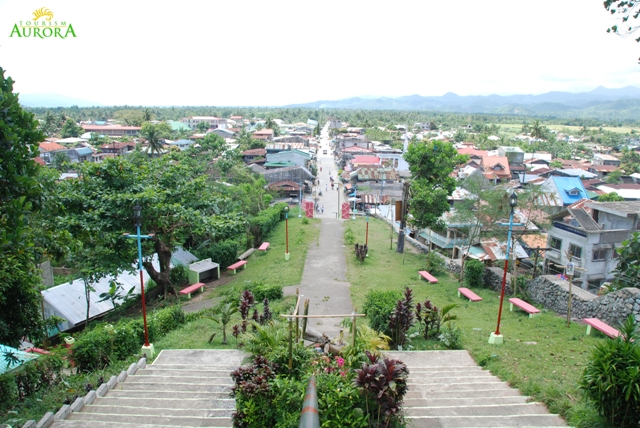
The Ermita Hill is geographically located at the center of the town of Casiguran.It provides an enchanting view of the entire Poblacion, the dark blue coast of Casiguran Bay and the barrios nearby. Aside from its magnificent landscape, Ermita Hill is known as a sacred dwelling for religious activities by devotees of the Miraculous Mother Mary, of whom a life-size statue is situated in a grotto on top of the hill. The native folks believe that through the intercession of the Our Lady of Ermita, the town is oftentimes saved from devastating typhoons and storm signals. Locals said that even the news reported an incoming storm, it does not directly hit the town. Moreover, under the Spanish rule, a Watchtower was built just a few steps at the back of the chapel to guard the town against possible attackers.
|
| Brief History of Casiguran, Aurora |
|
| |
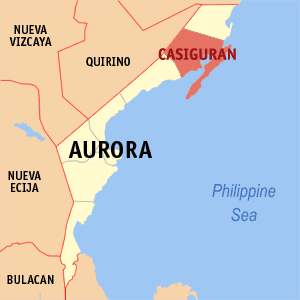
According to folk legend, the name Casiguran was obtained from the word "Kasiguruhan" which means "safety" or assurance ". Safety means defense/fortress or sanctuary for sailing ships during stormy weather. On the other hand, assurance means that if an unmarried stranger comes to the place, he unavoidably falls in love with someone and eventually gets married and most of the time stayed for good. Casiguran was founded by the Spanish Missionaries on June 13, 1609. But prior to their arrival, the early settlers of the place were the Dumagats/Aetas followed by migrants from other places of the country. These migrants spoke different dialects such as Ilokano, Visayan, Bicolano, Pampango. Gaddang, Itawes and Ibanag. Thus, a "kasiguranin" language evolved out of these dialects. In 1942, the entering by the Japanese Occupation forces landed in the town of Casiguran. In 1945, the liberation in the town of Casiguran from the defenders between the Allied Philippine Commonwealth troops and local guerrilla units against the Japanese forces during the Battle of Casiguran at the end of World War II. When the Philippines becameindependent in 1946, Aurora was still part of Tayabas Province (now Quezon Province) and Casiguran was a lone northern town. Its political jurisdiction is bounded on the north by the province of Isabela, on the west by Quirino Province, and on the south west by barangay Dinadiawan which was then the boundary between Baler and Casiguran. In 1959 and 1966, the barrios of Dilasag and Dinalungan which were part of Casiguran and situated on its northern and southwestern portions, respectively were created municipalities.
|
| |
 |
|