








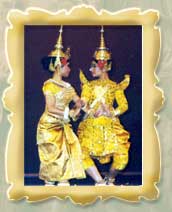
 Classical
Cambodian dance (also known as court dance/royal ballet) can be traced
back 1000 years. During the Angkorian Empire (9th -15th Century) celestial
dancers, called apsaras, appeared as stone carvings on the many ancient
temples. Their dance was a highly stylized performance of mythology which
served as a communication between the king and his gods. Every year the
king asked the dancers to perform dance-dramas to sacred music so he could
speak to the heavens. It is believed that the dancers were so powerful
that the monarch felt he had to communicate through them in order to insure
the well being of his people. In the modern era, dancers of the court
tradition have performed for public events which represent the king's
power and cultural legacy.
Classical
Cambodian dance (also known as court dance/royal ballet) can be traced
back 1000 years. During the Angkorian Empire (9th -15th Century) celestial
dancers, called apsaras, appeared as stone carvings on the many ancient
temples. Their dance was a highly stylized performance of mythology which
served as a communication between the king and his gods. Every year the
king asked the dancers to perform dance-dramas to sacred music so he could
speak to the heavens. It is believed that the dancers were so powerful
that the monarch felt he had to communicate through them in order to insure
the well being of his people. In the modern era, dancers of the court
tradition have performed for public events which represent the king's
power and cultural legacy.







|
In 1975 when Pol Pot 's Khmer Rouge Regime took over the country
the court tradition, along with other art forms, was prohibited.
Classical dancers were singled out as symbols of the past, and often,
if found out, punished with death. They lived their lives by trying
to hide their identities and their association with the royal court.
It is estimated that about 90 percent of all Cambodian artists,
including dancers, musicians, singers, actors, and sculptors, perished
between 1975 and 1979. In addition to this tremendous loss, classical
dance documents, photographs, films, and written records were, for
the most part, destroyed.
Website Designed by Angie Barragan |
