
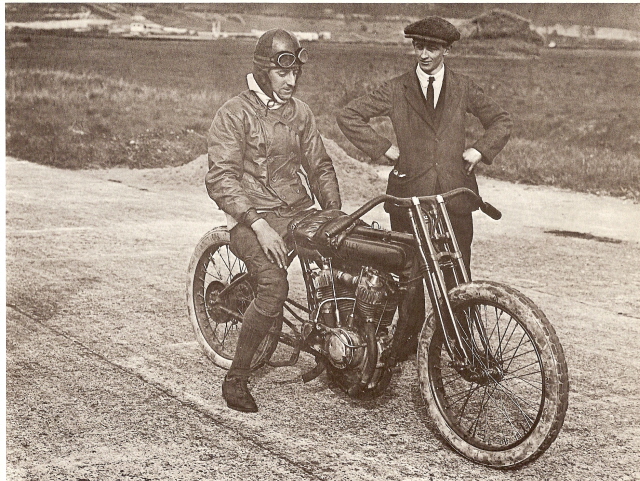
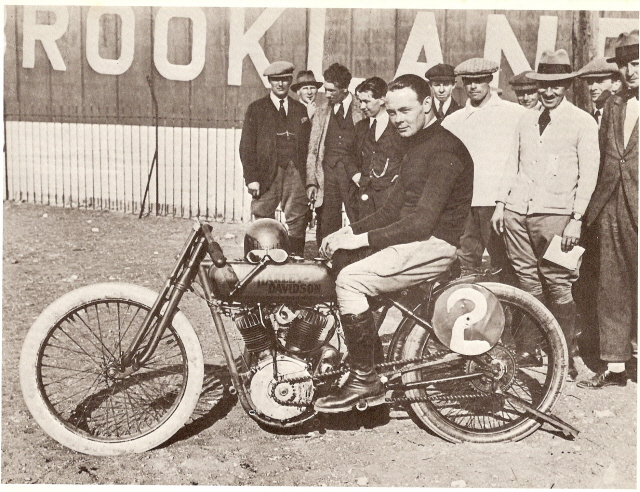
Firstly, the 1911 eight-valve ridden by Le Vack and dubbed �The Camel� was, according to Peter Hartley, reputed to be Franklin�s own bike when he was a regular at Brooklands before the Great War. Its wider significance in the eternal �Indian vs. Harley� rivalry is described in Hartley�s Brooklands Bikes in the Twenties. The H-D factory sent over to Britain two of their latest up-to-the-minute racers for the express purpose of becoming the first motorcycles in Britain (in the hands of Doug Davidson and Claude Temple) to officially exceed 100mph and thereby win a trophy called the Godfrey Cup. Hartley tells how Le Vack got wind of the plot and hastened down to Brooklands with �The Camel� to have a crack at it himself. Despite reaching 103mph in practice he failed to repeat this in his officially timed runs, �only� reaching 99.86mph before breaking a cam follower and wrecking the timing chest owing to a miscalculation with valve clearances. The honours thus went to H-D on 28 April 1921 at a speed of 100.76mph, while Le Vack was feverishly repairing his engine. He was thoroughly depressed by this outcome and ready to give up motorcycling altogether, but Billy Wells nevertheless convinced him to go back out onto the track again the very next day, where with altered valve clearances he promptly ran at 106.5mph. It was therefore H-D�s name that entered the history books, but how humiliating it must have been for this factory to see their very latest 1921 machinery trounced by a 5mph margin only one day later, and by a 1911 model!
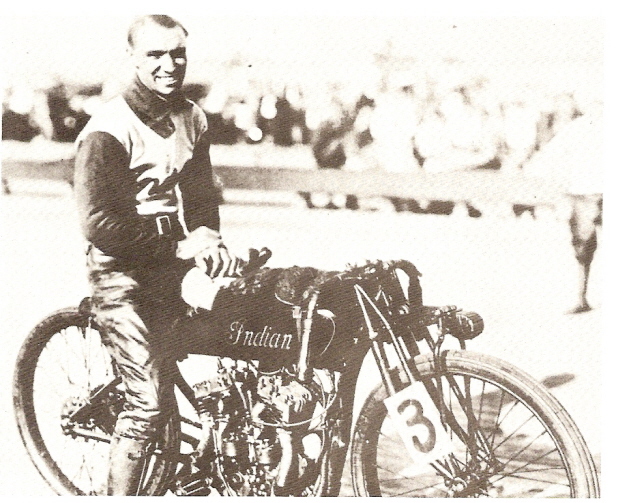
In the other photo which shows Le Vack at the finish of the Great 500-Mile Race, he is of course seated upon a Powerplus-based racer, in which Franklin shared design credits with the Gustafsons and which Franklin went on to develop into some very potent s.v. and OHV devices during the 1920s. Fresh off the boat from Ireland, he must surely have invested a large measure of his hard-won Brooklands and IoM experience into the design of that engine. At the time this photo of Le Vack was taken in 1921, Franklin was now Chief Designer at the Indian factory. His brainchild the Indian Scout was selling like hot cakes, and he was hard at work on a scaled-up version to be released in 1922 as the Indian Chief. These were road models so not often track-raced since their helical-gear primary drive was deemed unsuited for out-and-out speed work, however the lessons learned from Powerplus-derived racers in both s.v. and OHV formats during the twenties were quickly applied across the Indian range.

To tell more about the huge impact the Powerplus, Chief, and Scout models had on American motorcycling, I need to defer again to the 1988 Classic Bike article by Jerry Hatfield. In short, these models set a trend for the American market to be dominated by side-valve v-twins right through until the 1950�s, and subsequently by OHV v-twins to the present day. British motorcycle writers often poke fun at the dogmatic adherence of Americans to such huge, heavy and ultimately obsolescent devices compared with the nimble OHV machinery pioneered in the 1920s by AJS and Velocette. It wasn�t that the Americans didn�t know about such things, however. It was simply that the big, rugged, reliable v-twins suited the colonial environment (read http://www.indianmotorbikes.com/reprints/236/index.htm if you need convincing). Franklin also designed British-style singles in the 1920�s, but Indian couldn�t sell very many of them. And when he compared OHV and s.v. top-ends on his v-twins, he surprised himself with the amount of power he could extract from the s.v. devices, apparently flying in the face of reason.
[page 6]