|
La
Chakana
Café/ Restaurant/ Tours

Plaza
Principal
Samaipata
Bolivia
Tel:(591)39446146
chakanabol@
yahoo.com
|
|
National Park Amboró
|
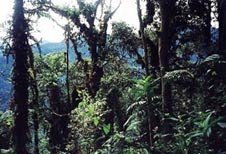 Established in 1990 this 430.000 hectares park is situated in
Central Bolivia where three distinct ecosystems meet: the Amazon
Basin, the Chaco plains and the Andes. This is why there is an
enormous variety in flora and fauna. Established in 1990 this 430.000 hectares park is situated in
Central Bolivia where three distinct ecosystems meet: the Amazon
Basin, the Chaco plains and the Andes. This is why there is an
enormous variety in flora and fauna.
The park is situated at altitudes between 700m and 3.100m. This
contributes to its natural beauty.
|
|
The Southern and Western parts of the park,
generally
classified as the Yungas, are formed by high, densely forested
mountains. It’s
a very humid area, often covered by clouds, the reason why there
are lots of cloud forests with giant ferns, mosses
and bromeliads. According to a group of 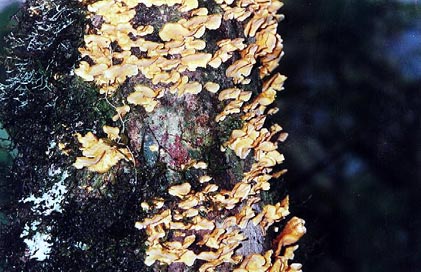 students there are
more then 500 types
of orchids in the park. In
this part a research has revealed the existence of 100 wild,
edible tropical fruits.
students there are
more then 500 types
of orchids in the park. In
this part a research has revealed the existence of 100 wild,
edible tropical fruits.
In addition, there are numerous impressive trees which are highly
valued timber like the cedar tree, the nut tree and the pine
tree. As well as the giant strangler tree.
Lots of medicinal plants and trees can be found here like the cats
claw (uña de gato) which helps fight cancer and builds up the
immune system. Plants
grow here which locals use for cleaning the organs like the liver,
kidney (Boldo), cleaning the intestines, and for improving the
respiratory system.
|
|
The Central part of the park consists of numerous
river basins, deep canyons and in between them elevated mountain
crests some of them covered with bamboo. This part has been hardly
explored, as it is mostly inaccessible.
The Northern Side, the lowest part of the park, is most
under threat as migrants from the highlands try to settle here and
cultivate l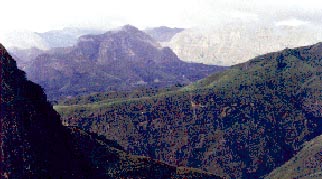 and. This part resembles the climate of the Amazon
Basin, very hot, lots of humidity and lots of rainfall. Here
various rivers leave the park and around the rivers lots of bird
life can be observed. and. This part resembles the climate of the Amazon
Basin, very hot, lots of humidity and lots of rainfall. Here
various rivers leave the park and around the rivers lots of bird
life can be observed.
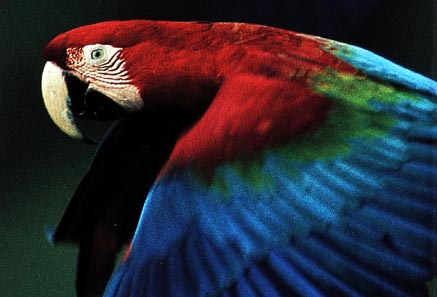
Ornithologists have counted more then 800 types of birds in the
park including condors, eagles, macaws, parrots, quetzals and
curassows.
Lots
of them are migrating birds on their way to Patagonia or North
America.
|
|
 Thanks to its proximity to the
Amazon Basin, much of the
Amazonian Wildlife is represented in the park. More then 150
types of mammals have been counted including jaguars,
pumas, bears (the very rare honey bear), monkeys, giant tapirs,
capybaras, peccaries and deer. Thanks to its proximity to the
Amazon Basin, much of the
Amazonian Wildlife is represented in the park. More then 150
types of mammals have been counted including jaguars,
pumas, bears (the very rare honey bear), monkeys, giant tapirs,
capybaras, peccaries and deer.
|
|
ACCESS
Since it is very easy to loose one's way in this very rough,
desolated park it’s absolutely necessary to hire a guide or to
go with an organized tour. Samaipata is
a good place to organize a tour due to its proximity to the park
and there are some travel agencies who offer one – or more day
(hiking) tours into the park.
|
|
There are 4 points of Entry.
For the visitor who enjoys walking, Abra de los Toros,
19 km from Samaipata accessible on a 4WD Track from Achira Cabanas
(off the main road to Santa Cruz), is the more interesting place. 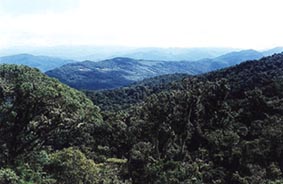 This
is the starting point for a 6-hour walk into the park. This hike
offers some beautiful cloud forests with lots of
ferns, mosses, and bromeliads as well as some
spectacular views over the park. The remains of an Inca fortress (Pukhara)
can be seen. Occasionally it is possible to view a Toucan,
the rare Quetzal , colorful parrots and more
kinds of birds of prey like the giant
Condor, the Eagle and some smaller vultures. The Jaguar and
the
Puma are rarely seen, but their footprints show their
presence. Sometimes Spider monkeys can be seen. This
is the starting point for a 6-hour walk into the park. This hike
offers some beautiful cloud forests with lots of
ferns, mosses, and bromeliads as well as some
spectacular views over the park. The remains of an Inca fortress (Pukhara)
can be seen. Occasionally it is possible to view a Toucan,
the rare Quetzal , colorful parrots and more
kinds of birds of prey like the giant
Condor, the Eagle and some smaller vultures. The Jaguar and
the
Puma are rarely seen, but their footprints show their
presence. Sometimes Spider monkeys can be seen.
|
|
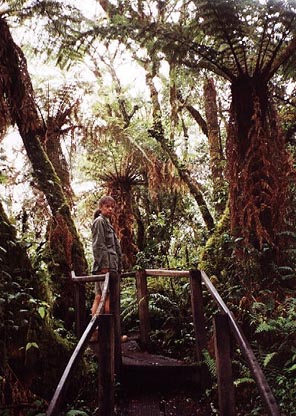 La Mina,2 km off the
road to La Yunga, is a good entry point to beautiful cloud
forests. Here some walks can be made from 2- 4 hours. La Mina,2 km off the
road to La Yunga, is a good entry point to beautiful cloud
forests. Here some walks can be made from 2- 4 hours.
There is a small entry fee, payable at the house of the guard, who
in return offers you a tee and a snack.
|
|
La Yunga
,
accessible on a 4WD Track from Samaipata (16 km), as well on a 4WD
Track from Mairana (29 km from Samaipata) is a good point to have
a quick general view of the park. Here is a spectacular viewpoint
over the park as well as a beautiful cloud forest full of ferns
and mosses which is accessible by a 600m long gangway. Here an
entrance fee has to be paid of 15 Bs.
|
|
Los Alisos,8 km north
of Samaipata has a trail leading to the mountain La Mina (2350m),
crossing some beautiful cloud forest and offering spectacular
views.
|
|
BEST SEASON
to go into the park
are the dry season months of
June, July, August and September. But except for really rainy
periods (mostly from December to March) the Park is accessible all year around.
|
|